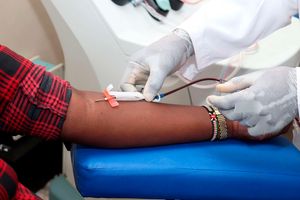
Hospitals running on empty as blood agency’s supply falls short

A scientist or Biochemist holds a test tube with a Lipemic blood sample. Hospitals are running without adequate amounts of blood in their banks because the Kenya National Blood Transfusion Services (KNBTS) is unable to meet their demands, posing a risk to patients who require an urgent blood transfusion.

Hospitals are running without adequate amounts of blood in their banks because the Kenya National Blood Transfusion Services (KNBTS) is unable to meet their demands, posing a risk to patients who require an urgent blood transfusion.
According to a performance audit report by Auditor-General Nancy Gathungu tabled in Parliament, KNBTS is unable to meet the demands of health facilities in the country with some hospitals not receiving up to 90 per cent of their blood requests from the agency.
Empty banks
The report covering five financial years from 2016/2017 to 2020/2021 indicates that nationally, KNBS can only supply 54 per cent of blood required by various hospitals leaving the rest run on empty banks.
“Analysis of data on blood requested by the hospitals in 15 out of 27 centres indicated that KNBTS was not able to supply on average 46 per cent of the blood requested for by the hospitals,” reads the report.
“There is a risk of blood not being available to the patients as evidenced in the analysis by the increase in average monthly blood requests,” warns Ms Gathungu in the report.
The audit team in its analysis of 27 hospitals revealed that three hospitals did not receive up to 90 of their blood requests, another 15 hospitals did not receive up to 73 per cent of their blood requests and five hospitals did not receive up to 40 per cent of their request.
Blood requests
According to the report, only four hospitals received over 80 per cent of their blood requests.
“Blood transfusion is a key part of modern healthcare.”
“It is the responsibility of the national blood programme to provide adequate supply for all patients requiring transfusion and to ensure safety and quality of blood and blood products for clinical use,” Ms Gathungu says in the report.
Ms Gathungu warns that failure by hospitals to access blood when needed poses a major risk to the lives of patients with critical illnesses such as anti-partum and post-partum haemorrhage, which contribute to high mortality rates among women while giving birth.
“The inability to supply adequate blood is attributed to KNBTS failure to meet the World Health Organization (WHO) requirements for setting blood collection targets coupled by its inability to meet its own collection targets as a result of inadequate mobilisation, recruitment and retention of blood donors,” reads the report.
The WHO recommends that, for a country to meet its blood and blood component requirements, it should collect a unit of blood from at least one per cent of its population annually.
An assessment of KNBTS’ performance against this WHO requirement revealed a shortfall of an average of 58 per cent during the years under review.
Performance audits
“Analysis of the KNBTS annual targets on blood collection revealed that it does not consider the needs of the hospitals in arriving at the targets.”
“Analysis of the set targets for 12 centres show that the set targets were below the hospitals’ blood requests by 27 per cent to 74 per cent,” reads the report.
The audit team examined the operations of KNBTS in five out of its six regional centres and in 10 out of its 18 satellite centres with regard to donor recruitment and notification, blood collection, blood processing, blood banking and distribution.
Performance audits are conducted to examine compliance with policies, obligations, laws, regulations, and standards and to determine whether resources are managed in a sustainable manner.
They also examine the economy, efficiency and effectiveness with which public resources have been expended.