How AI is helping WHO predict disease outbreaks in Africa
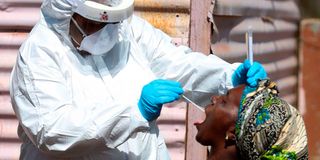
A doctor administers a Covid-19 test. During the pandemic, the world paid the price of not being prepared.

What you need to know:
- For Kenya, the news is a double-edged sword. At 57 per cent, the country sits slightly above the regional average, but still well below the global benchmark.
- This means that even Kenya is not yet fully prepared to respond to a public health emergency.
For many Kenyans, the Covid-19 pandemic is remembered as a time of lockdowns, masks, social distancing, and the daily televised updates from the Ministry of Health. Those briefings, detailing new infections, deaths, and warnings, became a single source of truth during the crisis. However, beneath the calm delivery of data, a challenge persisted: heavy reliance on manual data entry at the facility level often led to significant reporting lags.
Six years later, the World Health Organization (WHO) is turning to artificial intelligence to change that. By using AI to predict disease outbreaks, the aim is to move from reactive reporting to proactive preparation.
At the center of this initiative is Dr Dick Chamla, WHO’s head of Emergency Preparedness in Africa and team lead at the Emergency Preparedness Hub in Nairobi. He highlights a sobering reality: when it comes to preparing for emergencies, Africa is the least prepared region in the world.
Also read: Discipline, dignity and delivery: Dr Omweri Ombonye on redefining healthcare leadership at 34
“We measure preparedness using a score of 15 core capacities, from policy and finance to a country’s ability to respond to radiation or chemical exposure. The global average is 63 per cent, but Africa scores just 50.1 per cent,” he explains.
For Kenya, the news is a double-edged sword. At 57 per cent, the country sits slightly above the regional average, but still well below the global benchmark. This means that even Kenya is not yet fully prepared to respond to a public health emergency.
According to Dr Chamla, the challenge runs deeper than statistics. "The tragedy of past pandemics in Africa hasn't always been a lack of effort, but a fragmentation of truth," he explains. "When a virus begins its silent crawl through a community, the data trickles in through broken channels: a manual Excel sheet here, a paper report there, whispered rumours in village clinic hundreds of miles from the capital. By the time these fragments are gathered, cleaned, and analysed, the window for containment has often slammed shut."
“To solve this, WHO has developed the Preparedness Data Exchange (PDX), a centralised digital platform that aggregates real-time data from multiple sources. "We decided that AI is the bridge from the alert to the decision-making. The PDX contains everything from threats and risks to laboratory capacities, supplies, and logistics. It pulls together signals from many sources and flags what looks unusual before it becomes obvious in routine reports."
Dr Chamla says they have further integrated climate intelligence into the platform. The PDX is now tethered to NASA satellites that monitor rainfall and temperature; key drivers for outbreaks like cholera and malaria. By overlaying these climatic hazards with data on disease seasonality, vaccination coverage, mobility trends, and community vulnerability, the system can identify risks that would otherwise go unnoticed.
"Individually, these elements may appear insignificant. Together, they can signal heightened risk."
Once an alert is triggered, a rigorous verification process begins. "If you get an alert of a disease in a particular area, you have to verify it," he explains. Rapid response teams are deployed to the ground, where they collect critical information: the patient's age, gender, symptoms, and outcomes. They also take specimens; blood or other samples, which are sent to the laboratory for testing to detect specific pathogens.
If the detection confirms a specific pathogen and case numbers exceed the normal baseline, WHO advises the government to declare an outbreak formally.
Dr Chamla emphasises that WHO operates on a strict '7-24-7' gold standard: detection within seven days, declaration within 24 hours, and response within seven days. By this measure, Africa has made remarkable progress on the first step. Thanks to digital surveillance, 75 per cent of outbreaks are now detected within seven days, with an average period of two days.
But then, the gears grind to a halt at the declaration phase.
"Only 50 per cent of outbreaks are declared within 24 hours. The reason is rarely medical; it is political. Governments are scared of the impact on tourism and the economy. They fear the stigma of an outbreak," he explains, adding:
“Because early response depends on that declaration, only 12 per cent of outbreaks across the continent receive the rapid response they need.
As AI moves from the laboratory to the front lines, the question of ethics looms large. Across Africa's 54 countries, only six have established the government and legislative structures needed to govern AI effectively. On the global AI readiness index, 45 of the bottom-ranked countries are African.
To address this gap, WHO has developed a nine-pillar AI in Emergencies framework. It tackles the thorny issues of data ownership, confidentiality, and the very real threat of cyberattacks, assessing whether systems are vulnerable to hackers and viruses.
But the final hurdle, notes Dr Chamla, is financial. For years, emergency preparedness in Africa has not been prioritised because it requires long-term investment.
"Modeling studies have shown that for every dollar invested in preparedness, you get up to nine dollars in return," he explains. "Globally, the world needs about $10 billion (approximately Sh1 trillion) for preparedness. We don't have a precise estimate for Africa yet, but what we know is this: preparedness will only be as strong as the health system it rests on. The weaker the health system, the weaker the preparedness, and the more vulnerable the country becomes to public health crises."