How Kenya can use AI to fight the climate crisis
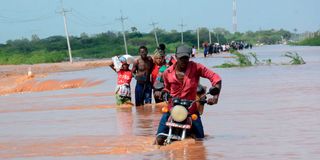
Transport disrupted at Gamba area in Tana River as floods causes havoc in the county on December 3, 2023.

What you need to know:
- For Kenya to harness its full potential, it must prioritise investment in local talent, data infrastructure and policy frameworks that support innovation while safeguarding public interests.
Kenya is no stranger to the devastating effects of climate change. From prolonged droughts to erratic rainfall, the country’s agricultural backbone has been severely tested. For a nation where agriculture accounts for nearly a third of GDP and employs about 40 per cent of the population, climate variability is more than an environmental concern—it’s an existential threat. Yet within this crisis lies an opportunity for Kenya to leverage one of the most transformative technologies of our time: artificial intelligence (AI).
AI, often heralded for its potential to revolutionise industries, can also serve as a powerful tool in the fight against climate change. But for Kenya to harness its full potential, it must prioritise investment in local talent, data infrastructure and policy frameworks that support innovation while safeguarding public interests. If done right, AI could be the cornerstone of Kenya’s strategy to not only mitigate the climate crisis but also build a resilient, sustainable economy.
Precision agriculture: Doing more with less Kenya’s agriculture is heavily rain-fed, making it highly susceptible to climate shocks. AI can help farmers adapt by optimising resource use and predicting weather patterns. For example, machine learning algorithms can analyse satellite imagery, soil data and historical weather trends to provide farmers with precise planting and harvesting schedules. Companies like Twiga Foods have already shown the potential of data-driven approaches to improve food distribution; AI can extend this innovation to the production phase.
Additionally, AI-powered irrigation systems can ensure efficient water use. By analysing real-time data from soil moisture sensors and weather forecasts, these systems can deliver water only when and where it is needed, reducing waste. This is particularly critical in arid and semi-arid regions like Turkana, where every drop counts.
Renewable energy optimisation
Kenya’s leadership in renewable energy—with over 75 per cent of its electricity coming from sources like geothermal and wind—provides a solid foundation for AI integration. AI can enhance the efficiency of renewable energy systems by predicting energy demand and optimising supply. For instance, machine learning models can forecast periods of high energy consumption and align them with peak production times, reducing reliance on fossil fuel backups.
Moreover, AI can play a pivotal role in expanding access to electricity in off-grid areas. Smart grid technologies powered by AI can dynamically allocate resources and reduce transmission losses, making renewable energy more accessible and affordable for remote communities.
Climate risk modelling
One of the greatest challenges in combating climate change is predicting its impacts. AI excels at analysing vast amounts of data to identify patterns and make forecasts. For Kenya, this capability could revolutionise disaster preparedness. AI-driven models can predict floods, droughts, and heatwaves with greater accuracy, enabling authorities to act before disasters strike.
Consider the potential for AI to improve early warning systems. By integrating data from meteorological stations, satellites and local sensors, AI can provide hyper-local forecasts. These predictions can be communicated to farmers, fishermen and pastoralists through mobile platforms, giving them time to prepare and adapt.
Verifying carbon offsets
AI can analyse large datasets from various sources—such as satellite imagery, IoT sensors, and industrial processes—to estimate carbon emissions accurately. Machine learning algorithms can detect patterns and trends in emission levels, allowing for precise measurement and real-time monitoring.
AI-powered tools can assess soil carbon sequestration rates using satellite data and machine learning models as well as analyse forest cover and growth using remote sensing to estimate carbon storage potential.
One of the biggest challenges in the carbon credit market is ensuring the credibility of offset projects. AI can validate claims by monitoring the actual impact of projects designed to reduce or offset emissions. Using computer vision, a subset of AI, Kenya can verify tree planting efforts or forest conservation through drone and satellite imagery. Again, natural language processing can be used to assess the legitimacy of project documentation or sustainability reports.
AI can model and predict future carbon emissions based on historical data and current behaviours. This helps industries and governments plan more effectively and align with regulatory frameworks.
There have been challenges in carbon offset pricing globally. AI algorithms can help optimise carbon credit pricing by analysing market dynamics, demand, and supply in real time. This ensures fair pricing and incentivises higher participation in carbon markets.
AI-powered blockchain solutions can be used to ensure transparency in carbon credit trading. Smart contracts and machine learning models can detect fraudulent activities or double-counting of credits.
Tackling deforestation
Deforestation is another major contributor to Kenya’s climate woes. Forests like the Mau Complex, vital for water catchment and biodiversity, continue to face threats from illegal logging and encroachment. AI can aid in conservation efforts through real-time monitoring. By analysing satellite imagery, machine learning algorithms can detect changes in forest cover and alert authorities to illegal activities.
AI-powered drones can also patrol forests, capturing high-resolution images and identifying areas at risk. Such technologies have already proven effective in countries like Brazil and Indonesia, and there is no reason Kenya cannot replicate these successes.
Policy and ethical considerations
While the potential benefits of AI are immense, its adoption must be guided by robust policies and ethical considerations. For one, Kenya must address the issue of data sovereignty. Most AI systems require large datasets to function effectively, but data collection must respect privacy rights and local ownership.
Additionally, there is the question of inclusivity. AI solutions must be accessible to smallholder farmers, who make up the majority of Kenya’s agricultural workforce. This requires investment in digital literacy and affordable technology. Public-private partnerships can play a crucial role here, bridging the gap between innovation and accessibility.
Regulation is also key. Without proper oversight, AI systems can perpetuate biases or be misused. Kenya’s government must establish frameworks that ensure transparency, accountability and fairness in AI applications. Fortunately, the recently launched National AI Policy provides a starting point for such efforts.
Building local capacity
For AI to truly thrive in Kenya, the country must invest in its human capital. This means nurturing a generation of data scientists, machine learning engineers and climate experts. Universities and technical institutions should collaborate with industry players to develop curricula that align with market needs.
Kenya can also tap into its vibrant tech ecosystem, often referred to as the Silicon Savannah. Startups like Gro Intelligence, which use AI to provide agricultural insights, demonstrate the potential of homegrown solutions. Supporting such initiatives through funding and mentorship will be crucial.
The global stage
By embracing AI, Kenya can position itself as a leader in climate innovation, not just in Africa but globally. The country’s unique challenges and entrepreneurial spirit make it an ideal testing ground for scalable solutions. Successful AI applications in Kenya can serve as models for other developing nations, showcasing how technology can bridge the gap between vulnerability and resilience.
Moreover, Kenya’s leadership on climate issues could attract international partnerships and funding. Organisations like the World Bank and the United Nations have shown growing interest in AI-driven climate solutions, and Kenya is well-placed to benefit from such collaborations.
The time to act is now
The climate crisis is not a distant threat; it is already here. Yet Kenya has the tools, talent, and tenacity to turn this challenge into an opportunity. By investing in AI, the country can not only mitigate the impacts of climate change but also build a future that is sustainable, inclusive, and prosperous.
The question is not whether Kenya can afford to adopt AI; it’s whether it can afford not to. The cost of inaction far outweighs the investment required to harness this transformative technology. It is time for Kenya to lead the way, rewriting its climate narrative and inspiring the world with its innovation and resilience.
Mr Ngila, a thought leader in global tech and sustainability, is the Chief Operating Officer of Climavox


