Kenya pushes for plastics treaty secretariat as Geneva talks face final hour
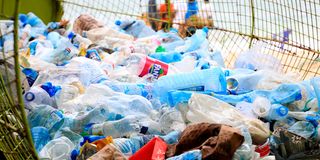
A plastic recycling point at the Nyali Public Beach in Mombasa.

What you need to know:
- Delegates at the Palais des Nations are making final attempts to avoid another extension of talks on a global plastics treaty, with Kenya pushing for stronger global rules and for Nairobi to host the treaty’s Secretariat.
- Environment Cabinet Secretary, Deborah Barasa, criticised the diluted draft treaty, saying it had shifted focus to national waste management with no binding global commitments, and called for provisions aligned with Africa’s interests to be reinstated.
In Geneva, Switzerland
With only hours remaining in the 10-day negotiations at Geneva's Palais des Nations, delegates are making final efforts to avoid another extension of talks on a global plastics treaty. Three words echo through the corridors: faith, hope and redlines.
The negotiations, which began in Nairobi three years ago with a 2024 deadline, failed to reach consensus in Busan, South Korea, bringing delegates back to Geneva for what many hope will be the final round.
Just as last year, delegates are expressing optimism in reaching an international, legally binding agreement to end plastic pollution, including in marine environments.
On Wednesday evening, a second plenary session was held to assess developments since the first session on August 9. In the Assembly Hall, member states shared their positions on the Chair's text—a draft document containing proposed articles that would form the basis of any treaty.
The room was divided between the High Ambition Coalition, which includes Kenya, and oil and plastic-producing states. Neither side appeared willing to compromise on their red lines regarding the Chair's text.
Environment Cabinet Secretary, Deborah Barasa, voiced disappointment with some parts of the draft text when she addressed the floor.
"We note with concern that the text of the proposed treaty has been significantly diluted and lost its very objective. It turns out to be a waste management instrument with most actions outlined at the national level," she said, adding that it contained "no global binding agreements on anything."
She noted that important provisions aligned with Kenya's national interests and those of Africa had been removed from the text.
Barasa reiterated Kenya's call for the Chair to reintroduce paragraphs proposing Nairobi as host for the treaty's Secretariat and for the first Conference of Parties to be held at the United Nations Environment Programme headquarters in Nairobi.
In an interview with Nation, CS Barasa said Kenya remains committed to ending plastic pollution despite the challenges.
"We have outliers when it comes to these negotiations, but we need to find a middle ground to end plastic pollution," she said.
"This is a moral imperative because every party is aware of the damage caused to our environment, human health and biodiversity."
Barasa emphasised that hosting the Secretariat would greatly benefit Kenya and Africa, with support from President William Ruto and a decision from the Africa Ministerial Conference on the Environment (AMCEN).
"This will ensure equitable participation in global governance and locate the organisation closer to the population it is fit to serve," she said.
While Kenya has led efforts to end plastic pollution, Barasa said a global instrument would strengthen policy implementation. The country's most recent policy, introduced in 2022, was the Extended Producer Responsibilities (EPR) framework, which requires manufacturers to take accountability for waste management.
"We need global backing. We faced litigation when we introduced EPR, and we know that once it goes global, it will not just be about policy but ensuring implementation based on available resources," she said.
At a press briefing organised by the Global Alliance for Incinerator Alternatives (GAIA), which represents countries from the global south, civil society organisations said the current text fails to deliver substantial progress.
"We have been exhausting our small delegations from the global south only for an eleventh-hour text that has been significantly compromised—one that signals regression and insults the progressive majority of ambitious states," said Merissa Naidoo, Plastics Program Manager at GAIA Africa.
"Transparency has been absent, inclusivity has been an afterthought, and equity has not even featured on the agenda. This new text sends a message to the world: we do not care about your health, we do not care about science and human rights. We only care about achieving a consensus that caters to the wish list of the petro states."
Dr Sivendra Michael, Fiji's Permanent Secretary for Environment and Climate Change, who has been vocal during the plenaries, said the negotiations encompass more than plastic pollution—they address the triple planetary crisis, including climate change and biodiversity loss.
He expressed concern that the draft's preference for voluntary and nationally determined approaches undermines the creation of a practical and level playing field necessary for a global circular economy.
"We cannot continue mopping the floor without turning off the tap. We need legally binding measures to control production. We need financial mechanisms to support producing countries to transition to alternative approaches," he said.
"I have complete faith and hope that we are pushing beyond limits to find compromise, but it is quite hostile and tedious for us, long hours after flying two and a half days from Fiji to Geneva. It is not fair to delegations to commit such amounts of time continuously restating positions," he added.


