Kenya races to end vaccine shortages with first local production targeted for 2027
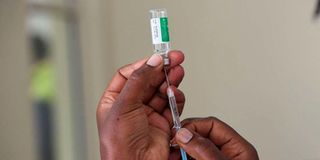
A health worker prepares to administer a dose of Covid-19 vaccine at Kenyatta National Hospital in Nairobi.

What you need to know:
- Years of painful vaccine stockouts forced parents to search fruitlessly for routine childhood immunisations.
- Now, Kenya’s Biovax Institute is stepping in, backed by a major World Bank investment, to produce the country’s first locally made vaccines by 2027.
Kenya is accelerating efforts to achieve vaccine self-sufficiency, driven by years of persistent childhood vaccine stockouts and the stark lessons of Covid-19’s “vaccine nationalism.”
For decades, thousands of Kenyan children have missed essential immunisations due to distance, poverty, hesitancy and, critically, systemic supply failures. These shortages peaked in 2024 and 2025, affecting key vaccines including BCG and Polio, with funding delays and national debt repeatedly disrupting supply.
The human cost of these failures is deeply personal for parents like Lucy Chebitok, from Cheptiret, who struggled to secure the Hepatitis B vaccine for her son, Kito. Each hospital visit ended in the same disappointment: the vaccines were out of stock. For her, the long and fragile global vaccine supply chain had failed—not just in principle, but in her child’s life. The idea of local vaccine manufacturing, she says, represents more than policy; it is a promise that her community’s health will no longer depend on foreign political will or logistical unpredictability.
It is this necessity that led to the establishment of the Kenya Biovax Institute (Biovax) in September 2021, a government-owned entity created under a presidential mandate as the country prepares to transition away from Gavi support.
The ambitious project is transforming a former Kemsa warehouse into a multi-phase pharmaceutical hub. The foundational Phase 1A—covering utilities and waste management—is now complete. The next and most crucial stage, Phase 1B, involving the acquisition and installation of high-tech vaccine processing equipment, is now accelerating.
This phase is backed by a $120 million (about Sh15 billion) investment from the World Bank’s regional health programme, part of a wider $1.5 billion (about Sh193 billion) initiative spanning 12 countries. The objective is to build a resilient regional health ecosystem capable of ensuring uninterrupted supply during both routine and emergency periods.
“We’ve been receiving exchequer release for this work and support from the World Bank. So far, we have used the government resources through exchequer release to do enabling works. And we are getting to Phase 1B where we are going to bring on board the processing equipment making this place a factory for producing vaccines. And there in comes the support from World Bank,” said Dr Charles Githinji, the chairperson of Biovax Board of Directors.
With the enabling works done, the Institute is now preparing to receive and install the processing equipment and to initiate the technology transfer process. Biovax is actively engaging potential partners for this transfer, while simultaneously building internal capacity in advanced vaccine technologies, particularly mRNA manufacturing, to prepare its workforce for future end-to-end production.
Biovax’s immediate goal is clear: to secure the partners and technology required to produce Kenya’s first locally manufactured vaccine vial by the end of 2027. “We have a plan that by the end of 2027, we shall inaugurate the release for the first batch of vaccine, the first of its kind in Kenya, and in line with the international standard as set by World Health Organization (WHO). Phase 1B which will take the next two years to produce the first vaccine,” Dr Githinji said.
The initial strategy is centred on Fill and Finish, a critical part of the vaccine value chain where bulk drug substance is packaged into final doses. The facility is projected to produce 72 million doses per year—equivalent to six million doses per month—focusing on three childhood immunisation vaccines, with the specific antigens yet to be determined. Biovax is also targeting immediate WHO prequalification status once production begins. This global gold standard would allow its vaccines to be used not only in Kenya but across international markets.
“The focus here will be on those vaccines that are critical for immunisation programs. It is critical that mothers are able to vaccinate their children on schedule, and so we want to ensure supply of those selected vaccines where we have capacity to produce here. On the commercial side, somebody has to pay for the vaccine. There is an off-tech arrangement with the government, where we produce the fill and finish, the government buys from us and then it will be delivered to the mothers, as has been done always, for free,” said Dr Wesley Ronoh, Biovax chief executive officer.
“This is a significant milestone for Kenya in terms of getting into vaccine manufacturing, but the aspiration is to move towards end-to-end manufacturing. We are building capacity, even as we do the fill and finish. But going forward in subsequent years, we also have another project at Konza that will do end-to-end vaccine manufacturing, starting from the drug substance up to the finished product,” he added. He noted that the broader continental ambition is to manufacture 60 per cent of Africa’s pharmaceutical and vaccine needs by 2040.
According to Dr Ramesh Govindraj, lead specialist in Health, Nutrition and Population Global Practice at the World Bank, the investment is designed to build a collective regional shield against future health emergencies. “Production of pharmaceuticals and vaccines is a very important part of health emergency preparedness and response. Ethiopia and Kenya were two of the first countries to join this program. Both of them are embarking on a similar endeavor, albeit focusing on different pharmaceuticals and different vaccines,” he said.
He added that under the African Union’s Agenda 2063, countries have committed that by 2040, the continent will produce 60 per cent of all its pharmaceuticals, vaccines and other health supply needs. “If you’re going to supply 60 per cent of all the needs on the continent, it’s very important that we come to terms as to how many countries will actually be in the manufacturing program. It’s not only a question of producing those vaccines, but making sure that they are stored properly, distributed, and finally the vaccines are delivered to the arms of the children who actually need them.”
The World Bank emphasised that the programme is also tied to strengthening routine health systems to ensure services such as childhood immunisation continue without disruption—even in the face of future health emergencies.