Kenya takes part in Berlin key energy talks, signs clean power deals
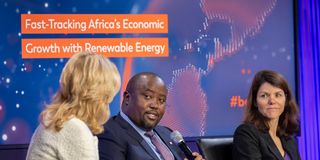
Principal Secretary, State Department for Energy, Alex Kamau Wachira (middle), and other delegates follow a presentation at the Berlin Energy Transition Dialogue in Germany on March 19, 2025.

What you need to know:
- Kenya's electrification rate currently stands at 76 per cent, with significant gaps in off-grid areas constituting about 70 per cent of the country's semi-arid landmass.
Since 2015, the Berlin Energy Transition Dialogue (BETD) has been a key international conference on the global energy transition. During the annual event, key decision-makers in the energy sector engage in dialogue, share ideas, address challenges and forge partnerships to achieve an environmentally sound, secure and affordable global energy transition.
The forum is organised by the German Federal Foreign Office in cooperation with industry partners, including German Renewable Energy Federation, German Solar Association and German Energy Agency.
This year's event centered on mobilising investments for energy transition and green growth in emerging and developing countries. At last year’s BETD, global energy experts and policymakers emphasised the critical need for advanced economies to allocate significant investments toward developing clean energy solutions in developing countries.
Participating in this year’s Dialogue, Kenya's Principal Secretary at the State Department for Energy, Alex Kamau, outlined the country’s ambitious energy goals and commitment to achieving 100 per cent electricity connectivity and transitioning to 100 per cent clean energy alongside clean cooking solutions by 2030.
The PS highlighted that Kenya has made significant strides and diversified its utility landscape from a single entity handling generation, transmission, distribution, and rural electrification in the 1980s to seven specialised utility companies today. Currently, 67 per cent of Kenya's electricity is generated by government-owned entities, with independent power producers (IPPs) having the capacity to generate 90 per cent of the power. He credited the Energy Act 2019 for creating a cost-effective tariff system that balances investor interests with consumer affordability through an independent regulator.
Despite these advancements, he acknowledged challenges in achieving universal electricity access. Kenya's electrification rate currently stands at 76 per cent, with significant gaps in off-grid areas constituting about 70 per cent of the country's semi-arid landmass. To address this, Kenya has allocated $465 million for last-mile connectivity projects over the next two years, supported by partners such as Japan International Cooperation Agency, the European Investment Bank, and French Development Agency.
However, more investment is needed to extend grid infrastructure to remote regions and PVP projects to strengthen the grid and build capacity.
PS Kamau also underscored Kenya's leadership in geothermal energy development, describing it as a reliable baseload resource unaffected by climate variability. He noted that Kenya's interconnected grid with neighbouring countries like Tanzania and Ethiopia positions geothermal energy as a key driver for industrialisation and regional power stability. He called for concessional financing to support private developers and mini-grid operators in addressing this.
Touching on the disparity in electricity costs between national utilities and private mini-grids, he urged stakeholders to explore innovative solutions like blended finance models. Mini-grid operators often face high financing costs, leading to five times higher tariffs than those of Kenya Power.
Looking ahead, the PS highlighted Kenya's role as a leader in renewable energy integration on the continent. He mentioned that Kenya hosted the inaugural Accelerated Partnership for Renewables in Africa (APRA) meeting last year and is working to mobilise international financial support for renewable projects. APRA aims to accelerate renewable energy deployment across Africa and transition the population from wood fuel to green fuel. He also stressed the need for capacity building among engineers to integrate wind and solar technologies into the national grid effectively.
In conclusion, PS Kamau reiterated the need for bankable Power Purchase Agreements supported by strong regulatory frameworks across African countries and letters of government support to guarantee investor security through the African Trade Insurance.
While there, the PS held several bilateral meetings to strengthen Kenya's energy partnerships and advance its renewable energy goals.
His meeting with Birgit Pickel, director-general for Africa at Germany's Federal Ministry for Economic Cooperation and Development addressed key projects under Kenya-Germany development cooperation. He highlighted Germany's long-standing support and partnerships in green hydrogen, clean cooking, energy access, and transmission network strengthening. The discussions focused on rehabilitating the Gogo hydropower plant and expanding geothermal capacity in Olkaria and Baringo-Silali.
In a roundtable with Jennifer Morgan, special representative for International Climate Policy at Germany's Federal Foreign Office, PS Kamau reviewed progress on the Accelerated Partnership for Renewables in Africa.
The PS signed a Memorandum of Understanding with his Italian counterpart, Sen Claudio Barbaro, Undersecretary of State for the Ministry of Environment and Energy Security. The agreement strengthens Kenya-Italy cooperation in energy transition, technology transfer, geothermal energy use, biofuel production and capacity building.
Representing Kenya in discussions chaired by Stefan Wenzel, state secretary at Germany's Ministry of Economic Affairs and Climate Action, PS Kamau advocated for increased investment in climate-neutral industries across the Global South through public-private partnerships and international financing. Here, he highlighted Kenya's development of Special Economic Zones with subsidised renewable energy tariffs to attract climate-friendly industries.
Dr Kevin Kariuki, vice-president for Power, Energy, Climate and Green Growth at the African Development Bank Group (AfDB), made a compelling case for prioritising electricity access. He emphasised that governments must focus on connecting more people to electricity across Africa. Dr Kariuki assured attendees that AfDB is collaborating closely with the World Bank to mobilise resources for green energy projects, including the ambitious Mission 300 initiative.
He noted that Africa's abundance of renewable energy resources gives it the potential to play a significant part in the global transition. "The continent could export electrons or molecules in terms of ammonia or green hydrogen. Already, the private sector is considering two major interconnectors; one between Algeria and Tunisia to Italy and another from Morocco to the UK and Spain."
Mission 300 aims to bring electricity to 300 million Africans by 2030, backed by an initial pledge of $30 billion from the World Bank and AfDB. Highlighting the Mission 300 pillars, Dr Kariuki called for investors to "ensure that the reforms enable private sector participation. Utilities, too, must be bankable to have people contacting to provide power."
Addressing the need for private sector involvement, Dr Kariuki called for reforms to create a conducive environment for private investment in Africa's green energy transition. He urged governments to find innovative ways to utilise available resources efficiently, speeding up electricity connections. Dr Kariuki stressed that attracting private capital requires bankable projects and robust regulatory frameworks that ensure investor confidence.
This is not the first time Kenya has been represented at the Dialogue. In 2023, President William Ruto delivered a keynote address at the Dialogue, outlining the challenges of energy security amid the worsening climate crisis and the push for investments in renewable energy in Kenya and Africa.