Nations meet in Geneva for crucial talks on global plastic treaty
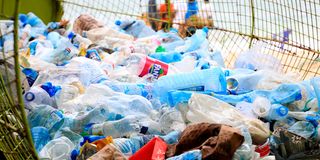
A plastic recycling point at the Nyali Public Beach in Mombasa.

What you need to know:
- The talks on plastics, which were to end two years after the adoption of a historic resolution on ending plastic pollution that happened in Nairobi in the year 2022, have spilt over way past a United Nations-backed deadline.
In Geneva Switzerland
A century-old invention is at the centre of talks at the Palais des Nations in Geneva, Switzerland.
Just like its stubborn nature to fade off the face of the earth once its production and use are done, negotiations around this invention have also been tough to conclude.
The talks on plastics, which were to end two years after the adoption of a historic resolution on ending plastic pollution that happened in Nairobi in the year 2022, have spilt over way past a United Nations-backed deadline.
Its use gained momentum after the Second World War. At the time, it was hailed as a cheaper alternative to glass, paper and metal.
Now, its pervasive nature in almost all items you can think of points to a complex way of managing its production, use, and waste elimination.
According to the United Nations, the world produces over 400 million metric tonnes of plastic every year. In 2019, when the Global Plastics Outlook released its latest report, it showed that around the world, there were 353 million metric tonnes of plastic waste.
Now, world leaders have a second attempt to end the plastic pollution menace that is creeping into our bodies, landfills, and the marine environment.
It is the second part of the fifth session of the Intergovernmental Negotiating Committee (INC 5.2) tasked to deliver a historic agreement that will possibly end plastic pollution.
In a typical United Nations process, everyone at the table must not only take a seat but also have a say on the final outcome before a joint decision is made.
They call it multilateralism.
Like in a game of darts, there is a hushed breath before a throw, but the general goal for any player is to hit the bull's eye.
At the opening plenary on Tuesday morning, member states, just like every darts player, entered the vast room at the Palais des Nations with their national interest in hand.
Global leaders steering the wheel of the process yesterday asked member states to put aside national interests and have a single, unified future for the planet.
Ecuadorian ambassador and chairperson of the INC 5.2, Luis Vayas Valdivieso, told representatives of the 180 member states, including Kenya, that the common good does not conflict with the national interest, but rather a better outcome for the future of the planet.
“You understand your national priorities, your red lines and constraints. This moment demands concrete and meaningful progress, not maximalist positions but joint solutions. Not finger pointing but pragmatic engagement,” he said.
“We are not just reviewing a document; we are setting the foundations for a global tool that could change the future of environmental history,” he added.
Ambassador Luis reminded delegates that while science has shown that the urgency to end plastic pollution is real, with clear evidence, the responsibility to deliver a better outcome on August 14 lies with them.
“We understand how we arrived at this point. A natural disaster did not cause this crisis. It is mainly an unintended result, we are pretty sure that nobody wants plastic pollution,” he said.
“We have not been able to find a systematic and effective way to stop it. Since it is a human-made crisis, it must be tackled through human effort and global cooperation,” Luis added.
Inger Andersen, Executive Director of the United Nations Environment Program (UNEP), reminded delegates that the world wants and needs to tackle the plastic pollution crisis.
She exuded optimism in her speech, one that would probably spill into the hearts of negotiators to inspire a positive outcome.
“You face ten days of intensive negotiations. You know that you will have to work hard and with determination, as you have done before. You know that you will have to work in the spirit of solidarity and compromise, as you have done before. But I believe you can leave Geneva with a treaty.
“People are outraged. They are worried. They are watching. And rightly so. Plastic pollution is already in nature, in our oceans and even in our bodies,” she added.
At a separate press conference held after the opening plenary, Ms Andersen told the Nation that the disparities that currently exist in handling plastic waste, giving a comparison of Kenya and Switzerland, will be tackled well if the treaty sails through.
“It begins with having global rules. When there are global rules on how these things (plastic waste) are managed, investors can see that there is predictability because they know that there is a market,” she said.