One in eight child deaths averted by malaria vaccine: Study finds
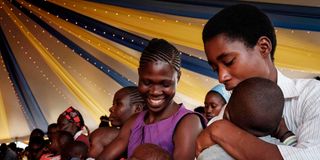
Mothers participate in the launch of the extension of the world’s first malaria vaccine (RTS, S) pilot programme for children at risk of malaria illness and death within Kenya’s lake-endemic region at Kimogoi Dispensary in Gisambai, Vihiga County on March 7, 2023.

What you need to know:
- The vaccine also reduced hospital visits due to severe malaria by 22 per cent in Ghana, Kenya, and Malawi between 2019 and 2023.
- This is despite the fact that only 71 per cent of children in the study received the first three doses of RTS,S, and just 40 per cent received the fourth dose.
The malaria vaccine has successfully averted one in eight deaths among children eligible for the lifesaving vaccine, a new report has revealed.
According to the study published in The Lancet, the RTS,S malaria vaccine also reduced hospital visits due to severe malaria by 22 per cent in Ghana, Kenya, and Malawi between 2019 and 2023. This is despite the fact that only 71 per cent of children in the study received the first three doses of RTS,S, and just 40 per cent received the fourth dose.
The three countries are among 22 others that have since introduced the lifesaving vaccine into their routine immunisation schedules and have also witnessed a 13 per cent reduction in malaria mortality among children.
“Introduction of the RTS,S malaria vaccine over a period of nearly four years through routine immunisation services in Ghana, Kenya, and Malawi averted an estimated one in eight deaths in children eligible to receive the vaccine,” the report states.
The study, titled ‘Impact of introducing RTS,S/AS01E malaria vaccine on mortality in young children in Ghana, Kenya, and Malawi’, was funded by the World Health Organisation (WHO), Gavi, the Vaccine Alliance, and the Global Fund to Fight AIDS, Tuberculosis and Malaria.
The WHO describes malaria as a life-threatening disease common in tropical countries, spread to humans by female Anopheles mosquitoes. According to WHO, malaria is the leading cause of death in young children in sub-Saharan Africa and resulted in 560,000 deaths in 2023, the majority of which were among young children.
The global agency estimates that 282 million malaria cases and 610,000 deaths were recorded globally in 2024. The WHO African Region continues to shoulder the heaviest malaria burden, accounting for 94 per cent of malaria cases and 95 per cent of deaths globally. “Children remain the most vulnerable to parasitic infections, with about 438,000 African children succumbing to malaria in 2024,” says the agency.
During the 46-month evaluation period, a total of 1,289,504 children received the first dose of RTS,S, 1,158,850 received the second dose, 1,068,039 received the third dose, and 436,527 received the fourth dose in the implementation areas, through the routine Expanded Programme on Immunization. When assessed at about 30 months after introduction, coverage of the first, second, and third doses had increased compared with coverage estimated at 18 months. According to the study, coverage of the third and fourth doses of RTS,S was similar among girls and boys in each of the surveyed countries.
The vaccine uptake, however, tended to be higher in households with a higher wealth ranking than in those from lower-ranked households.
“Coverage of the third and fourth doses of RTS,S tended to be lower in children who did not use an insecticide-treated net compared with those who did, but a substantial proportion of non-users of insecticide-treated nets were reached,” said the report.
The four-year study also revealed that 37.4 per cent of children aged 12–23 months in Ghana, 5.7 percent in Kenya, and 19.7 per cent in Malawi who were included in the study did not sleep under an insecticide-treated net.
“Coverage of the third dose of RTS,S among non-users of nets ranged from 46.9, 50.6, and 73.3 percent in Kenya, Malawi, and Ghana respectively,” said the study.
The uptake of the fourth shot, however, remained low among the population, at 21.6, 22.8, and 42.5 per cent in Malawi, Kenya, and Ghana respectively.
The WHO now says findings from the evaluation of the public health use of the RTS,S malaria vaccine confirm a significant reduction in child deaths in the first African countries to offer the vaccine. The positive impact, according to the agency, is likely to be as high or higher in other African countries offering the vaccine to young children in areas of high malaria burden.
“This is very solid evidence of the potential for malaria vaccines to change the trajectory of child mortality in Africa, and why it is urgent to overcome funding challenges to accelerate rollout,” said Dr. Kate O’Brien, WHO Director of the Department of Immunisation, Vaccines and Biologicals.
She added: “Demand is high and supply is sufficient, but more financing is needed so that countries can purchase enough vaccine, along with other malaria prevention tools, to reach all the kids most at risk of serious disease or death.”
Her sentiments were echoed by the WHO Director of the Department of Malaria and Neglected Tropical Diseases, Dr Daniel Ngamije Madandi, who argued that malaria vaccination strengthens the response and increases access to malaria prevention in countries.