Plastic, politics, and the power of art
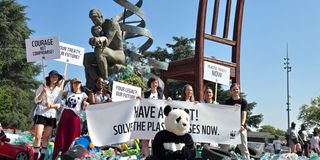
A photo of a piece of art by Benjamin Von Wong, showcasing plastic pollution outside Palais des Nations in Geneva. PHOTO| HELLEN SHIKANDA

What you need to know:
- During the Geneva negotiations for a global plastics treaty, Canadian artist Benjamin Von Wong unveiled The Thinker’s Burden, a six-metre sculpture made from plastic waste collected in the city, sparking conversations even as talks ended without a deal.
Outside the United Nations’ (UN) Palais des Nations in Geneva, a new sculpture turned heads of visitors and residents alike during the 10-day negotiations for a treaty that ended last week with no deal.
A young boy clutches at an old model car that is part of a collection of plastics strewn under a six-metre tall carving titled –The Thinkers Burden.
People are lined up to take photos, and everyone tries to shake the hands of the creator, Benjamin Von Wong, who is braving the European summer heat to explain to anyone who cares what his art represents.
Activists pose for a photo in front of the piece of art before chanting ‘stop the plastics crisis’ in unison.
Beyond the brackets, the science and tough stances that were in the negotiation rooms, art was slowly shaping a narrative of change.
At any climate-related negotiations, whether the Conference of the Parties or the making of a plastic treaty, artists have found ways to pass messages that serve as metaphors.
In Baku last year, we had Maasai artists singing and dancing to their tunes to pass a message that indigenous voices need to be heard.
Wong’s piece was also a conversation starter in the two-week tough talks in Geneva.
His art is an assemblage of different forms of plastics, including fishing nets, toys, tyres, construction material, and cigarette butts.
“We collected all these in Geneva,” he tells Nations in an interview.
The sculpture reimagines Augustin Rodin’s work. Rodin was a French sculptor whose original piece called Le Penseur (translated to The Thinker) inspired part of Wong’s art.
“It represents a thinker, crushing plastic bottles inside of one hand, thinking of how to solve this big complex issue, while cradling a baby which symbolises the next generation that don’t yet have a voice at the table,” he told Nation.
Below the Thinker is a lady-like sculpture which simulates our planet, and Wong refers to it as Mother Earth.
“It represents the fact that we depend on a healthy environment to survive, and the plastics around it are like a giant strand of DNA, which shows the toxic impact of plastics,” he explained.
Every day, Wong added more plastic to the sculpture, a gesture to the delegates that the more they delay taking action to end the crisis, the likelier the world will be choked by plastic pollution.
This is not his first activism in the form of art.
He started tackling the plastic pollution problem when he learnt about the Great Pacific Garbage Patch. It is the largest of the five offshore plastic accumulation zones in the world's oceans.
“I put a mermaid on 10,000 plastic bottles and that was the first sort of plastic-based installation that I had created,” he told Nation.
Since then, he has created many art pieces and even got a Guinness World Record for making an installation out of 168,000 plastic straws.
When Wong was in Nairobi in 2022, he created a four-story giant tap that stood tall at the United Nations Environment Programme (UNEP) during the second part of the fifth United Nations Environment Assembly, UNEA 5.2. Instead of gushing water, his art piece vomited plastic. His call for action was to turn off the plastics tap, inclined to reduce plastics production.
It is then that countries adopted a historic resolution to end plastic pollution, aiming to create a legally binding treaty by last year, but the deadline was missed.
In the sixth session of the negotiations, it took Wong about six months to create the six-foot-tall sculpture.
This year, again, countries failed to ink a deal on coming up with a treaty that would possibly end plastic pollution.
Wong was hopeful that delegates would make the right decision during the just concluded negotiations in order to come up with regulations and better designs for plastics.
“Plastic pollution is a great unifier of people because nobody wants a polluted environment. And yet, somehow, three years later, we're in a situation where fossil fuel lobbyists and petro-states have come out in force against any kind of limitations on production,” he says.
Wong says that while all he can do is to use his art to pass a message, he worries that multilateralism is weaker than it has ever been. He hopes that the conversation in the delegates’ rooms will be centred on protecting human health and well-being.
“If we can make something work in this terrible environment, then the chances of it being successful over time are probably a lot higher,” he says.
His experience working with over 80 women in Kibera to come up with the iconic tap is one that also fuels his activism on ending plastic pollution.
“I think that when we come into these halls of privilege, there is a story around pessimism for the future,” Wong told Nation.
“There's this phrase that I find quite interesting –pessimism is a privilege. For so many who are in really hard situations, they can only be optimistic. And I think that we need to adopt that same level of active optimism,” he added.


