Report: Only 20pc of Kenya's soil is suitable for food production
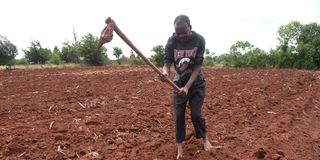
Charles Chelagat, a resident of Karona in Moiben Constituency, Uasin Gishu County, prepares his farm for planting on May 22, 2024.

What you need to know:
- Soil salinisation currently affects 40 per cent of irrigated land in Kenya, with approximately 85 per cent of soils being nutrient-deficient.
Kenya is facing a severe soil crisis that threatens food security and agricultural sustainability. This is according to the recently released Soil Atlas by the Heinrich Boell Foundation. The comprehensive publication reveals that only 20 per cent of Kenya's land is suitable for food production, with the country losing up to 26 tonnes of soil per hectare annually to erosion.
Soil salinisation currently affects 40 per cent of irrigated land in Kenya, with approximately 85 per cent of soils being nutrient-deficient. This degradation is estimated to reduce agricultural output by 30 per cent, increasing dependency on food imports. The situation is even more alarming across East Africa, where over 40 per cent of soils are degraded, undermining the region’s food security.
"Soil is the foundation of life, yet it remains one of the most overlooked and undervalued resources. Its health influences the food we eat, the water we drink, and the air we breathe," noted Joachim Paul, director of Heinrich Boell Foundation during the launch of the Soil Atlas Kenya Edition 2025. This edition was adapted from the original version of the Soil Atlas 2024 published in Germany to include facts and figures on vital resources on soil relevant to the situation in Kenya.
Dr Silke Bollmohr, lead editor of the Soil Atlas Kenya Edition, emphasised that soil discussions must extend beyond fertility. "Biodiversity, ecosystems, and resilience are crucial aspects of soil health," she stated. According to Dr Bollmohr, degraded soil is particularly vulnerable to erosion, with global costs reaching approximately $400 billion annually. Sub-Saharan Africa bears the heaviest burden. She explained that the climate crisis is worsening the situation, with erratic weather patterns, longer dry seasons, and heavier rainfalls intensifying soil erosion.
Multiple factors contribute to the escalating soil crisis. Overusing synthetic fertilisers, monoculture farming, and deforestation have led to declining soil fertility, erosion, and desertification. Currently, 63 per cent of Kenya's arable land is affected by acidity, 80 per cent suffers from phosphorus deficiency, and 75 per cent experiences depleted organic carbon levels, reducing soil fertility and microbial activity.
Experts emphasise that over-reliance on fertilisers alone is not the solution. Despite applying 57 kilogrammes of fertiliser per hectare, Kenya produces less grain than Uganda, which uses only two kilogramnes per hectare. Studies of AGRA projects in Burkina Faso and Ghana reveal that focusing on chemical inputs and high-yield seeds has not significantly improved production or increased farmers' incomes. Instead, many farmers are trapped in debt cycles due to rising costs of fertilisers and pesticides.
In 2024, the African Soil Health and Fertilizer Summit held in Nairobi acknowledged the need for holistic solutions beyond merely increasing fertiliser use. However, the resulting African Fertilizer and Soil Health Action Plan (2023-2033) has raised concerns. Its goal of tripling the production and use of synthetic and organic fertilisers by 2034 seems to contradict efforts to improve soil health genuinely. Critics argue that it favours influential industrial players while sidelining organic solutions that could be more beneficial in the long run.
Kenya has prioritised reducing reliance on imported fertilisers through the 2023 Kenya Green Hydrogen Strategy and Roadmap, which aims to replace up to 50 per cent of nitrogen fertiliser imports with locally produced green hydrogen-based alternatives by 2032. While this strategy supports a cleaner energy transition and reduces import dependency, it overlooks the essential role of organic fertilisers in sustainable agriculture.
Dr Harun Warui, lead programme coordinator for Agroecology and Food Rights at the Heinrich Boell Foundation, advocates for agroecology as a sustainable alternative. "Agroecology offers a sustainable path forward by integrating biodiversity, soil management, and organic inputs such as organic fertiliser and biopesticides. Agroecological farming can improve yields by up to 30 per cent while reducing dependence on costly synthetic fertilisers."
The soil crisis extends beyond agricultural productivity to affect food nutrition. Research shows significant declines in nutrient levels of crops over past decades, with reductions between six-38 per cent in calcium, phosphorus, iron, riboflavin, and Vitamin C. Protein content in maize dropped by 20 per cent between 1921 and 2001, while magnesium levels fell by 25 per cent.
At the launch, Christine Gatwiri, project coordinator at the Route to Food Initiative, emphasised that "healthy soils lead to nutrient-dense crops, which support human health and reduce reliance on external fortification." While acknowledging government efforts through mandatory large-scale fortification policies, she argued that addressing nutrient-deficient soils is essential for long-term nutrition security.
Since 2012, Kenya has implemented mandatory large-scale fortification to enrich wheat and maize flours with various nutrients. However, this approach raises concerns about over-supplementation, accessibility for rural populations, and increasing costs and environmental impacts of industrial processes. Most importantly, it fails to address the root causes of nutrient deficiencies.
Encouragingly, several initiatives in Kenya and East Africa are exploring sustainable pathways to improve soil health. Murang'a County's Agroecology Policy and Strategy promotes organic fertilisers, crop diversification, and soil conservation practices. Kenya's National Agroecology for Food System Transformation Strategy emphasises organic fertilisers, crop rotation, and integrated pest management to restore soil fertility.
Kenyan farmers are increasingly adopting alternative soil restoration methods like biofertilisers, composting, and agroforestry. However, agrochemical corporations continue to influence policies that block sustainable agricultural reforms. In Kenya, 44 per cent of pesticides used are banned in the European Union due to environmental and health risks, highlighting the need for stronger regulations.
Sylvia Kuria, an organic farmer and co-editor of the Soil Atlas, warns that "soil is not an infinite resource; it is a living, breathing system that requires care, investment and respect." Protecting and restoring its health is vital for ensuring food security, protecting biodiversity and addressing climate change.
Representing the government at the launch, the head of agricultural engineering at the Kenya Agriculture Ministry Laban Kiplagat assured the audience that the government is slowly switching to organic fertiliser to help heal the Kenyan soil so it remains healthy for generations.
“We are aware that in the past, unscrupulous people have taken advantage of frustrated farmers to increase yields. We have embarked on a process of checking all the dealers of agro-inputs across the country; and any person found in violation will be dealt with."