Sh60 million pumped into Lakes Baringo and Bogoria rehabilitation
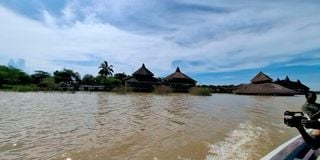
Some of the structures at Soi Safari Lodge on the shores of Lake Baringo have been submerged due to the rising water level of the lake.

What you need to know:
- Environment Principal Secretary, Mr Festus Ng’eno, said the grants benefiting 16 community groups will significantly improve the lives of people affected by the lake crisis.
Community groups around Lakes Baringo and Bogoria have received Sh60m grants from the Global Environment Facility (GEF) Small Grants Programme to support the restoration of their degraded ecosystems.
In the last five years, the two lakes have experienced significant rises in water levels, resulting in the displacement of thousands of residents and the submergence of homes, structures, and social amenities.
The initiative aims to restore these ecosystems, support biodiversity, and promote climate-resilient livelihoods for the affected communities.
Implemented by the United Nations Development Programme (UNDP), the restoration projects will benefit 16 community groups by promoting climate-smart agriculture, agroecological practices, soil health improvement, carbon sequestration, and more.
Empowerment
During the launch held at Kapicha Ecotourism Centre in Mogotio Sub-County, UNDP Deputy Resident Representative Ms Madelena Monoja emphasised the importance of empowering communities to view environmental resources as their own.
“Supporting communities to conserve the environment reaffirms our commitment to restoring Lake Bogoria, one of Kenya’s most unique ecosystems. It’s not just any landscape. It is a Ramsar UNESCO World Heritage site and an internationally recognised sanctuary for migratory birds,” she said.
The programme especially empowers women-led local organisations to develop homegrown solutions that conserve the environment, boost resilience, and foster inclusive development.
She said the current funding will support the rehabilitation of Lakes Bogoria and Baringo ecosystems over the next two years.
“Community-driven initiatives can catalyse meaningful environmental and social change,” she said.
Also read: Nowhere to run: Families in limbo after being displaced twice by rising Lake Bogoria water
Mogotio Member of Parliament, Reuben Kiborek, underscored the need for concerted efforts to conserve the lakes’ ecosystems.
“We must coordinate to conserve Lakes Baringo and Bogoria, which are key revenue sources for the county and vital for future generations. There is also a need to compensate families displaced by flooding,” MP Kiborek said.
Baringo Governor Benjamin Cheboi praised the Small Grants Programme as a bold move empowering communities to lead environmental conservation, promote sustainable livelihoods, and advance climate resilience at the grassroots.
“We are honoured to host this critical launch phase, a testament to the progress our communities have made in conservation, ecotourism, and environmental initiatives. The GEF project for Lakes Baringo and Bogoria is a significant intervention addressing land degradation and livelihood loss. I thank UNDP and partners for supporting 16 grantees with Sh60 million,” Governor Cheboi stated.
Biodiversity conservation
He added that the funding has greatly impacted biodiversity conservation, ecotourism, and rangeland restoration, while stimulating community enterprises and innovative grassroots conservation efforts.
“This support is timely and meaningful for our people. The programme strengthens the county’s resource base and expands economic opportunities, creating alternative incomes and increasing participation among women and youth,” he noted.
Environment Principal Secretary Mr Festus Ng’eno said the grants benefiting 16 community groups will significantly improve the lives of people affected by the lake crisis.
From 2010 to 2020, Lake Baringo expanded from 128 km² to 268 km² - a 108percent increase, while Lake Bogoria grew over 25 per cent, from 34 km² to 43 km². Lake Nakuru also rose by 70 per cent, from 40 km² to 68 km².
The rising waters have claimed nearly 140 km² of riparian land around Baringo, affecting approximately 3,087 households.
Research by the Kenyan government and UNDP, conducted since October 2020, attributed the rising water levels in Rift Valley lakes primarily to climate change, siltation from human activities, and geological movements.
It noted that climate change drives increased runoff due to altered land use, sending larger water volumes rapidly into lakes and destabilising their fragile ecosystems.
The report identified deforestation and excessive water extraction as major causes of ecosystem degradation.
Land degradation is also linked to reduced forest cover in water towers like Mt. Kenya, the Aberdare Range, Mau Complex, Mt. Elgon, and Cherangany Hills.
James Kimaru, Senior Warden of Lake Bogoria National Reserve, said the dramatic water rise caused flamingoes to migrate to Lakes Nakuru, Elementaita, and Lokipi in Turkana.
Floodwaters
He said about 90 per cent of the famous hot geysers, a major tourist attraction, have disappeared beneath the floodwaters.
Lake Bogoria is globally renowned for its flamingoes, hot springs, wildlife, and over 373 bird species. Unfortunately, flooding has severely impacted this world-class tourist site,” Mr Kimaru explained.
The lake, once hosting over 1.5 million flamingoes, now supports only about 124,000.
Flooding has altered inflow rivers such as Waseges and Maji Moto, increasing fresh water input and reducing alkalinity in northern feeding grounds for flamingoes.
Critical infrastructure, including the main gate and administration block, built in 2017/2018 for Sh30 million, now lies submerged within the lake.
Additionally, 26 km of the Loboi-Emsos road inside the reserve, constructed for Sh15 million to improve access to the hot springs, is also underwater.