Solar-powered dairy farms transform East Africa's agriculture amid climate crisis
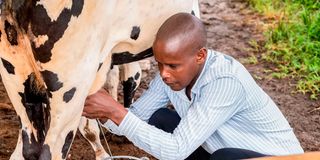
Kansiime Jackson, a Ugandan dairy farmer and chairperson of Kalyabulo cooperative that has 100 dairy farmers. Their cows are producing between 4,500-3,000 litres of milk per day.

What you need to know:
- In Uganda’s Nakaseke district, where droughts once devastated livelihoods, Kansiime now tends to his thriving seven-acre pasture farm—a lush oasis powered by the sun.
For years, Kansiime Jackson, a dairy farmer in central Uganda, watched helplessly as drought withered his crops and starved his cattle. Despite his careful efforts to mulch and conserve moisture, his vegetables continued to wither under the harsh climatic conditions.
Besides this frustration, the father of five’s memory is etched with the relentless rhythm of long treks—dust rising beneath the hooves of his cows as he guided them across sun-scorched earth in search of grass and water.
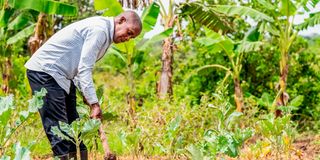
Kansiime Jackson, a Ugandan farmer, tending to his vegetable farm. He stopped growing vegetables after learning that dairy farming was more beneficial.
“The climate was not favourable. We have two seasons — rainy and dry. During the dry season, we could lose most of our animals due to shortage of water and pastures,” Kansiime says.
New dawn
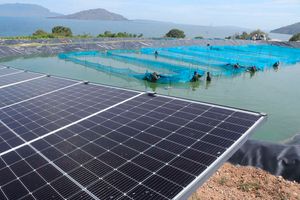
But Kansiime’s story, once defined by drought and loss, has taken a remarkable turn. Today, he stands in the middle of a thriving dairy farm—lush green fodder sprouts under the careful hum of solar-powered irrigation, his cows healthier than ever, their milk production steady even in the dry season. The secret? The Distributed Renewable Energy Ecosystem Model (DREEM), an innovative approach bringing solar energy and climate-smart agriculture to farmers like him in rural sub-Saharan Africa areas
Three years ago, Kansiime was selected to join a group of farmers for training under DREEM, where they learned about alternative fodder production, water conservation techniques, and sustainable pasture management to survive dry spells.
Through DREEM’s partnership with the government, Kansiime acquired affordable solar-powered irrigation systems, eliminating dependence on rain-fed farming.
The farmers also benefited from motorised chaff cutters and different types of pasture seeds like sugar graze.
Today, Kansiime’s land—once struggling and barren—is a model of green productivity.
"Feeding our cows instead of them looking for their own pasture is good these days," Kansiime says with a satisfied smile. "We now feed them well throughout the year with pasture that we’ve grown ourselves. We make silage and store it, but we also sell the excess to other farmers who haven’t planted."
In Uganda’s Nakaseke district, where droughts once devastated livelihoods, Kansiime now tends to his thriving seven-acre pasture farm; a lush oasis powered by the sun.
He uses solar-powered irrigation to grow high-yield pastures, ensuring his cows have nutritious feed year-round. Reliable fodder means higher milk yields, boosting his income. But his impact doesn’t stop there. Kansiime is the chairperson of a farmer’s collective that processes and exports milk to Kenya and Tanzania, strengthening East Africa’s food security while earning foreign exchange. The Kalyabulo cooperative has 100 dairy business cooperative members.
He currently owns 70 dairy cows. The group’s cows produce up to 4,500 litres of milk per day, which they sell as fresh milk and yoghurt through value addition.
Dairy farmers in the group are offered subsidised prices on essential equipment like chaff cutters for silage making, solar pumps, and solar water heating/home systems, with the option of instalment payments.
"We use solar for irrigation, which means we have enough water for farming. This eases the work and sustains our farming business. Being a dairy farmer has improved my family’s living standard — it’s the only business I do, yet it provides for all our needs. I’ve even employed four workers to help on the farm."
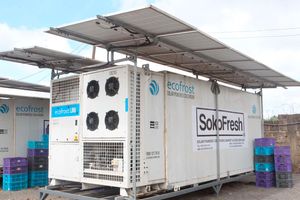
Uganda produces about five billion litres of milk per annum and 40 per cent of it is exported to COMESA (Common Market for Eastern and Southern Africa ) markets. This is according to Heifer International country director in Uganda, William Matovu. With this high milk production, he says 90 per cent of the 86 cooperatives in Uganda that they work with used to rely on diesel generators to run milk cooler systems. By supporting and empowering farmers like Kansiime with solar energy solutions, they are now greening the value chain, making it more sustainable and resilient for food production.
“By just introducing one solar station at one collection centre, you reduce carbon dioxide emissions by about four tonnes per month. Secondly, eliminating the use of generators on farms contributes to a more sustainable agricultural system,” Mr Matovu tells Climate Action.
He adds that sustainable pasture production, particularly when enhanced by irrigation, can lead to a positive cycle of benefits for farmers. Irrigation allows for the production and storage of feed, which in turn can improve feed conversion rates and reduce greenhouse gas emissions from livestock.
His sentiments are echoed by the Kenya Climate Innovation Centre Chief Executive Officer Joseph Murabula: “In terms of climate change, dairy is considered the biggest polluter in the agriculture sector. By greening the dairy sector, we reduce about 50 per cent of greenhouse gas emissions.”
In Kenya the DREEM project is in Laikipia, Isiolo, Kitui and Makueni counties where 23 farmers have been on boarded this month.
Murabula notes that Kenya Climate Innovation is the hub coordinating the entire programme but it has on-boarded partners to help in terms of skills development, community impact, access to finance, disbursing funds and managing of portfolio to the enterprises.
"We expect continuous adoption of solar energy technology, scaling up operations, creating more jobs—especially for youth—and leveraging these enterprises to sustainably reduce greenhouse gas emissions," says Murabula, highlighting the transformative potential of the project.
He adds that 23 farmers hardest hit by climate change yet often overlooked were prioritised. “We prioritised marginalised areas with increasingly erratic weather. If we don’t intervene where the need is greatest, who will?"
However, transitioning to solar-powered farming is not a walk in the park—especially for grassroots farmers. Murabula notes that the upfront cost of solar systems remains prohibitively expensive for most smallholders, threatening to exclude those who need it most.
He says they got a boost through a grant from the Charles Stewart Mott Foundation, which they are using to support individual farmers based on their needs.
Sam Passmore, who directs the environment programme at Charles Stewart Mott Foundation, says the organisation has supported grassroots farmers for 10 years through partnerships with private sectors and governments.
Speaking during the DREEM conference recently held in Limuru and attended by officials and farmers in Kenya, Uganda and Tanzania, Mr Passmore said: We are deeply committed to empowering youth and women in agriculture. In Tanzania alone, we’ve supported 150,000 people to adopt green energy solutions. The DREEM hub’s work—and the collaboration of Uganda, Kenya, and Tanzania—shows incredible momentum. This isn’t just about technology; it’s about transformative impact on regional food security."