State of health: Why Ruto’s UHC dream is still a work-in-progress
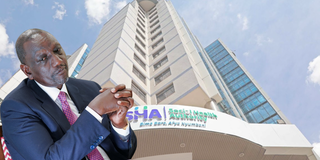
Despite President Ruto's repeated promise and Health CS Duale's affirmations that outpatient services are free under the Social Health Authority (SHA) for registered Kenyans, a nationwide investigation revealed a stark gap between policy and practice.

On September 29, 2022, President William Ruto took the stand at parliament to address Kenyans for the first time as the sitting president.
He was laden with promises, including mending the country's income tax system to be more progressive, requiring high earners and wealth to be taxed more heavily, allocating additional resources to the judiciary to enhance its autonomy, and evaluating the Competency Based Curriculum (CBC) and recommending appropriate reforms to the education system.
On health matters, he announced that he would restructure the country’s primary health system and put more resources into promotive, preventive, and early diagnosis.
“A key driver of this realisation is the National Health Insurance Fund, whose restructuring is not only necessary for efficiency but also enables it to become a fit-for-purpose social insurance scheme that caters to all, including those suffering from chronic diseases,” he said.
A year later, on November 9, 2023, in his second State of the Nation address at Parliament, President Ruto announced that his government had instituted radical reforms in the provision of health care services in Kenya, including the enactment of four new laws, including the Primary Health Care Act, the new Social Health Insurance Act, the Digital Health Act, and the Facility Improvement Financing Act.
“These laws will usher in and guarantee a new era in the provision of health care, covering all essential services from preventive, promotive, curative, palliative, and rehabilitative services, guaranteeing every Kenyan access to comprehensive and quality health care,” he announced.
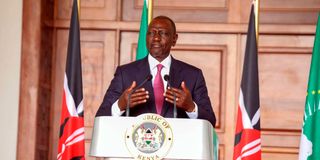
President William Ruto.
He said that under Afya Nyumbani, a national initiative focused on improving public health, the government had scaled up investment in the health care workforce, by ‘employing 20,000 new health care workers, deploying 8,429 workers whose contracts had lapsed and enrolling 3,394 interns across the country to increase the availability of human capital in the public health sector.’
Further, under the Afya Nyumbani model, he announced preventive care as an essential pillar of health care service delivery and community health promotion as the intervention to deliver preventive and promotive health solutions at the grassroots.
100,000 community health promoters, he noted, had been deployed to visit Kenyans at their homes, provide basic diagnoses for common conditions, and refer cases to appropriate medical facilities.
Out NHIF, in SHIF
In October 2024, the Social Health Insurance Fund (SHIF) officially replaced the National Health Insurance Fund (NHIF), envisioned as the cornerstone of Universal Health Coverage (UHC).
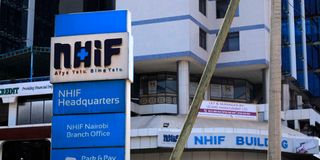
The offices of the now defunct National Hospital Insurance Fund in Nairobi.
In his 2024 address, President Ruto acknowledged that despite health being a devolved function, counties were struggling with shortages of medicine, equipment, and sometimes staff, hindering service delivery and leaving countless Kenyans with suboptimal access to health care.
Health delivery, he said, was about ensuring that health care is not a privilege for the few who can afford it and a pipe dream for the many who cannot. NHIF, he said, ‘was saddled with deaths and inefficiencies and health care was being severely and negatively impacted.’
“For far too long, too many households have lived on the edge, just one illness away from financial catastrophe. Our health care system has historically neglected the poor and vulnerable, leaving them without any options. While private sector medical covers remain out of reach for the majority,” he said.
The solution he proposed was to transform financing reforms, making health care accessible and affordable; digitize health care services to enhance efficiency, eliminate fraud, and stop corruption; and empower a skilled and motivated health workforce. This would happen through signing into law four pieces of legislation, including the Social Health Insurance Act, which replaced NHIF and established the Social Health Authority, which oversees three essential funds.
“NHIF served a few salaried Kenyans and those who could afford to pay, but TAIFA care covers every Kenyan, regardless of employment or financial status. Despite serving a limited class of citizens, NHIF nevertheless accumulated billions of shillings of debt because of misalignment between contributions and the actual cost of health care. TAIFA Care has undertaken an accurate costing of all health care-related goods and services in order to provide timely, effective, and efficient service to every Kenyan that is afforded,” said the President.
He added, “The NHIF had a waiting period lasting between registration and eligibility for service. Under TAIFA care, citizens are eligible for all services upon registration.”
“Through the Digital Health Act, we are revolutionising health care delivery. Every step of the process, from registration and eligibility checks to claims, is now digitised. By eliminating unnecessary human interaction, we are tackling corruption, reducing inefficiencies, and ensuring that resources are used where they are needed most.
"Like any major transition, there are challenges, but I promise you we are fully committed to making the system work. We will ensure that hospitals are equipped with the tools they need, medicine, equipment, and other resources necessary to provide quality care while involving citizens in decision-making at every facility.
He announced that the government had started clearing decade-old debts, including those owed to the public, private, and faith-based medical facilities, some of which had been pending for over a decade. The remaining balances, he said, would then be paid in phases.
Transition nightmare
One year into its rollout, however, the ambitious reform has resulted in a paradoxical situation: millions are registered, but access to critical care has diminished, threatening the stability of the entire healthcare system. The transition from NHIF to SHA did not resolve the massive historical debt owed to hospitals. This outstanding debt, combined with new, delayed payments under the SHA system, pushed facilities to the breaking point.
By mid-2025, private hospital associations like the Rural and Urban Private Hospitals Association (RUPHA) and the Kenya Health Federation (KHF) began sounding the alarm over billions of shillings in pending bills.
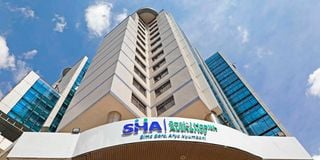
The Social Health Authority building in Nairobi.
Hospitals also reported that cash flow pressures forced them to reduce operations, default on loans, and struggle to pay staff salaries, leading to strikes and a general decline in service quality across the country.
In a desperate measure to remain operational, RUPHA hospitals demanded that patients under SHA pay upfront. Effective September 22, 2025, private hospitals in various regions directed SHA patients to pay in cash for services, telling them to seek reimbursement from the authority later.
This policy instantly negated the protective benefit of the insurance for thousands of Kenyans, particularly those requiring specialised care. This forced patients needing regular services like dialysis or cancer treatment into financial strain, halting life-saving treatment or reverting to out-of-pocket payments.
According to RUPHA Brian Lishenga, RUPHA facility liabilities stand at a combined Sh21 billion, with Sh6 billion being legacy debt and Sh15 billion ongoing SHA debt.
Hospitals have accrued financing costs through loans and overdrafts to keep paying vendors for goods and services offered under NHIF. This has in turn denied the same hospitals critical headroom to invest in supporting SHA UHC ambitions.
He explains that RUPHA hospitals are still facing a number of challenges under SHA, including mass rejection of valid claims affecting maternity, surgical and general medical admissions, vague, opaque resubmission processes for claims designed to defeat any successful appeal and suspension of inpatient bed capacity for maternity services at many level 3 facilities and all level 2 facilities. The latter, he says, ‘has led to retrenchment of staff, cutting back on investments in rural communities and hardship for women.’
“Delays in primary healthcare reimbursements have affected the provision of essential outpatient care. Payments are now typically two months behind schedule. This is also disproportionately affecting level 2 and three facilities in rural communities. SHA portal downtimes persist, affecting biometric authentication and causing delayed care,” says Mr Lishenga.

Probe shows SHA paid falsified invoices, while in others, money was disbursed to non-existent health facilities.
“Many facilities remain suspended for an alleged fraud investigation. SHA has deliberately stalled internal dispute resolution mechanisms, and audit reports have not been shared with affected facilities.
"SHA has not established the Disputes Resolution Tribunal to allow providers aggrieved by either the reduced bed capacity or suspensions to lodge appeals. This is a miscarriage of justice,” says Lishenga.
He further adds that screening services like cervical cancer and prostate cancer screening are yet to be activated, leaving preventive care in limbo, and that the Emergency, Chronic and Critical Illness fund remains larger unoperational, creating stress at facilities due to patients not being able to meet costs.
In their petition to the Ministry of Health and to SHA in July, the Kenya Network of Cancer Organizations (KENCO), representing over 70 civil society groups and thousands of cancer patients in Kenya noted that oncology benefits were cut from Sh600,000 per individual under NHIF to Sh400,000 per household (or Sh550,000 if supported by the Emergency, Chronic and Critical Illness Fund.) This reduction, they said, is devastating in a context where cancer treatment can cost millions of shillings.
These financial costs include standard chemotherapy, which costs Sh23,000 per session for eight sessions, amounting to Sh268,000, and blood work at approximately Sh4,500 per cycle for eight cycles, adding to Sh36,000.
Imaging and diagnostic monitoring further raise the costs, including a CT scan (Sh20,000), echocardiograms every three months (Sh3,000), and a PET scan at Sh53,400.
Targeted therapy, Herceptin alone, costs about Sh33,800 per cycle for 18 cycles (or more for some patients), totaling Sh608,400. Kadcyla, often prescribed for maintenance or resistance cases, costs Sh180,000 per cycle for 14 cycles, adding up to a staggering Sh2.32 million.
Hormonal therapy, including Zoladex (Sh19,615 every three months indefinitely) and Letrozole (Sh5,000 for a three-month dose over 10 years), sums to over Sh100,000 in the first year alone. Radiotherapy averages Sh3,600 per session for 30 sessions (Sh108,000); surgery costs around Sh120,000, follow-up CT scans of the chest and pelvis cost Sh8,000 and Sh12,000, respectively.
Members of the National Empowerment Network of People Living with HIV/AIDS in Kenya, NEPHAK, also petitioned the Ministry of Health to have HIV care included under the Social Health Authority (SHA) benefit package.
HIV and TB care were originally excluded from SHA because they were adequately funded by international partners, specifically PEPFAR (The U.S. President's Emergency Plan for AIDS Relief) and the Global Fund.
However, the funding cut led to a crisis for patients. While antiretroviral drugs (ARVs) are still provided for free through these donors, essential services covered by the past funding are now unavailable.
The most critical impact had been the halt in essential lab work, with facilities unable to perform vital diagnostic tests, including viral load testing, CD4 count testing, and creatinine tests.
Vulnerable populations have also faced systemic roadblocks: teenage mothers often lack the national identification documents required for registration, denying them and their infants crucial maternal and child health services. Many have been detained in hospitals for inability to clear their medical bills.
The operational side of the SHA has also been plagued by corruption and poor technology implementation, eroding public confidence. The digital system, intended to streamline operations, has been a major source of widespread dissatisfaction.
Frequent downtime stalls patient registration and claim submission, while early failures in the biometric system meant patients, even those fully paid up, were blocked from access because the system could not authenticate their identity, leading to service denial.
Public trust took a severe hit after the exposure of massive fraud schemes. Criminal syndicates utilized "ghost facilities" to submit and attempt to clear over Sh10.6 billion in fraudulent claims. This deliberate theft of public health funds fueled the cash crisis and further polarized the relationship between the government and honest healthcare providers.
A GeoPoll survey in March 2025 indicated that 75 per cent of respondents cited corruption and mismanagement as significant issues plaguing the SHA.
Hospitals reported receiving reimbursements as lump sums without clear disaggregation, hindering effective tracking. Furthermore, the auditor general's findings raised concerns about the opaque procurement of the SHA's digital system and the potential for a 2.5 per cent administrative fee on member contributions, raising fears that costs were simply being shifted back to the vulnerable patient.
“If we were to redesign the SHA payment system, we would redesign contradictions so that there is no "free outpatient". This will encourage payments to SHA so that it is not underfunded.
Once step one is done, allow for monthly premium payments, then pay clean verified claims within 14 days not 90 days aim to move this to even shorter 48-72 hrs. This will improve hospital cash flow and convert them into SHA allies,” Lishenga poses.
"Level two and three facilities are the backbone of the health system. Outpatient reimbursements need to be predictable and regular first and foremost. No delays for two months.
They do not have any other revenue sources unlike larger hospitals. Activate preventive medicine packages to further support their sources of cash flow with incentives to those that do well in this area," he adds.
As the president delivers his State of the Nation address on Thursday, November 20, Kenyans anticipate answers and solutions to the systemic challenges they have experienced in the health sector this year.
Follow our WhatsApp channel for breaking news updates and more stories like this.