TB patients' struggle for survival as drugs disappear
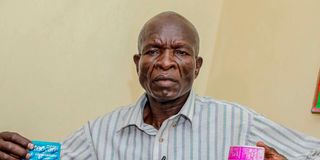
Walter Thomas, a TB patient, during the interview at his home in Umoja on March 12, 2025.


What you need to know:
- A total of 1.25 million people died from tuberculosis globally in 2023 (including 161 000 people with HIV).
It has been 20 years since Walter Thomas, 60, was diagnosed with tuberculosis (TB). In all those years, he has been going to hospital weekly to be tested and get injections for multi-drug resistant TB.
His tests, which mainly are an analysis of his sputum, are supported by the Centre for Health Solutions, a non-profit organisation.
“Last week, I went to a health facility in Kiambu County and learnt that the samples health workers took from me and many other patients about a month ago were still with them,” says Walter.
Kenya has largely relied on the US to fund TB programmes. Now the recent funding cuts have disrupted access to services for prevention, screening, and treatment for people with TB.
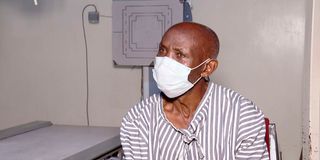
Peter Muturi, a TB patient, at Nakuru County Teaching and Referral Hospital.
As a painter, Walter takes home about Sh1,000 daily and now he has to budget for TB drugs following the USAID shut down — one which greatly funded his drugs.
“I used to be a drunkard then with a never ending chang’aa addiction that was accompanied by a smoking addiction,” he starts off in a low tone as he goes down a painful memory lane on how he has battled a disease that has eaten away a huge chunk of his lungs, leaving what doctors now describe as a ‘string of flesh’ as per the latest X-rays.
Walter is a multidrug-resistant tuberculosis (MDR-TB) patient; which means his life will forever depend on regular medication, tests and check-up.
MDR-TB is a serious form of TB caused by bacteria that are resistant to at least two of the most potent first-line anti-TB drugs — isoniazid and rifampicin. Another major concern arising from the funding cuts is the potential increase in drug-resistant TB cases. Inconsistent treatment due to financial constraints can lead to incomplete therapy, forcing patients to develop resistance to standard drugs.
About TB
According to the World Health Organization, TB is an infectious disease caused by Mycobacterium tuberculosis bacteria that affects the lungs. It spreads through the air when infected people cough, sneeze or spit.
“A total of 1.25 million people died from tuberculosis in 2023 (including 161 000 people with HIV). Worldwide, TB has probably returned to being the world’s leading cause of death from a single infectious agent following three years in which it was replaced by coronavirus disease,” the global health regulator shows in its March 2025 report.
Walter narrates to Healthy Nation how he learnt about his condition: “I would feel extremely tired even after a good night’s rest, which made it difficult for me to work. Since I was coughing endlessly for many weeks, I I decided to get some syrup at a local chemist thinking the medication would immediately clear the cough. But I was wrong.”
His friend asked him to go to hospital after suspecting that he could be suffering from TB.
Eventually, he decided to go to Kenyatta National Hospital.
“When I got there, my cousin, who is a health worker at KNH, looked at me with pitiful eyes and then asked, ‘do you smoke? If so, just go home first and take lots of milk.’
“I did so and by midnight, the cough showed up with thick bloody sputum mixed with visible pieces of flesh,” he says.
That night, he says he saw death lurking in the shadows of the dimly lit candle in his room.
He woke up early in the morning this time round heeding to what his friend had advised, but there was one major problem.
“Between me and poverty, I had only Sh200, which was nowhere near the cost of treatment and so I was only able to afford a medical card that at the time went for Sh60.”
With no money to afford treatment, Walter says he had no option but to go back home and suffer in silence.
Luckily, Médecins Sans Frontières (MSF) doctors learnt of his predicament and immediately located and picked him up for admission at Mbagathi Hospital.
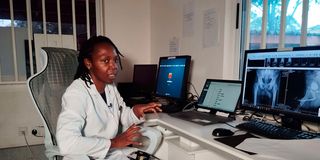
Dr Zipporah Mwebi, a radiologist at Nakuru Teaching and Referral Hospital, during the interview.
“I went back home because I did not have money for an X-ray, but MSF sorted it out. They ensured I was treated and was immediately put on medication for eight months,” he tells Healthy Nation.
“I had tested positive for TB but due to ignorance as well as alcohol and tobacco addiction, I defaulted on my medication by the sixth month,” he confesses.
He would later learn that most of his drinking friends at the chang’aa den he used to frequent had contracted and succumbed to TB.
“Now that I think of it, we used to share drinking glasses and didn’t care whether they had been washed or not. If I bought a kilogramme of fried or roasted meat, all of us would dig in without caring much about hygiene or anything else, that’s how I think I got it,” he says.
Walter notes that despite the progress Kenya has made in the fight against TB, President Donald Trump’s stop order on foreign aid that saw the shutdown of USAID, which the country has been relying on in its quest to eliminate the deadly disease, has immensely affected his treatment.
“I have few pills left and so I have been frantically calling the facilities that used to give me the drugs, and they have none, which has me worried. That is why this morning I have decided to go to Mbagathi and see if I can find them.”
TB patients who don’t take their prescribed medication remain infectious, increasing the risk of spreading the disease.
In Nakuru County, Peter Muturi is dressed in a black and white hospital garb as we walk into one of the X-ray rooms at the Radiology wing of Nakuru Teaching and Referral Hospital.
The 70 year old is wearing a mask and his daughter Milkah Waithera, also in one, is watching closely from the door as the radiology technician sets her father up for the all-important X-ray.
“He has been complaining of chest pains for a while now. We have been referred here from Bahati Sub- County Hospital, where they had confirmed that he had TB,” Milkah explains.
Peter had been on TB medication for a week before pneumonia showed up; and so he was battling a co-infection at the time. But the timing of his diagnosis has put his family on the edge. They aren’t sure if he will get the six-month treatment regimen for patients who have just been diagnosed with TB.
“I am worried about his well-being, we do have treatment for a month but I am not sure what we are going to do if he is not able to get the medication on time,” says Milkah
Health workers at Bahati Sub-county Hospital referred him to Nakuru Teaching and Referral Hospital to get more tests done because they suspected that he had pneumonia.
“It’s only been three days since dad was put on medication and he is still struggling to breathe. The doctors told us it could be water accumulation in his lungs, and that’s why we brought him here,” says Milkah.
According to Dr Zipporah Kemunto, a radiologist at Nakuru Teaching and Referral Hospital, they conduct 80-100 X-rays at the hospital daily. “Forty out of the 100 X-rays we conduct are for TB screening, and this is usually for Pulmonary Tuberculosis; the one that affects the lungs,” explains Dr Kemunto
The hospital has a chest clinic where most TB patients get their treatment. It is also in the sub-county (Nakuru West) with the highest number of TB patients in the county out of the 11 sub-counties.
“TB is spread in areas where there is congestion; and Nakuru West has informal settlements, where there’s crowding, making those living there prone to getting infected with TB,” says Diana Muteti, the TB coordinator in Nakuru West.
Dr Neimah Barasa, the county TB Coordinator, shares that last year alone, Nakuru recorded more than 3,100 TB cases, among them multi-drug resistant tuberculosis, which has health officials on the edge on how they can curb the spread of this strain of TB that is tough to cure and even takes longer to treat.
“We are seeing a rise in the drug resistant cases, especially from community infections, and not as diagnoses from other healthcare levels. In Nakuru, we are managing 33 cases. The youngest is 10-months-old, and this just goes to show that TB can affect anyone,” says Dr Barasa.
Dr Barasa explains that the USAID suspension has greatly affected the workforce at the facility, contributing to fewer diagnosis and testing of TB.
“These were specialists whose work was partner-funded and so we have had to work around the staffing gaps by incorporating treatment sites with the normal outpatient clinics and building the capacity of county staff to the updated guidelines. We are working to ensure that no TB patient goes without drugs,” explains Dr Barasa.
Nakuru County Health department says it has been able to look for local solutions to the challenges occasioned by the gaps in donor funding, especially for a disease like TB that is still a highly-stigmatised disease.
While addressing delegates last month at a Civil Society Organisation meeting in Nairobi, Evaline Kibuchi, the chief national coordinator, STOP TB Partnership, revealed that a recent study conducted on the catastrophic cost of treating TB in the country and implications on family settings found that it’s too expensive to treat the disease as it relies on out-of-pocket payment.
“It’s too expensive for Kenyans because of the frequent hospital visits that demand patients pay out of pocket each time they visit and so if not covered by SHA, it means these costs will impoverish Kenyans,” she told delegates while urging the government to prioritise their inclusion to the new insurance scheme.
“As a country, we need to prioritise lowering the cost of treatment for TB so that these costs do not become a barrier to treatment,” she urged.
In August last year just months before President Trump’s order, Kenya reported a TB/HIV co-infection rate of 25 per cent, an increase from 23 per cent in 2022, the latest annual report by the National Tuberculosis, Leprosy and Lung Disease program showed.
According to the findings from 2023 data, Kisumu, Homa Bay, Siaya and Busia had the highest co-infection rates.
The data also showed that low co-infection rates were reported in counties of Baringo, Mandera, and Wajirat one per cent.
In 2022, among TB patients with comorbidities, the highest loss to follow-up (LTFU) rates were observed for those with asthma, chronic obstructive pulmonary disease , and drug abuse disorders.
According to the data, the highest death rates were reported for patients with cancer and liver disease. The highest treatment success rates were seen in patients with smoking, alcoholism, and asthma, despite the high LTFU rate for asthma.
Overall, the country’s TB incident cases (new and relapse) were 88,895, which is a case detection rate of 74 per cent, with about 26 per cent of the cases being missed or not notified.
“The overall case notification rate for the year 2023 was 204/100,000 population,” the Health ministry then pointed out.
Dr Immaculate Kathure, the head, Division of Tuberculosis and other lung diseases at the Health ministry, noted that Kenya notified a total of 97,126 cases of all forms of TB in the year 2023 out of the estimated number of 124000.
The cases also increased by 7.2 per cent compared to 2022 while among the notified cases, 8,231 (8.5 per cent) were previously treated.
This meant that the country still having a high burden of TB and HIV-associated TB despite transitioning from the list of high-burden DRTB countries.
She explains that the age distribution of TB cases in the country indicate that children aged 0–14 years accounted for 12,884 of the total notified cases.
“The age group 25 to 44 years bore the highest burden, with 61,390 cases.
Before USAID shutdown, the Health ministry in partnership with entities like the Centre for Health Solutions, which is fully funded by the US, was implementing strategies that include improving access to drug susceptibility testing through timely availability of laboratory commodities and the use of stool Gene-Xpert Ultra for diagnosis of TB in children below 10 years.
The government was also working towards expanding the use of chest X-rays for screening the contacts of DR-TB contacts, and strengthening healthcare worker capacity for early detection and effective management of DR-TB through training and support.
But now with the USAID shut-down, Kenya risks losing all the gains she had made in fighting and eradicating TB despite the 90-day pause on the stop order.