The power of worms: Meet farmers transforming organic waste into wealth

Godfrey Sabali holding the red winggler worms in a vermicast at his Landoni farm in Vihiga county on October 14, 2025.The worms are used to compost organic waste.
What you need to know:
- The process begins by acquiring red wriggler worms from fellow farmers.
- The worms are then multiplied in various containers such as plastic bins, basins, or custom-built timber boxes.
In Vihiga’s Landoni village, Godfrey Sabali and his colleagues are demonstrating a sustainable way to turn organic waste into valuable products.
They have built a thriving business from organic waste using an innovative method: vermiculture. As an experienced farmer from the Earth Lungs initiative, Godfrey is at the forefront of this sustainable practice, which involves raising red wiggler worms to create rich compost.
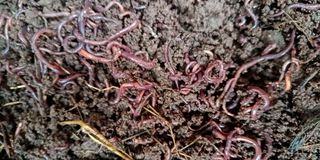
The red wiggler worms used to make manure.
The area is a hub of farming activities, many of which focus on adding value to farm products through a local cottage industry. "This is a noble concept of regeneration where we make value of our organic waste from various farming activities," he explains. "We engage in livestock farming, bamboo farming, managing farmyard waste, extracting banana fiber from pseudo-stems, and handling wastes from weaving."
The process of vermicomposting
The process begins by acquiring red wiggler worms from fellow farmers. The worms are then multiplied in various containers such as plastic bins, basins, or custom-built timber boxes.
The base is prepared with moist, chopped cardboard or paper. Alternatively, a layer of coarse sand followed by soft sand can be used. This is then covered with maize stalks for filtration. The worms are introduced in layers along with organic waste, which serves as their food. The micro-climate must be kept moist. After about two months, the worms will have multiplied and can be introduced to larger compost heaps to accelerate the composting process.
Why red wigglers are vital
The red wriggler is the worm of choice for vermiculture due to its exceptional composting ability, rapid reproduction rate, and tolerance to various environmental conditions.
The worms also play a key role in improving overall soil biodiversity.
What to feed the worms—and what to avoid
The worms thrive on a diet of eggshells (for calcium) and plants like Lantana Camara (for nitrogen). However, certain kitchen wastes must be avoided, including ash, salt,
onions, lemons, and fats, as these can dehydrate and suffocate the worms.
"Not all waste materials are suitable for composting," warns Godfrey. "Improper materials can release a pungent smell that poses health risks if moisture is added and management is poor." He also notes that vermicomposting systems can be attacked by pests and require good management to ensure the worms thrive.
To deter rodents, fresh cow dung is added to the compost. A 20-litre container of water is also added and recycled every two weeks. After three months, the valuable vermi-tea (a liquid fertiliser) and vermicast (worm castings) are ready for harvest.
Environmental and economic benefits of vermi-tea
Vermi-tea is a game-changer for crop nutrition. It can be used to address nutrient deficiencies and, when pumped into fish ponds, encourages the growth of algae, a natural fish feed. The worms themselves also serve as a high-protein feed for fish and poultry.
"The vermi-liquid fertiliser utilises organic compounds that create an inbuilt resistance against fungal attack while nourishing the crop," Godfrey states. "This is an environmentally friendly tool for crop growth and development."
The venture is also economically rewarding. According to Godfrey, vermi-worms sell for Sh2,000 per 5kg (with a bonus), while vermi-tea sells for Sh600 per litre.
Godfrey has successfully marketed his vermicast as far as Kilifi County, selling a 20kg bag for between Sh1,900 and Sh2,000. He describes vermicompost as a premium, nutrient-rich organic fertiliser that is vital for sustainable agriculture. It contains beneficial microbes and humic substances that are essential for soil health.
He urges more farmers to embrace vermiculture as it improves soil structure, permeability, and porosity while enriching the earth with versatile nutrients. "Vermicast is a complete natural fertiliser which has positive effects on the soil by improving its health.
"Farmers should remain environmentally conscious and go for vermiculture to enrich our biosphere and ecosystem, creating a regenerative and circulatory system. I am also urging both levels of government to initiate incubation centres in institutions and farmers’ centres to promote vermiculture. I have hopes and a big picture of seeing the country go organic and deliberately create an eco-system balance."
This call is echoed by Colloins Kweyu, a youthful farmer from Kakamega, who practices vermiculture and encourages his peers to venture into this profitable, self-employment creating sector.
His plea to the government is to provide funds and technical support for such projects, ensuring the food consumed is free from chemicals. He concludes with a powerful reminder: "Udongo ni mali"—the soil is wealth.