The swelling that won’t quit: Two women's battle with lymphoedema
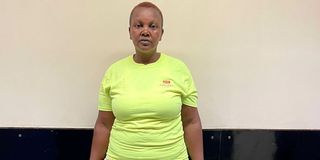
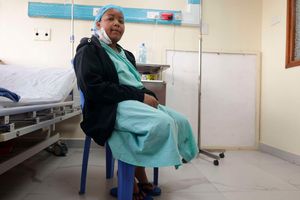
Jane Wambui, 44, who has lived with lymphoedema for over 15 years, during the World Lymphoedema Screening Day at Kenyatta National Hospital on March 6, 2026.

What you need to know:
- The symptoms often begin gradually. Patients may first notice heaviness or discomfort in a limb before visible swelling appears.
- Common signs include heaviness of the affected limb, visible swelling, skin hardening, pain, and changes in the colour or texture of the skin. As the condition progresses, the tissues can harden further.
Jane Wambui's battle with lymphoedema (swelling of the limbs) began in 2011, when she noticed her legs were no longer proportional. Concerned, she visited a hospital in Kikuyu for kidney function tests. The results came back normal. She went to another hospital and underwent ovarian tests. Those too were normal.
Hospital after hospital, no diagnosis came. Healing slipped further away the more she searched.

Desperate, she turned elsewhere. She spent a week at a church camp praying for healing. "Being the only member of my family to ever struggle with this condition, other family members told me I had probably been bewitched. So I packed my belongings into a bag and went to a one-week church camp led by Dr Owuor, seeking a miracle. It never came. The swelling continued," recalls Wambui.
She then travelled to her grandmother's home to slaughter a goat as a sacrifice. Nothing worked. "It had been over a year of visiting hospitals when I was called to go back home to meet my grandmother and establish whether my family and I were under a curse. She advised me to slaughter a goat as a sacrifice. But healing never came. Instead, the swelling continued. I became angry, thinking she had lied to me about what truly needed to be done. I abandoned her and refused to attend her funeral when she died," says Wambui.
When a miracle was not forthcoming, Wambui began wearing long dresses to avert stares and stop people from asking questions she had no answers to. Her favourite knee-length dresses and shoes no longer fit. With her body changing, she grew self-conscious and began isolating herself from social events.
In 2023, her face began swelling, forcing her back to hospital. She underwent kidney function tests for the second time, but her kidneys were found to be normal.
Instead of sending her home, her doctor persisted, ordering more tests to understand whether the face swelling was connected to her limbs. They discovered a clot in her leg that was causing the swelling, and she received treatment. However, the swelling on her face remained.
"When I went back for a review, they found that the clot was still present and had moved up along the leg, causing more swelling. I was immediately referred to Kenyatta National Hospital, where for almost a year I saw a number of specialists, including a vascular specialist and an oncologist, but no solution was found. I was referred back to the vascular specialists, then on to plastic surgeons, and eventually to a physiotherapist, who finally determined that I was battling lymphoedema. By this time, my other foot had also started swelling," says Wambui.
The physiotherapist began management of her swelling in December 2025, which included an injection, bandaging, exercises, and fluid drainage.
"The interventions worked. The swelling and pain reduced drastically. I went back to wearing shoes again and putting on dresses that I felt comfortable in."
However, Wambui, 44, notes that finances remain a stumbling block. The bandages required for wrapping her feet to manage the swelling are expensive.
"The bandages cost Sh44,000 and are not found within the hospital premises. I also need to frequently undergo tests for blood clots, which cost about Sh40,000 and are not covered by the Social Health Insurance Fund,” she tells Healthy Nation outside Kenyatta National Hospital during Kenya's first-ever World Lymphoedema Day screening.
A lifetime of swelling, a name finally found
Eighteen-year-old Brenda Maina has lived with swelling in her leg for as long as she can remember. Born with the condition, she spent most of her childhood without knowing what was wrong. It was only years later in her final year of high school that doctors finally gave it a name: lymphoedema.
Growing up, the swelling was noticeable but not severe enough to attract much attention.
"When I was young, the upper part of my leg was swollen. It wasn't that big, but you could see the difference between my legs," she recalls.
At the time, neither she nor her parents understood what was causing it. For many years, the condition did not significantly affect her life. She attended school, participated in activities, and carried on like other children. But things began to change when she joined high school. From Form One onward, the swelling gradually became more pronounced.
"Before receiving a proper diagnosis, my family sought help at several hospitals. At one point during my primary school years, I was given compression stockings as part of the treatment. But as a young student, I struggled to use them consistently because they were uncomfortable and they hurt.”
By the time she reached high school, the swelling had become more visible. Yet the teenager still did not know what condition she was dealing with. At school, she often invented explanations to avoid difficult questions.
"I used to tell people it was the weather. I went to school in a place where it was very cold, so I would say the cold was affecting my leg. It was the only thing that made sense, considering we didn't exactly know what I was dealing with. I wasn't in pain. I could still do activities like dancing and playing netball."
Her turning point came in April of her Form Four year, when she was referred to the physiotherapy department and met a specialist who finally helped her understand her condition.
"That is where I found my doctor. She took care of me and explained that I have lymphoedema. The diagnosis initially came as a shock, but she explained the condition and how I could manage it."
Since then, she has been undergoing treatment that includes bandaging and physiotherapy exercises. One of her biggest challenges has been something many people take for granted: finding clothes and shoes that fit comfortably while her leg is bandaged.
"Because of the bandaging, my leg looks bigger. It's hard to find shoes and clothes that fit, so I mostly wear baggy clothes. For a person like me that is naturally small, the loose clothing sometimes creates another challenge. When I wear baggy clothes, some people just think I'm very skinny," she reveals.
Still, she remains optimistic and grateful for the progress she has seen since starting treatment. Throughout the journey, her family has been a strong source of support.
Dr Janet Mwau, the lead lymphoedema specialist at Kenyatta National Hospital, has spent years treating patients whose lives have been altered by a condition many people know little about. For her, awareness is just as important as treatment.
"Lymphoedema is basically swelling of the limbs. It can affect the legs, the arms and sometimes even the genital area in men. The condition occurs when the lymphatic system, responsible for draining fluid from body tissues, fails to function properly, causing fluid to accumulate in the affected limb," says Dr Mwau.
She categorises the condition into two types: primary and secondary. Primary lymphoedema occurs when someone is born with a problem in the lymphatic system, causing swelling to develop over time. Secondary lymphoedema, on the other hand, results from damage to the lymphatic system later in life. One of the most common triggers is cancer treatment.
"We see many cases after cancer surgery. During surgery, lymph nodes near the affected area may be removed to prevent the spread of cancer. That can disrupt lymphatic drainage. Chemotherapy and radiotherapy can also contribute. Radiation can harden the skin and damage the lymphatic vessels, which then leads to swelling," explains Dr Mwau.
"Other causes include trauma, infections and parasitic diseases such as lymphatic filariasis, which is transmitted by mosquitoes. Lymphatic filariasis is caused by a parasitic worm that enters the body through mosquito bites. The worms settle in the lymphatic system and block the flow of lymph fluid, causing swelling," she adds.
Symptoms and diagnosis
The symptoms often begin gradually. Patients may first notice heaviness or discomfort in a limb before visible swelling appears. Common signs include heaviness of the affected limb, visible swelling, skin hardening, pain, and changes in the colour or texture of the skin. As the condition progresses, the tissues can harden further.
Diagnosis typically involves both physical examination and imaging tests. One of the key diagnostic procedures is lymphoscintigraphy, a scan used to assess lymphatic flow.
This procedure helps to show where the blockage is and how the lymphatic system is functioning.
Treatment for lymphoedema generally falls into two categories: surgical and conservative management.
"Surgical management is done by specialists such as plastic surgeons. They may connect lymphatic vessels to nearby veins or transfer lymph nodes from one part of the body to another to restore drainage. However, most patients are treated through conservative approaches, such as compression bandaging, compression garments, proper skin care, infection control, and physiotherapy exercises," she says.
Despite available treatments, the condition carries a heavy social burden. Because lymphoedema is highly visible, many patients experience stigma.
"This is a physical condition that everyone can see. People notice the swelling immediately, and patients often face many questions about what is wrong with them. As a result, some patients try to hide the affected limb. Many of them cover their arms or legs because they are uncomfortable with the attention. Some even withdraw from work or social activities, especially when the swelling becomes severe. Many patients develop mental health challenges because they feel isolated or misunderstood."
In Kenya, reliable data on the number of people living with lymphoedema remains limited. However, Dr Mwau says the condition is becoming more visible due to cancer treatments and endemic diseases.
"At Kenyatta National Hospital, our physiotherapy department sees more than 300 outpatients every month. Out of these, about 50 are lymphoedema patients. The coastal region has many cases because of lymphatic filariasis. Western Kenya also reports cases related to podoconiosis, while cancer-related lymphoedema occurs across the country," notes Dr Mwau.
"Children are not immune. Some are born with it. When it appears at birth or within the first two years of life, we call it congenital lymphoedema. There is a type that usually develops between the ages of two and 30, which commonly affects teenagers, and then another that appears after the age of 30."
For children born with the condition, treatment begins with conservative management.
"We start with compression therapy to control the swelling and prevent it from getting worse. As the child grows older, a multidisciplinary team, including vascular and plastic surgeons, may consider surgical options."
Dr Mwau stresses that early detection is critical.
"If we detect the condition early, we can prevent it from worsening. In some cases, we can even reduce the swelling significantly. But when lymphoedema has advanced to elephantiasis, it becomes much harder to reverse. Some people have lived with lymphoedema for 20 or even 30 years, but in other cases, the swelling can become severe within
just a few months," she says.
She adds that lack of awareness is one of the biggest reasons the disease progresses to advanced stages.
"Some people think it is a curse or witchcraft. Others simply do not know that it is a medical condition that can be treated."
Kenya's first World Lymphedema Day
That lack of knowledge motivated Dr Mwau and her colleagues to organise Kenya's first structured celebration of World Lymphedema Day. Over the past few days, the team has conducted screenings and awareness sessions at the hospital. During these sessions, patients undergo a series of checks.
"We measure their weight, check their blood pressure and blood sugar, and conduct a physical examination. Not every swelling is lymphoedema, so we need to determine the exact cause. Patients also receive counseling and referrals for further tests where necessary. But screening is only part of the process," she explains.
During the screenings, the team assessed over 90 patients, most of them already in advanced stages of the disease.
"Some patients want a quick cure. They hope to take a pill and the swelling will disappear. But unfortunately, we do not have a definitive cure for lymphoedema. When the disease reaches the elephantiasis stage, it is considered a disability," she says.
"At that point, the patient requires lifelong management. We can reduce the swelling and improve their quality of life, but we cannot always return the limb to its normal size. Still, treatment can make a significant difference. Our goal is to reduce the swelling and help patients return to their normal lives without stigma," Dr Mwau concludes.