The true cost of a medical emergency in Kenya
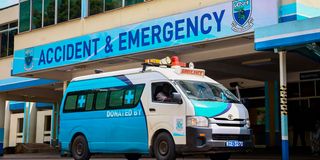
An ambulance, parked at Kenyatta National Hospital, Accident and Emergency wing, on June 21, 2025.

Brian Muendo died after finding himself in the wrong place at the wrong time. A brawl between bar patrons and bouncers left him badly injured. Pleas for help and calls for an ambulance went unanswered in time. When assistance eventually came, it was too little, too late. His body now lies at the Kenyatta National Hospital mortuary.
His is just one case among many. Worrying statistics show that people routinely die because emergency care arrives late, or does not arrive at all.
Medical emergencies are, by nature, sudden. They come without warning and, for most people, without preparation. What could have been managed almost always ends up in loss of life. And when illness or injury strikes, the crisis rarely stays medical for long. It quickly turns financial. Then comes the emotional and psychological toll. Together, these layers add up to the true cost of a medical emergency in Kenya. Here’s how:
What happens when a medical emergency is reported?
Once an emergency call comes in at a command centre, the operator asks for the most critical information: the location, the nature of the emergency, and the condition of the patient.
It is after these details are established that Kevin Nyangena Asiago, a paramedic and fleet operations manager at Quick Save Ambulances, says: "We activate our units, whereby we usually consider sending the nearest ambulance close to the patient."
The dispatched team then keeps the command centre updated on every development based on their assessment. This, he explains, helps in deciding whether to send more paramedics or additional ambulances to the scene.
How much does an ambulance cost?
The average cost of a private ambulance within Nairobi, or between counties, ranges from Sh3,500 to Sh4,500, depending on the distance, level of care, and type of emergency.
"We charge so we can at least get something to pay some of our nurses and paramedics," Nyangena notes.
Response time, he adds, depends on the distance between the emergency and the nearest available ambulance.
Air ambulance costs are significantly higher. According to Amref Flying Doctors, they depend on how far the patient is being transported, the level of medical care required, and the type of aircraft used. Within Kenya, costs can range from about Sh300,000 for a flight from Naivasha to Nairobi, to about Sh1.5 million for a flight from Mandera to Nairobi.
"It is important to understand that this is not just a flight. It is a fully equipped flying intensive care unit, staffed by highly trained pilots and critical care medics, designed to safely transport patients in life-threatening conditions across long distances. The cost covers the specialised medical crew, fuel, flight logistics, and the equipment needed to safely manage a patient in transit," Amref Flying Doctors said.
Are patients required to pay before receiving help?
The reality is mixed. Most private ambulance providers say the priority is saving life, and payment can be arranged before or after the service. In accident cases, Quick Save does not charge at all.
"We usually take the casualty or the victim to the nearest hospital. We don't even charge," Nyangena said. "If they have relatives and feel they need to pay something, they pay. If they don't, we just assist."
At hospitals, however, the situation is often different. Many facilities ask for a financial deposit before attending to emergency patients, with amounts varying by the type of emergency. The law, however, requires both public and private hospitals to provide immediate emergency care and stabilise the patient first, regardless of ability to pay.
In truly critical cases, medics prioritise stabilising the patient before referring them to more advanced facilities, explains Dr Vincent Oyatoh, CEO of Sheba Medical Centre in Nairobi's Imara Daima.
When patients arrive without insurance or the ability to pay, private institutions typically provide first aid and then refer them to a public hospital. When insurance limits are exhausted during emergency care, patients are usually asked to pay in cash.
What does emergency hospital care cost?
Costs vary widely depending on the facility, the severity of the condition, and the level of care required. Some emergency care providers are now introducing pre-paid models to ease access.
Why do costs vary so widely?
Sometimes costs go beyond the average because of additional expenses, particularly in critical conditions or ICU care, explains Mr Nyangena.
"The costs arise from consumables and mechanical ventilators, which are quite expensive and push the total bill up significantly," he adds.
Does insurance or SHA actually help?
Medical insurance plays a role, but with clear limits. It mostly covers emergency medical and surgical cases, according to Dr Oyatoh.
Most air evacuations are covered through insurance, particularly for international travellers and corporate clients, according to Amref Flying Doctors. A smaller number of patients, mainly those without cover, pay out of pocket, which can be financially devastating given the costs involved.
Amref Flying Doctors works with a wide portfolio of local and international insurance companies. The extent of cover depends on the individual or corporate policy held. On SHA, Amref says clients can access its services on demand and should contact their local SHA offices for guidance on air and ground ambulance services.
However, SHA has not yet covered private ambulances. "They have not issued the rates because there was ongoing registration of ambulances, but they have not released them," Nyangena says.
Some hospitals ask patients to purchase drugs, gloves, and other essential supplies externally during emergencies, though this is not universal. "Ours does not ask them to buy," Dr Oyatoh said, noting that the highest his facility has charged for emergency care was Sh25,000.
What happens if you cannot afford to pay?
The response depends on the provider and the circumstances.
For ground ambulances, Quick Save says the priority is always to save life first. Payment is secondary. In accident cases, victims are taken to the nearest hospital at no charge.
For air evacuations, the approach is more structured.
"We offer medical advice free of charge and guide clients who may be unable to pay towards alternative medical facilities closer to them. In many cases, adequate solutions can be found locally. We also refer clients to ground ambulance partners for more affordable options," Amref Flying Doctors said.
In exceptional cases, Amref carries out evacuations free of charge under a limited charity flight budget, transferring patients to Kenyatta National Hospital.
"We always try to find a solution, whether through local government, insurance, partners, or other support. The priority is to enable the evacuation wherever possible, while operating within a structure that allows us to sustain the service," an Amref Flying Doctors representative said.
When a patient urgently needs evacuation but cannot pay immediately, the air ambulance service recommends seeking care at the closest medical facility while engaging local government authorities to support the case.
Who can actually afford emergency care in Kenya?
Access largely depends on insurance coverage, income, and advance planning.
As Africa's leading aero-medical provider, Amref Flying Doctors serves a diverse range of clients, local citizens, business travellers, tourists, corporate clients, NGOs, diplomatic missions, and governments. The organisation says access for ordinary Kenyans has improved significantly over time.
What needs to change?
Healthcare financing is central to the problem, according to the flying doctors. Expanding insurance coverage to include air ambulance services would make a significant difference. Increasing uptake of low-cost membership models would also help ensure long-term sustainability.
There is also a need for greater public awareness of affordable prepaid options, stronger public-private partnerships, and formal recognition of pre-hospital air and ground ambulance services as an essential part of healthcare, not a luxury.
Follow our WhatsApp channel for breaking news updates and more stories like this.