Toxic beauty: Mercury-laced skin lightening products flood Kenyan market

What you need to know:
- Skin-lightening products include, but are not limited to, bleaching creams, whiteners, skin brighteners, and fading creams.
- The products are usually marketed as skin lighteners and anti-aging treatments that remove age spots, freckles, blemishes, and wrinkles.
The Kenyan market is being flooded with skin-lightening products containing dangerously high levels of toxic mercury, some selling for as little as Sh599, a new report by the Zero Mercury Working Group (ZMWG) has exposed.
Skin-lightening products include, but are not limited to, bleaching creams, whiteners, skin brighteners, and fading creams. The products are usually marketed as skin lighteners and anti-aging treatments that remove age spots, freckles, blemishes, and wrinkles.
Mercury is added to skin lightening products (SLPs) to suppress melanin production, giving a lighter complexion and fading blemishes. However, long-term exposure can cause severe health effects, from rashes and skin blotching to kidney failure, immune system suppression, and neurological damage.
While working on the report, titled Zero Out Toxic Production, five member organisations of the ZMWG purchased skin lightening products from local retail shops and from the official manufacturers’ websites in Pakistan, and from online platforms distributing these products worldwide: Daraz for Pakistan; Jiji, Jumia and Kilimall for Kenya; Shopee and Lazada for the Philippines; and two online platforms in the US - Aleena Cosmetics and Axabee Skincare.
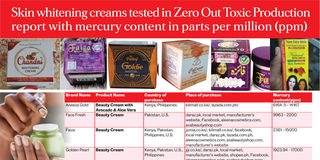
The Kenyan market is being flooded with skin-lightening products containing dangerously high levels of toxic mercury, some selling for as little as Sh599.
Those purchased in the Philippines and Kenya were analysed by the Quality Assurance and Control Systems (QACS) laboratory in Athens, Greece. Results showed that the products contained mercury levels as high as 14,000 parts per million (ppm). One ppm is generally recognised the legal limit for mercury as an unavoidable trace impurity in skin care products under the Minamata Convention on Mercury, which applies to 153 countries globally.
Some of these products included Aneeza Gold Beauty Cream with Avocado & Aloe Vera cream, Faiza Beauty Cream, Golden Pearl Beauty Cream, Goree Beauty Cream with Lycopene and Parley Goldie Advanced Beauty Cream- Pearl &Shine. In Kenya, Aneeza Gold had the highest mercury concentration (14,167 ppm), followed by Golden Pearl (10,409) and Faiza (9,609 ppm).
The report shows that most of the products, based on packaging labels, appear to have originated from Pakistan. The report notes that the “products were purchased locally from retail shops supplied by Pakistani manufacturers and from large online platforms offering skin whitening creams globally and locally.”
Mercury levels in skin whitening creams (SWCs) showed significant inconsistency, fluctuating based on the specific brand, the country where the product was bought, and even between different samples of the same cream.
Identical product
However, the reasons for this variability, specifically, why the identical product would contain different amounts of mercury when tested in different laboratories or when purchased in different countries remain unclear. To manage this internal variation for comparison, an average mercury concentration was calculated for products where multiple samples of the same item were acquired from different sellers within the same country.
“The targeted creams were found to be generally available online. In particular, the ‘Faiza’ and ‘Golden Pearl Beauty Cream’ SWCs were offered for sale in all four countries included in this study,” the report says in part.
“The creams purchased in the US generally showed higher mercury levels, while those sold in Pakistan tended to have lower concentrations. Average mercury concentration in the US was more than 13,300 ppm, closely followed by the Philippines, while the SWCs sold in Pakistan contained on average about 2,800 ppm of mercury. Among the brands, Aneeza Gold and Goree consistently showed the highest mercury concentrations across multiple countries,” the report notes.
The analysis uncovered critical flaws related to mercury content and batch numbering. Most strikingly, mercury levels varied wildly, even within the same product line. For instance, Parley Goldie SWCs showed concentrations spanning from negligible (0.03 ppm) to dangerously high (13,999 ppm) across different batches. Furthermore, a specific cream brand and batch number known to contain high mercury was found distributed internationally, confirming the widespread circulation of potentially harmful products. These findings highlight a severe lack of quality control in manufacturing and point to the global danger posed by these products.
Beyond the mercury variation, investigators observed alarming inconsistencies in product identification. Several SWCs distributed across multiple countries carried the same batch number, suggesting poor oversight of the supply chain.
This issue was exemplified by the Faiza brand (batch 24FX23), which was found on five different creams sold in Kenya, the Philippines, and Pakistan, and by Goree (batch GB145), observed on three creams purchased in the US, Kenya, and Pakistan. This repetition of batch numbers across different creams and international locations indicates a fundamental breakdown in traceability and batch management, raising serious questions about the authenticity and regulation of these cosmetics.
“However, creams with identical batch numbers showed differences in mercury content. For example, the Goree Beauty Cream of this specific batch had a mercury concentration of approximately 2,000 ppm in samples purchased in Pakistan, whereas the same batch sold in the United States contained 24,000 ppm,” states the report
The report adds: “While these discrepancies may pose questions on the different conditions and methodologies used, they certainly show and confirm the high level of mercury pointing to the fact it has been intentionally added. While there may be a discrepancy, the creams with the same batch numbers did have mercury above the regulated levels.
Furthermore, it can be seen that creams with the same batch number are widely available. These observations are reflected in the figure to the left.”
The report comes on the heels of another one by the same Group, which revealed that Amazon continues to sell skin-lightening products with dangerously high levels of mercury to countries in the Global South, including Kenya, even though these same products are banned in the US and Europe.
The report, titled “The global online toxic trade in illegal mercury-added skin lighteners continues unabated outside the USA,” reveals that despite the Minamata
Convention’s ban on the manufacture and trade of mercury-added cosmetics, these products continue to flood local markets and online platforms. Unscrupulous manufacturers and retailers, including major e-commerce platforms like Amazon, profit from these toxic products without disclosing their dangers.
The Zero Mercury Working Group report criticises Amazon for employing ‘double standards’ in its product safety enforcement. The report notes that Amazon.com in the US is largely complying with the 1 part per million (1 ppm) mercury content threshold, thanks to a recent legal settlement in California, which compelled Amazon to adopt a sales-prevention protocol to block listings of toxic products on the US site.
Crucially, it mandates that Third Party Sellers on Amazon.com must first test their skin-lightening products for mercury and other hazardous substances in approved laboratories. US sellers must also meet other requirements, including label verification and facility registration. However, the ZMWG points out that these protective measures and seller requirements have not been extended to the global consumers.
Therefore, by failing to implement similar controls worldwide, Amazon and other online platforms have essentially facilitated a ‘black market’ where SLPs deliberately containing mercury and other hazardous ingredients are sold internationally to consumers without any safety warnings or hazard listings.
Early 2025, the group tested 31 skin lightening products known to contain mercury from prior testing by governments and civil societies, and found that 25 of them contained mercury at significantly elevated levels, with an average mercury concentration of close to 14,000 ppm. The highest recorded mercury level was more than 27,000 ppm in the Chandni Whitening Cream purchased on Amazon India. Six of the SLPs were found to contain mercury levels below 1 ppm.
“In terms of prevention, it is important to note that third party sellers may use different names (or no name) and altered packaging in an attempt to avoid an online platform’s automatic screening tools, while also misleading the user,” reads the report.
“Toxic SLP sales that are prohibited in stores should also be banned online. Platforms attract customers to their sites, profit from each sale, dictate the terms of the transactions, control the website, influence the prices, and often distribute the products. Therefore, platforms worldwide should accept their corporate responsibility for ensuring that products fully comply with health and safety laws,” adds the report.
In a statement in 2020, Amazon stated that it “runs, manages and operates the marketplace, wherein it provides an online marketplace and software enabling third party sellers on the marketplace to display, list and offer their products for sale to end customers.”
They also stated that “the products offered for sale on the marketplace are always owned and sold by the seller at any point of time,” and that “each seller owns the products and independently offers them for sale on the marketplace in their own right, and that the sellers are themselves responsible for ensuring all compliances under applicable laws.”
Griffins Ochieng, director CEJAD, notes that E-commerce sites function as mere procurement platforms for various third-party suppliers, creating a legal loophole that allows the illegal trade to flourish. As a result, developing countries have ended up being a dumping ground for the developed world's banned or low-quality products.
He also warns that exposure to these hazardous consumer products is causing a massive increase in non-communicable diseases (NCDs), especially cancer, which is driving up healthcare budgets.
“State agencies must focus not just on immediate threats like cholera, but on establishing strict controls, like working with organisations such as the Kenya Bureau of Standards to implement global standards, perform market surveillance, and enforce product recalls, similar to pharmaceutical recalls by the Pharmacy and Poison Board,” he explains.
Dr Wahome Joseph, consultant toxicologist at Meru Teaching and Referral Hospital, detailed the severe and systemic damage that mercury poisoning particularly from long-term, low-level exposure inflicts on the human body, affecting everything from the skin to the brain and kidneys. He explained that mercury is recognised as a potent neurotoxin, and although it has limited historical uses in human medicine, such as in dental amalgams, it is not safe for direct human use or consumption.
“Mercury's toxicity is far-reaching, with observable effects on multiple major organ systems. When applied directly to the skin, mercury can cause irreversible cosmetic and inflammatory damage: Instead of the desired lightening, the skin ends up with a grayish discolouration, sometimes misinterpreted as brighter. Users may experience dermatitis, presenting as skin rashes and irritation. Heavy and prolonged application can be corrosive, leading to ulcerations and blistering of the skin,” said Dr Wahome.
“Perhaps the most alarming effects are those on the central nervous system, which often manifest with chronic, long-term exposure. It ends up presenting itself with central nervous disturbances or neurological disturbances. Patients have presented with severe behavioural changes, including insomnia, depression, and even aspects of psychosis, where a person becomes highly irritable,” added Dr Wahome.
“The toxin disrupts neurotransmission, leading to mild tremors and muscle weakness. Prolonged exposure has been linked to memory loss and a deterioration of mental functions or mental capability. Besides, damage to the sensory parts of the nervous system can cause hearing loss, numbness, and affected vision.”
Dr Wahome explained that once absorbed into the body, the kidney works aggressively to clear the toxin, making it the primary target for damage.
"The main organ trying to clean it up is the kidney. So again, concentration in the kidneys can lead to massive damage, and even kidney failure can present itself," Dr Wahome warned.
Symptoms of mercury-induced kidney damage include proteinuria (protein in the urine) and swelling of the lower limbs. The toxin can also trigger an immune-mediated reaction within the kidneys, compounding the damage.
The risk extends to the next generation as mercury is easily absorbed through the skin and transferred. "If it is used by pregnant women, it can expose the infants and they can be affected development-wise," he cautioned. Exposure in utero can disrupt a child’s developmental stages, and even infants who are born can present with skin discolouration if exposed postnatal.
Nation reached out to the Kenya Bureau of Standards (Kebs0 to understand the protocols they have set in place to intercept the products at entry points, technology used to inspect cosmetics shipments and ways they use to confirm authenticity of products despite labels claiming so.
Esther Ngari, Kebs managing director, explained that mercury and mercury compounds are prohibited in cosmetic products in Kenya under the applicable Kenya Standards, in alignment with the country’s commitments to the Minamata Convention on Mercury.
“To prevent non-compliant skin-lightening products from entering the Kenyan market, cosmetics are classified as high-risk goods and are therefore subject to mandatory Pre-
Export Verification of Conformity. This means products are inspected and tested in the country of origin by Kebs-appointed partners before shipment. Only products that meet the requirements are issued with a Certificate of Conformity. Products found to contain banned substances are seized and enforcement action is taken in accordance with the law,” she stated.
“At the ports of entry, consignments undergo a risk-based inspection process that includes documentary review, visual checks and sampling in accordance with the relevant Kenya Standards and approved sampling plans. Samples are analysed in Kebs laboratories using advanced analytical techniques, including elemental spectroscopy, to detect prohibited substances such as mercury. Our laboratories are equipped with state-of-the-art instruments and are accredited to the ISO/IEC 17025 standard, ensuring the highest level of testing competence. This combination of standard-driven scientific sampling, laboratory verification and regulatory oversight ensures that cosmetic products entering the Kenyan market comply with safety requirements established to protect consumers,” added the MD.
She explained that within the market, Kebs conducts continuous surveillance by purchasing products from retail outlets and online channels for testing.
“Intelligence from previous alerts, complaints and international regulatory networks guides the prioritisation of products that pose higher risks to consumers. These scientific and intelligence-led measures ensure that non-compliant cosmetics are identified even where labels are misleading, thereby safeguarding consumer health,” said Ngari.
“When cosmetic products are found to be non-compliant, whether due to banned ingredients, mislabelling, safety concerns or failure to meet quality specifications, they are detained and enforcement action is taken in line with the law. Enforcement actions include seizure, product withdrawal from the market, and referral of cases to the relevant authorities where criminal offences may be involved. Kebs conducts these activities throughout the year as part of ongoing market and border surveillance.”
Ngari added that Kebs does not publicly share sensitive operational details on specific consignments for security and legal reasons. “However, information of public interest, including safety alerts on identified noncompliant cosmetics, is routinely published to protect consumers and support lawful trade. We remain steadfast in protecting Kenyan consumers and will continue to work closely with customs, security agencies and other regulators to ensure that harmful products do not enter or remain on the market.”
At the sixth meeting of the governments (COP-6) for the Minamata Convention in Geneva, Switzerland, delegates are focusing on two main issues concerning the global treaty that bans mercury in cosmetics. Participants are debating whether a gap in the treaty's wording has created a loophole that undermines the convention's goals for public health.
Delegates are also considering whether online platforms should be held legally responsible for selling cosmetics that illegally contain mercury. The purpose of COP-6 is for countries to negotiate and update the global rules aimed at eliminating the use, trade, and pollution of mercury.
[email protected]