Truck drivers, sex workers lead Mpox spread despite declining infections
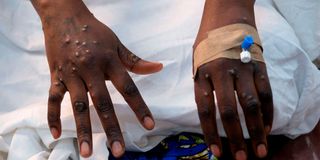
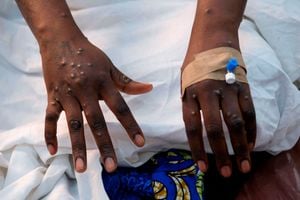
The hands of a patient with skin rashes caused by the Mpox virus. One year on, WHO reports that Mpox infections have declined sharply but high-risk groups are still spreading it.

What you need to know:
- Truck drivers and sex workers remain the primary drivers of cross-border Mpox transmission between Kenya and Uganda.
- WHO officials revealed that these high-risk groups are reluctant to reveal their contacts, hampering contact tracing efforts.
High-level discussions between Kenyan and Ugandan health officials have revealed that truck drivers and sex workers remain the primary drivers of cross-border Mpox transmission, despite a significant decline in overall infection rates across Africa.
The findings emerged during a World Health Organisation Africa Region (WHOAFRO) coordinated meeting on Thursday, marking the first anniversary of Mpox being declared a public health emergency of international concern.
Dr Michel Muteba, clinical epidemiologist at WHOAFRO, told Nation that whilst coordination between Kenya and Uganda — including shared data on sex workers and truck drivers — has helped mitigate transmission risks, critical gaps remain in contact tracing efforts.
"Mpox vaccines in Uganda have helped, but we still have gaps regarding mobility and specifically contact tracing of suspected cases," Dr Muteba explained. "Truck drivers and sex workers are reluctant to reveal their contacts, making contact tracing challenging. Sex workers are key drivers of cross-border transmissions."
He cautioned, however, that this does not mean all women testing positive for Mpox contracted it through sexual contact.
Test kit accuracy
Meanwhile, concerns over testing kit reliability have been dismissed by WHO experts following continent-wide evaluations. Dr Hieronyma Gumede-Moeletsi, regional advisor for laboratory and genomic surveillance at WHO's Regional Office for Africa, assured that the 22 African countries still battling Mpox — including Kenya — need not worry about test kit accuracy.
"There is nothing wrong with the testing kits currently being used," Dr Gumede-Moeletsi stated. "We conducted comprehensive evaluations when several countries raised concerns about false negative results."
She noted that the kits have successfully detected other rash-related diseases beyond Mpox, emphasising the need for improved training in their usage and stronger laboratory systems preparation for future outbreaks.
Dr Patrick Otim, Programme Area Manager at WHO's Regional Office for Africa, warned that the continent is not yet out of danger, citing concerns that government officials have relaxed efforts to break transmission chains.
"We are almost at the end, which means we need to double our efforts," Dr Otim said, expressing gratitude to member states, partners, and donors whose collaboration has strengthened surveillance, community engagement, laboratory testing, vaccination rollout, and case management across the African region.
The statistics paint a sobering picture of the outbreak's impact. Over the past 12 months, 28 countries have been affected, with more than 174,000 suspected cases, nearly 50,000 confirmed cases, and 243 lives lost.
However, there are encouraging signs. Weekly confirmed cases have declined by 34.5% over the past six weeks compared to the preceding period, though WHO is working with governments to ensure this reduction reflects genuine control measures rather than under-reporting or reduced testing.
Currently, 22 countries face active Mpox outbreaks. Côte d'Ivoire has successfully controlled its outbreak after 42 days without new cases, whilst Angola, Gabon, Mauritius, and Zimbabwe have gone more than 90 days without confirmed cases. The transmission pattern varies across regions, with clades 1b and 2b being the most dominant strains.
WHO's response has been comprehensive. Since August 2024, the organisation has developed Global Strategic Preparedness and Response Plans and established the Mpox Access and Allocation Mechanism to streamline access to vaccines, diagnostics, and therapeutics.
In collaboration with Africa CDC, WHO has developed continental Mpox preparedness and response plans and co-led implementation through the Continental Incident Management Support Team.
Laboratory supplies
The vaccination effort has gained momentum, with 13 of the 22 countries with active transmission now having vaccine deployment plans, and eight actively vaccinating high-risk groups and contacts. Over three million doses — nearly half the target — have been delivered, with more than 951,000 doses administered and approximately 900,000 people receiving at least one vaccination.
WHO has deployed 112 international experts to affected countries, trained more than 4,000 health workers, and delivered US$4.5 million worth of essential medical, logistical, personal protective equipment, and laboratory supplies to 30 affected countries. Additionally, US$76 million in funding has been mobilised to support response operations.
Testing coverage has improved dramatically in some regions, with the Democratic Republic of Congo seeing coverage increase from under 20 per cent to 65 per cent, enabling faster detection and case confirmation.
Despite these achievements, significant challenges persist. Dr Otim highlighted limited vaccine access, competing emergencies, funding gaps, inadequate healthcare access, and stigma that prevents people from seeking care. Ongoing conflict in Eastern DRC continues to disrupt response efforts.
"We need urgent action to secure more vaccines, scale up operational funding, and strengthen cross-border coordination to reduce spread risks into new areas and continents," Dr Otim emphasised.
WHO's priorities for the next six months include expanding community-based surveillance in high-risk areas, continuing to procure and distribute essential supplies to hotspots, supporting integration of Mpox response into other health programmes for sustainability, supporting targeted vaccination, and advocating for increased vaccine deployment funding.
Dr Otim stressed that fighting stigma is as crucial as combating the virus itself. "Communities must feel safe and supported to seek care. We call on everyone to challenge false claims about Mpox and share facts instead."
With continued collaboration and solidarity, WHO remains committed to working with governments, partners, and communities to ensure equitable access to vaccines and treatment whilst protecting those most at risk.