Typhoid vaccine: A game changer for Kenya's children
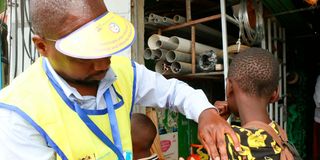
A community health promoter administers Typhoid Conjugate vaccines to a young boy in Maili Sita, Nakuru County on July 5, 2025.
What you need to know:
- Typhoid conjugate vaccine was recommended by the World Health Organization in 2017 following robust clinical trials in Asia and Africa.
Kenya has taken a bold and commendable step in public health interventions by launching the typhoid conjugate vaccine (TCV) into its national immunisation schedule. This isn’t just another addition to Kenya’s vaccine basket—it is a transformative moment in the fight against typhoid fever, a disease that continues to negatively impact thousands of children, especially in urban informal settlements and rural areas.
As a scientist and public health practitioner who has worked on typhoid control for a long time, I cannot overstate the significance of this milestone. The launch of this vaccine—alongside the measles-rubella (MR) vaccine—signals Kenya’s readiness to take on drug-resistant typhoid with the most effective tool available. It’s a move grounded in evidence, shaped by global experience, and guided by the health needs of Kenyan communities.
Also read: Saying goodbye to typhoid the vaccine way
TCV was recommended by the World Health Organization (WHO) in 2017 following robust clinical trials in Asia and Africa. In a landmark study in Nepal, TCV demonstrated 82 per cent efficacy in preventing typhoid. A similar trial in Malawi showed 84 per cent protection among children. In Pakistan, the vaccine became a key weapon in controlling an outbreak of extensively drug-resistant typhoid, where it was found to be 95 per cent effective against drug-resistant strains.
These numbers are not just percentages; they represent lives saved, hospitalisations avoided, and school days recovered. TCV is safe, delivers long-lasting protection with a single dose, and can be given to children as young as six months—fitting neatly into the existing routine immunisation schedule.
Kenya has not been spared the heavy burden of typhoid fever. Every year, thousands of cases are reported—many in areas where clean water and proper sanitation remain out of reach. Alarmingly, typhoid strains in parts of the country are increasingly resistant to commonly used antibiotics, making treatment more complicated, expensive, and, in some cases, ineffective.
Also read: Hopes and fears in new vaccination campaign
At the same time, measles and rubella remain a threat. From January 2024 to February 2025 alone, Kenya recorded nearly 3,000 cases of measles and 18 deaths, despite the vaccine being freely available. These are preventable tragedies. The national campaign now underway aims to reach more than 20 million children with TCV and an additional 7.5 million with MR. Some children may receive both vaccines.
Vaccines do more than prevent disease. They reduce pressure on the already overstretched health systems, including healthcare workers; prevent families from plunging into poverty due to medical costs; and allow children to grow, learn, and thrive. In the case of TCV, it also helps reduce the need for antibiotics and thus helps to prevent further evolutions of drug resistance. Studies show that every dollar spent on immunisation yields multiple times its value in social and economic benefits.
Kenya’s leadership in adopting TCV reflects a deeper commitment to Universal Health Coverage and preventive care. I commend the Ministry of Health for prioritising this life-saving vaccine and allocating funding in the 2025/26 national budget to ensure the vaccine is available, accessible, and sustainable.
We must continue to focus on maintaining public trust. Misinformation and disinformation about vaccines can undermine even the most well-planned campaigns and health programmes. As PATH, we have seen this in many countries and have worked hard to counteract it by equipping health workers with accurate information and supporting local champions, including community, tribal, and religious leaders, who can engage families and communities in meaningful conversations.
In Liberia, for example, we worked through the disruptions of Covid-19 and intensive vaccine rhetoric to roll out TCV effectively. In Malawi, clear and consistent information sharing in the aftermath of Cyclone Freddy ensured that caregivers brought their children to receive TCV. In Burkina Faso, we worked closely with transitional leaders and district governors to dispel rumors. In every country, the same truth applies: when communities are informed and involved, they respond positively.
To parents and caregivers across Kenya, this vaccine is for your child. It is safe, effective, and free of charge. Please take your children to the nearest health facility or outreach post for vaccination. Do not wait for the illness to strike when you have the power to prevent it.
To health workers, you are the backbone of this campaign. Your role in educating and encouraging families is vital. Let us keep pushing forward.
To the government, continue to invest in routine immunisation systems, community awareness, and the integration of TCV into the national schedule beyond the campaign.
Let us not lose this momentum because when we vaccinate today, we protect tomorrow.
Dr Mugisha is the global director, Vaccine Implementation, PATH


