US raises Kenya travel advisory over Ebola as Nairobi assures visitors
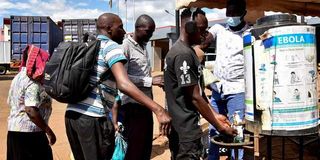
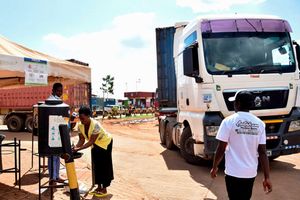
Travellers sanitize their hands before entering at the Kenya immigration services to access port health services at the Busia One Stop Border Post October 8, 2026.

This week, the world heard two important messages about Kenya and Ebola. One, from Washington, tells Americans to think hard before coming. The other, from Nairobi, says they are welcome, and travel is not barred.
The first message came on October 19. The US State Department renewed its Kenya Travel Advisory and raised it from Level 2 to Level 3: "Reconsider travel". The embassy's summary says the level was changed "due to health risks". The advisory states that the US Centres for Disease Control and Prevention (CDC) "has issued a Travel Health Notice for Ebola Bundibugyo Virus Disease for Kenya".
The advisory is based on a travel health notice from the CDC. It tells Americans that Kenya has confirmed cases of Ebola disease caused by the Bundibugyo virus. The notice says local health authorities are investigating to identify contacts and assess the risk of further transmission. The CDC recommends usual precautions for travel to Kenya, including avoiding contact with people who have symptoms of the disease.
The CDC notice also cautions American citizens to act if they develop fever, headache, muscle pain, weakness, diarrhoea, vomiting, stomach pain, or unexplained bleeding or bruising, which is a late stage of the illness. They should isolate immediately, cancel travel and contact the local health authorities or a healthcare facility for advice.
The advisory, issued by the US Embassy in Kenya, tells citizens that "medical services in Kenya are limited" and "they are often unavailable in rural areas".
"Medical facilities in Kenya often lack sufficient medicine and equipment. Except for a few private medical facilities based in the large urban centres with enhanced capability, many health issues may require medical evacuation at your own expense. Medical facilities will usually deny service if payment is not made upfront," reads part of the advisory.

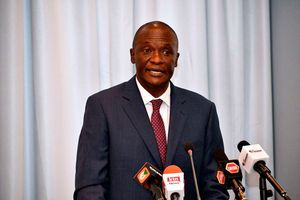
Dr Korir Sing'oei, the Principal Secretary, State Department for Foreign Affairs.
However, on Wednesday, Kenya's Foreign Affairs Principal Secretary (PS) Korir Sing'oei said the advisory is precautionary and prohibits nothing.
"The United States is duty-bound to advise its citizens with respect to decisions that it deems important. The issue around Ebola is a sensitive matter, and it is important for them to advise its citizens. Kenya has been put on category three, which is more of a caution, and there are no implications with respect to barring travellers coming to Kenya associated with that advisory," said Sing'oei.
He added: "We have been working very closely with the United States over the last almost six months, when there was an attempt by the Kenyan government to set up infrastructure to isolate and contain potential Ebola-infected persons. The whole idea of the Kenyan government was: 'Let's build this capability before this issue hits home.' Nobody at that point was anticipating that the first case would be brought into the country by a Kenyan national. And as a result of that, we now have nine cases, all of them under quarantine, creating a lot of anxiety and a lot of concern."
The PS emphasised that Kenya should prioritise robust disease surveillance at its borders over full closures. He cautioned that strict border restrictions could severely damage the economy. He noted that authorities must carefully weigh public health against the risk of disrupting trade, travel, education and essential social services.
"Unless we can strengthen our surveillance systems across borders and rely on them, we are all vulnerable. The patient who died, who brought Ebola here, passed through surveillance systems in several countries. The need for global cooperation to address this challenge has never been greater. The main issue is to ensure that we have a response that is proportionate to the risk," said the PS.
"Given the way this disease is transmitted, transmission requires a very high level of contact, and the people who are truly exposed are those in very close contact with an infected individual. States therefore have to weigh the cost of certain measures against the economic consequences for travel, trade, tourism, education and social services. It is a very tight balance. That is why the call is to work hard on prevention, surveillance and information sharing, and to stay vigilant, because the most vulnerable border entries are the ones we have the capacity to surveil," he added.
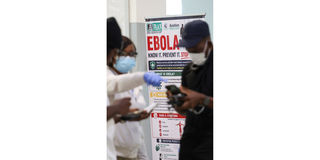
A port health official checks travellers' information at a health screening station at Murtala Muhammed International Airport following reports of an Ebola case in Nigeria, in Lagos, Nigeria, October 22, 2026.
Regionally, Nigeria has confirmed its first Ebola case in 12 years, since the 2014 West African epidemic. The case involves a female foreign national who travelled into Nigeria through Uganda. She began showing symptoms on October 7, 2026. She first sought care for suspected malaria at a private health facility in Abuja on October 11. Later testing confirmed infection with the Bundibugyo strain of the Ebola virus.
In response, federal health authorities have begun rigorous contact tracing. They have placed 44 people under active surveillance, including her husband and the health workers who gave her initial treatment. Officials say Nigeria's experience puts it in a good position to manage containment effectively.
Following this development, Ghana's Ministry of Health issued a press release on enhanced surveillance and national preparedness. It responds to the ongoing Ebola outbreak in the Democratic Republic of the Congo and to newly reported cases in Kenya and Nigeria. Ghana has not recorded any Ebola cases. However, health authorities warned that direct flights and high passenger traffic from Kenya and Nigeria increase the risk of the virus entering the country
To protect public health, the ministry, the Ghana Health Service, and key aviation partners have put several measures in place. These include strengthening airport screening, holding simulation exercises at Accra International Airport and the Ghana Infectious Disease Centre, updating laboratory standard operating procedures, and training health workers to ensure prompt detection and isolation. Travellers arriving from high-risk areas are also being monitored for 21 days, in line with public health guidelines.
The release also described Ebola virus disease. It says the incubation period is two to 21 days. Symptoms include high fever, severe headache, fatigue, sore throat, confusion and unexplained bleeding. It clarified that the virus spreads through direct contact with infected body fluids or contaminated materials and is not airborne. Signed by Health Minister Kwabena Mintah Akandoh, the statement urged the public to remain calm, follow official health updates, avoid sharing unverified information, and practise good hand hygiene.
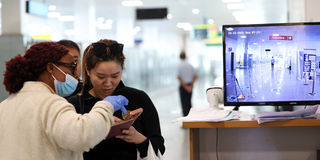
A port health official checks travellers' information at a health screening station at Murtala Muhammed International Airport following reports of an Ebola case in Nigeria, in Lagos, Nigeria, October 22, 2026.
Meanwhile, Dr Jean Kaseya, Director General of Africa Centres for Disease Control and Prevention (Africa CDC), has announced a high-level virtual meeting of African ministers of health on Wednesday, October 28, 2026. The ongoing Ebola outbreak poses an escalating threat to health security across the continent. The meeting will allow ministers to assess the situation, strengthen coordination across borders, speed up support to affected countries and reinforce preparedness throughout Africa.
He noted that frontline health workers, partner organisations and member states have worked tirelessly to curb transmission since Africa CDC declared the outbreak a public health emergency of continental security on May 18, 2026. However, managing the changing situation now requires stronger continental unity, heightened response efforts and renewed political commitment.
"Ebola is crossing borders. Our response must move faster, with stronger coordination, greater solidarity and decisive political leadership. We have the expertise and the capacity on this continent. We must mobilise them together to stop this outbreak and save lives," said Dr Kaseya.
Follow our WhatsApp channel for breaking news updates and more stories like this