What could be the real cost of an Ebola outbreak? Kenya checks economic risks in plan to fight virus
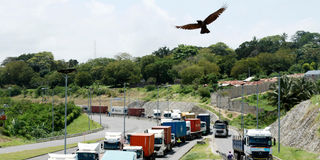
Long queues at the Kenya Ports Authority Miritini gates in Mombasa, in this photo taken on October 7, 2026. Members of the Kenya Heavy Commercial Vehicle Operators Society opposed Ebola screening at border checkpoints, saying it would lead to congestion.

Kenya has begun assessing the economic cost of the Ebola Bundibugyo outbreak as international partners commit millions of dollars to contain the disease, and projections from neighbouring Uganda warn of potentially billions of dollars in losses if the crisis disrupts tourism and trade.
The assessment will examine the cost of treating patients, deploying health workers and containing infections as well as the wider economic impact of travel restrictions, cancelled conferences, disrupted trade and declining tourism.
Infectious disease modelling expert at Daystar University, Professor Shem Otoi said he had been invited to join Kenya’s National Ebola Task Force to lead the economic costing exercise. The modelling is yet to begin, but the team expects to complete it within two weeks after collecting data from hospitals, airlines, the Ministry of Health, quarantine facilities and other sources.
The analysis will start at the level of one patient and build up. It will cover the whole journey from diagnosis to discharge or death, including testing, isolation, medicine, and protective equipment for health workers. The second layer is lost productivity, where we look at the time a patient spent in the hospital. If they were supposed to be working in the economy, that is time lost," he said.
“If we combine all these costs, we multiply the number of patients projected in a forecast by the estimated cost, projected into the future,” he said.
But the economic impact could extend well beyond the health sector, affecting tourism, hospitality, transport, conferences, and international trade if the outbreak triggers travel restrictions or discourages visitors.
He cited Uganda as an example of how outbreak responses can have consequences beyond the period of active transmission.
Although the World Health Organisation declared Uganda Ebola-free in August, travel restrictions imposed by some countries could continue to affect movement and business.
Canada has introduced temporary border measures running until November 27, 2026, affecting people who have visited or live in Uganda, South Sudan and the Democratic Republic of the Congo (DRC).
Under the measures, most foreign nationals from the three countries are barred from travelling to Canada during the suspension, including some who hold approved visas or electronic travel authorisations. Canadian citizens, permanent residents and people registered under the Indian Act who have been in the affected countries within the previous 21 days may enter, subject to a 21-day quarantine unless exempted.
The Canadian government has also advised its citizens to avoid non-essential travel to Uganda, citing the regional impact of Ebola, as well as terrorism and high crime rates.
Uganda’s experience offers a glimpse of the potential economic risks facing Kenya if the outbreak disrupts international travel and business for an extended period.
A June 2026 research note on the economic impact of Ebola in Uganda, prepared by University of Pretoria professor Heinrich Bohlmann for the CLEAR-Africa consortium, examined the potential effects of travel restrictions, cancelled events and reduced visitor spending.
The note said Uganda had expected more than 1.3 million international visitors in 2026. Tourism contributes about 3.5 per cent of the country’s gross domestic product, with much of the activity concentrated in and around national parks. The sector supports an estimated 800,000 jobs directly and indirectly.
The report warned that even if Kampala remained the main centre for containment, precautionary measures, travel restrictions and travellers’ reluctance to visit could affect the tourism and events industry across the country.
“Business, leisure and tourism-related industries that depend heavily on foreign spending, including gorilla trekking activities, will be significantly impacted,” the note said, identifying transport operators, hotels, accommodation providers and catering businesses among those exposed.
Using the Global Trade Analysis Project (GTAP) economic model, the researchers estimated that a medium-severity shock lasting six months could reduce tourism revenue by 40 to 50 per cent for the remainder of 2026. Under a more severe and prolonged scenario, the decline could reach 90 per cent.
The medium scenario projected losses of about US$500 million, with economic growth slowing from approximately seven per cent to six per cent. Under the severe scenario, losses could exceed US$1 billion.
The report estimated that at least 100,000 tourism-linked jobs could be at risk this year, rising to as many as 450,000 if the outbreak and its effects persisted. It also warned that international travellers’ confidence could take up to 18 months to recover fully.
However, the authors cautioned against interpreting the projections as an argument against containment measures. Instead, they said decisive action was necessary to limit the outbreak’s duration and enable economic activity to return to normal.
They recommended avoiding blanket restrictions where possible and tailoring interventions to protect lives while minimising harm to livelihoods.
Meanwhile, international support for Kenya’s Ebola response is increasing.
On Tuesday, Africa Centres for Disease Control and Prevention (Africa CDC) director-general Jean Kaseya announced that the agency had mobilised about US$1.5 million (approximately Sh194 million) in financial, technical and operational assistance for Kenya.
The support includes deploying 10 African public health experts, providing laboratory reagents and diagnostic test kits, and strengthening surveillance, contact tracing, case management and community engagement.
Africa CDC is also supplying equipment worth about $350,000 (Sh45 million) to strengthen Kenya’s Public Health Emergency Operations Centre, which coordinates responses to public health emergencies.
“Africa’s health security is a shared responsibility. Kenya’s leadership and containment efforts demonstrate the importance of decisive national action, while Africa CDC’s support reflects the power of African solidarity,” Dr Kaseya said.
The United Nations has also allocated more than US$2 million (Sh259 million) through the Kenya Humanitarian Fund, managed by the UN Office for the Coordination of Humanitarian Affairs, to support preparedness and response efforts.
The funding will help humanitarian partners support government-led interventions, including surveillance at border crossing points and training for rapid-response teams and frontline workers.
It will also finance preparedness activities along high-risk refugee and travel routes linked to the Kakuma refugee complex in north western Kenya, emergency healthcare and infection prevention kits, and public awareness campaigns on prevention and early detection.
As of October 20, Kenya had recorded nine confirmed Ebola cases, including two deaths, all linked to the index case confirmed by the Ministry of Health on October 6. A total of 685,027 people had been screened since the outbreak was detected.
Follow our WhatsApp channel for breaking news updates and more stories like this