Why environmentalists are against raising seawalls in Lamu's islands despite flooding
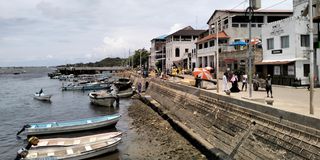
A section of a seawall in Lamu Old Town on April 3,2025. Residents have been pushing for seawalls to be increased in height to curb ocean flooding, but the idea is being opposed by environmentalists.
What you need to know:
- In many cases, collapsed and neglected seawalls have left houses bordering the ocean underwater, while others have been swept away by seawater.
Lamu residents will have to endure recurrent invasion of ocean water into their residential areas after environmentalists cautioned against raising the height of seawalls.
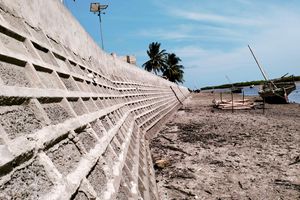
Seawalls are commonly built along the seashores to prevent overflow of water from Indian Ocean to residential areas.
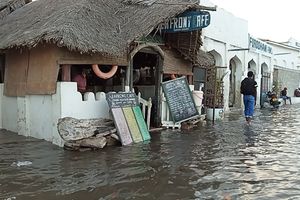
However, during high tides, the more than 60 islands across Lamu archipelago have always had a rough time owing to overflowing ocean water that reaches residential places. In many cases, collapsed and neglected seawalls have left houses bordering the ocean underwater, while others have been swept away by seawater.
Areas like Lamu Island, Mkokoni, Wiyoni, Shella, Matondoni, Kipungani and Mbwajumwali regularly experience seawater inundation during high tides, submerging homes and businesses.
Every time such scenarios are witnessed, locals blame the government for failure to raise seawalls, complaining that existing seawalls are too short and dilapidated.
“Most of the seawalls in our islands are very short in height. That’s why it becomes easy for the Indian Ocean water to overflow every time there’s a high tide. If the seawalls are raised, such frustrations will be minimised,” said Ali Abdalla, a resident of Lamu Island.
Fatma Bakari of Shella described how flooding disrupts tourism and businesses: "It's very inconvenient that most areas in Shella have no seawalls. We need tall seawalls erected to at least enable us to enjoy doing businesses even during the highest tide.”
Damage to property
However, environmentalists have strongly opposed the move to raise seawalls.
Lamu County National Environment Management Authority (Nema) Director Edward Menza warned that raising seawalls is not a safe move since taller seawalls can cause increased beach erosion and subsequent damage to property along the beaches within and without, especially if not properly designed or maintained.
“Instead of curbing flooding, you might end up worsening the situation, damaging properties and negatively impacting the natural coastal environment.
"However, natural barriers are encouraged, with slanting and not vertical walls being the last option,” said Mr Menza.
Omar Ahmed, an environmentalist at Save Lamu Organisation, said the presence of tall seawalls might lead to reflection of waves back towards the coast, which in turn can erode the beach and damage structures even more.
“Apart from wave reflection, seawalls can also alter the natural coastal ecosystem, impacting habitats for plants and animals. And that’s why we are opposed to the idea of constructing or raising the seawall heights,” said Mr Ahmed.
Lamu Marine Forum Director Mohamed Athman encouraged Lamu islanders to
embrace mangrove planting in the region and surrounding areas to mitigate climate change impacts and reduce the risk of coastal flooding.
“Instead of pushing for increased height of seawalls, it’s high time people plant mangroves as a natural remedy. Mangroves can help curb ocean flooding as they act as a natural buffer against storm surges and erosion. They achieve this through several mechanisms, including stabilising soil, trapping sediments, and dissipating wave energy,” said Mr Athman.
But this is not sitting well with residents of Mkokoni Island, who are worried their village might be submerged and houses swept by the ocean if a seawall is not constructed soon. Since the collapse of their seawall in 2017, the community has endured repeated flooding, property damage, and sleepless nights fearing the next high tide.
The situation has left many counting losses every time a high tide is experienced in the area.
The locals blame the previous contractor for building a weak, structurally unsound seawall that couldn’t withstand waves.
Aboud Ali said in recent times, they have been forced to contend with the frequent flow of water from the ocean into their houses and business premises despite their pleas on government to construct a new seawall.
“Sometimes we don’t sleep thinking that our houses might be swept away. You can imagine sleeping while surrounded by the ocean without anything to shield or protect you from it,” said Mr Ali.
He added: “We urge the government to construct a seawall that is strong enough to withstand the frequent knocks of the ocean waves.”
The residents also cited the lack of maintenance as a key reason behind the collapse of many of Lamu islands’ seawalls.
Maryam Fuad said their biggest fear is waking up to find their village swept away by the ocean during high tides. “We are tired of begging. Every high tide, we lose something. If nothing is done, our village could disappear."