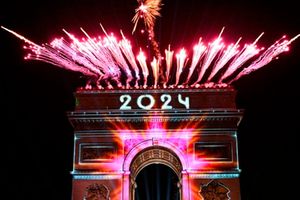
Why fireworks are bad for your health
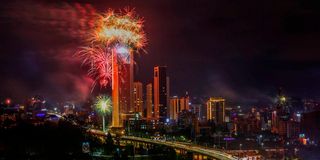
Fireworks illuminate Nairobi's night sky from GTC Towers when Kenyans ushered in the New Year 2024.

What you need to know:
- Studies have shown that fireworks have a major environmental impact.
- Research shows the impact fireworks had during major celebrations across the world.
When the clock struck midnight on Monday, signaling the beginning of a New Year, thousands of excited onlookers around the globe waited to experience a longstanding tradition for the New Year – lighting up fireworks.
Kenyans, especially those in Nairobi and other cities across the country, thronged near landmark buildings known to have pyrotechnics during major events for a full-circle experience of the fireworks displays.
On December 30, however, Permanent Secretary for the State Department of Mining, Ejijah Mwangi, put a caveat on Kenyans intending to display fireworks on New Year’s Eve, to ensure that they get a license beforehand.
This regulation is enshrined in the Explosives Act and anyone who contravenes this law risks a Sh500 fine or a two-month jail term.

Revelers marvel at a fireworks display at Travelers Beach Hotel in Mombasa on January 1, 2024 as Kenyans welcomed the New Year.
“Protection of lives and property calls for strict regulations and control of sale, storage and usage of fireworks as stipulated,” he posted on X (formerly Twitter).
However, there is a bigger picture than the accidents that may arise from the fireworks.
Studies have shown that fireworks have a major environmental impact.
Most of the research available shows the impact fireworks had during Diwali – a Hindu festival of lights, the United States' Independence Day (July 4) and on New Year’s Eve.
The researchers measured levels of different pollutants before and after the fireworks display to find out the concentration of Carbon dioxide, Nitrous Oxide, and particulate matter (PM).
A study published by the journal Lung India shows that other pollutants arising from fireworks display include sulfur dioxide, carbon monoxide and metals salts like aluminum, manganese, and cadmium.
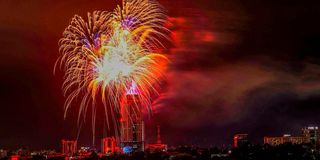
Fireworks illuminate Nairobi's night sky from UAP Towers when Kenyans ushered in the New Year 2024.
“When fireworks are set off, chemicals used in their composition react to ignite and propel the explosives with a resultant noticeable and odorous cloud of PM in the atmosphere. Inhalation of such particles is one of the most important routes of exposure to elevated concentrations of these emissions. PM deposition in the respiratory system mainly depends on the particle size,” explained the Lung India study.
The study also shows that children are at a higher risk of getting respiratory complications when exposed to fireworks, compared to adults.
“Compared with adults, children have poor defences against PM and gaseous air pollutants, have a differential ability to metabolize and detoxify environmental agents, and have an airway epithelium that is more permeable to inhaled air pollutants,” explained the scientists.
A comparative study published in the scientific journal Springer Nature of Applied Sciences shows that carbon dioxide concentration in the air was 2 per cent higher after the fireworks display on July 4.

Fireworks light up Nairobi's night sky over UAP Old Mutual Tower during the New Year’s celebrations on January 1, 2024.
“There was no immediate impact of the fireworks on the CO2 concentration. However, the CO2 concentration began increasing at around 6 pm on July 4, and continued to increase overnight, reaching a peak value of 470 parts per million at 6:45 am on July 5,” explained the study.
A study published by the journal BMC advises manufacturers to reduce toxic metals in both commercial and residential pyrotechnics displays and their potential for producing adverse health effects.
In regards to noise pollution, scientists warn pyrotechnicians (people who light up fireworks) to wear protective gear to prevent any form of hearing loss.
“The shooting noise at the launching site results in a very loud level above 100 dB (decibels). We think it is necessary to give sufficient consideration to the effects caused by the launch sounds of fireworks,” said a Journal of Occupational Health study.