Climate change hits home as rivers and taps dry up
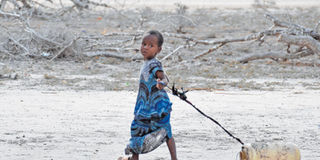
A young girl in Korisa location of Ijara Sub-county in Garissa drags a barrel of water home. Kenya has formulated the Climate Change Bill 2014 — which was signed into law on May 13 last year — the Climate Change Response Strategy, and the Climate Action Plan, all of which are expected to address issues of climate change. But there is more that the government needs to do. It needs, for instance, to formulate functional policies on land use, urbanisation, pastoralism and resource utilisation. PHOTO| FILE| NATION MEDIA GROUP
Due to climate change, there has been an increased frequency of drought while storms have become more severe, he says. When rains come they are ferocious, as it happened in 1997-98, 2002 and 2015.
Notably, from 1990, Kenya has witnessed at least seven major droughts: 1991-1992, 1995-1996, and 1998-2000, according to the International Federation for Red Cross.
Drought was also reported in 2004, 2005, 2010-2011 and the current one being witnessed in various parts of the country.
It is not a year yet since Kenya last experienced the El-Nino weather phenomenon, but where farmers expected a season of plenty soon after the heavy rains, the opposite is true as hundreds of thousands and their livestock suffer food shortages in at least 13 counties.
The United Nations Office for the Coordination of Humanitarian Affairs (Ocha) says the enhanced rainfall due to El-Nino was “favourable to most of Kenya because it replenished pastures, enhanced good harvest and replenished water sources”, but that now seems so long ago.