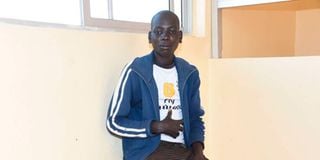
Lomertelei, 25, was recently admitted at the health facility with wasted muscles, anaemia, paleness and drastic loss of weight. He was too frail to move. He says the condition started this year with persistent headaches, general body weakness and recurrent nose bleeding.
This man is suffering from visceral leishmaniasis, commonly known as kala-azar. The disease causes acute anaemia and can be fatal.
But unaware of his condition, Mr Lomertelei would seek help from local health centres, where he was given painkillers during each visit, but with no diagnosis.
“My stomach started to swell and I could not take certain foods because of discomfort on the left side of my abdomen. The pain killers were not helpful,” says Mr Lomertelei.
When the Healthy Nation visits him in hospital, he is being blood-transfused to stabilise his condition, ready for medication –a draining process that takes 17 days.
Meanwhile at Lodwar County Referral Hospital, Angechel Elos, 15, is lucky to be alive. Last year, he had accompanied his father, elder brother and other herdsmen on a 14-day routine journey to Kotido, Northern Uganda to graze. Along the way, the teen was bitten by a sand-fly and immediately taken ill.
"I started experiencing fever, exhaustion and loss of appetite,’’ he narrates.
In the wilderness and with no hospitals nearby, Elos’ family had to rely on traditional methods to treat him. When his condition worsened, with his spleen protruding, they had to call a local doctor to see him.
He was unconscious, severely anaemic and with a swollen stomach when he was wheeled to Lodwar Referral Hospital a few days later. Doctors expressed little hope for his recovery. With his blood count below level four against the normal 12, he needed urgent blood transfusion.
Elos was blood-transfused and put on a nutrition programme. After his condition stabilised, he was discharged. He will now be monitored for the next six months.
At this hospital, there is a stabilisation room dedicated for Kala-azar patients. A majority of them are herdsmen aged between 11 and 16 years. All were admitted in December last year. Their medical reports show they are malnourished.
Epuyo Nakuwa, 13, from Marsabit County, is admitted here. On his abdomen are burn marks, an indication of desperate attempts by his parents to treat him through traditional ways. Besides malnourishment, his report says he had anaemia and pneumonia.
Isaiah Matundura, a specialist at the facility, says men and boys who move for long distances in search of water and pasture for their livestock are at higher risk of contracting the disease, known locally as ‘‘etid’’. The condition is aggravated by high poverty levels in the region. Here, locals live either in dilapidated structures or in the open, which exposes them to sand-fly bites that transmit the disease.
The geographical location of Turkana County, bordering nomadic pastoral communities with limited access to health care services and water, is one of the risk factors here.
“During drought, there are a lot of cross-border movements where locals interact with or settle among people who are infected,’’ observes Jimmy Loree, the county’s coordinator in charge of Kala-azar.
While this region is an anaemia-endemic zone, the majority of locals are too poor to afford treatment. To combat the disease, the county government and its development partners, among them Izumi and Probitas, set up a kala-azar centre in Chemolingot in 2019, where tests and drugs are provided for free.
So far, more than 160 patients have since been treated here, with 98 per cent full recovery rate, according to the medic. The dry months between June and March are the worst here, a time when the facility experiences an upsurge of cases.
“Managing visceral leishmaniasis is an expensive affair. Doctors in West Pokot estimate the cost of treating a first-time patient at Sh250,000 and Sh2 million for a relapse case.
"About 24 doses are required to treat a patient. With each dose selling at about Sh50,000, full t treatment often costs more than Sh1 million,’’ explains Dr Matundura, noting that assistance from partners have helped in management of the condition in the area.
Visceral Leishmaniasis remains a public health problem in about 30 sub-counties in Kenya. Turkana, West Pokot, and Baringo counties are by far the most affected. The disease is caused by protozoan parasites of the genus Leishmania and transmitted by sandflies of the genus Phlebotomus.
Globally, it occurs in 88 countries with 500, 000 cases of visceral leishmaniasis estimated annually, mostly among poor and marginalised communities. More than half a billion people worldwide are at risk of infection. Notably, the bulk of cases (90 percent) are in six countries, namely Brazil, Ethiopia, India, Somalia, South Sudan and Sudan.
In Kenya, leishmaniasis occurs in two forms: visceral leishmaniasis (kala-azar) and cutaneous leishmaniasis (Oriental sore).
Although the disease is curable, it still causes high morbidity and sometimes death due to its low index of suspicion by health care providers, late diagnosis and case management.
In most counties, treatment is limited to county and sub county hospitals through injections. This injectable treatment method, though, can have toxic side-effects.
The County Government of Turkana, for instance, has added four more treatment centres in the past four, according to Loree. Today, most sub counties in the vast county have a treatment centre.
“This has drastically reduced the time taken for one to start treatment. Lives have been saved. This has also boosted the recovery rate from only 70 percent a few years ago to 97 percent,” he reveals.
As part of efforts to fight the disease in the region, Turkana County government has been carrying out periodic awareness campaigns, including at the household level. This is done in collaboration with more than 3000 community health volunteers and kraal elders, and has improved early identification and linkages to treatment.
While admitting that eradicating the disease is an uphill task, the county notes that more interventions such as capacity building for technical and collaboration with development partners is critical.
In Baringo County’s Tirioko area, Kevin Ritan is a survivor. “My brother contracted it first before. I had to drop out of school to seek treatment when I became ill,’’ says Ritan.
At Kacheliba Sub-County hospital, medical Superintendent Dr Solomon Tukei says the facility attends to between 40 and 50 Kala azar patients per month, with 485 cases in the last one year.
In this sub county, there’s a Kala-azar treatment centre constructed in 2007 by Doctors Without Border (MSF) and handed over to the Drugs for Neglected Diseases Initiative (DNDI) in 2012.
But unlike in Turkana County, this county has a shortage of facilities and resources for managing the disease. With a capacity of 26 patients, the kala azar treatment facility sometimes accommodates twice as many patients.
Says Dr Tukei: “Procurement of drugs is a problem. We entirely rely on donors for drugs and to feed our patients.’’
Report by Fred Kibor, Sammy Lutta, Florah Koech and Oscar Kakai
This report is produced in partnership with the African Investigative Journalism Conference, an initiative of the Journalism Department at the University of Witwatersrand in South Africa, and the Nation Media Group.