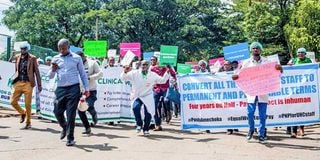
In a sit-down interview, Dr Moraa Mose, a general surgeon at Kakamega County General Hospital who is currently pursuing a master's in healthcare management at Strathmore University, dissected five challenges ailing the country’s healthcare system.
“First, some counties like Makueni and Kisumu have made bold investments in primary healthcare, community health structures, and digital systems pushing the envelope on what decentralisation can achieve.
But many others struggle with service delivery inconsistencies, health outcome disparities, opaque procurement systems, uncoordinated planning cycles,” she starts off.
“What was meant to promote people-centered care has too often produced a fragmented, unequal system where your location determines your level of access to healthcare.”
According to Dr Mose, the second challenge that Kenyans are currently grappling with is medical insurance.
This is after, in 2024, the government launched the Social Health Authority (SHA) a restructured national health insurance model meant to drive UHC by pooling funds and standardising access.
Its key features include a mandatory, pooled national scheme, universal Essential Benefits Package (EBP) and emphasis on preventive, promotive, and primary care.
“However, questions remain: will SHA reach the informal sector effectively? Can it overcome public distrust inherited from NHIF? and is it insulated from political interference?
The means testing used by SHIF has the following downsides - lack of accuracy in self-reported data, over-reliance on digital footprints and lack of legal anchoring and enforcement clarity,” the general surgeon points out while adding that without robust governance safeguards, SHA may become a rebranded bureaucracy, not a transformative shift.
Thirdly, the healthcare management master's student reminds that Kenya’s commitment to the Abuja Declaration remains nothing but hot air.
“Kenya committed in 2001 to the (Abuja Declaration) and swore she would allocate 15% of her national budget to health.
Two decades later, we are still stuck under 9 percent, this persistent under-investment fuels: high out-of-pocket costs, poor infrastructure and weak referral systems, Inadequate emergency and pandemic response capacity,” she told Nation .
Donor funding, she says, continues to bankroll major health programmes, especially for HIV, TB, malaria, vaccines, and reproductive health.
“While critical, this donor dependence has led to verticalised programmes with limited integration, budget distortions that prioritise donor interests over national priorities, sustainability risks when funding cycles end or shift and policy inertia where reforms are stalled pending donor alignment.
A system heavily reliant on external funding is vulnerable, reactive, and constrained in long-term planning. Domestic financing must lead, not follow,” she advised.
From inflated procurement deals to politically timed facility launches, healthcare remains entangled in patronage politics.
“Budgets shaped by electoral math, not evidence, appointments based on loyalty, not merit and projects designed for visibility, not viability.
This politicisation erodes efficiency and hollow out institutions, leaving systems weak even when money is available,” Dr Mose noted while reminding the government of what the World Health Organisation (WHO) director general Dr Tedros Adhanom Ghebreyesus once said, “Universal Health Coverage is a political choice. It takes vision, courage, and long-term commitment.”
The general surgeon reminds the government that 15 years later, the dream of ‘health for all’ endures, but it won’t survive on declarations alone.
Kenya, she believes, has a progressive legal framework for UHC.
“But we can’t legislate outcomes; we must invest, govern, and plan with integrity.
To make UHC real, we must: hit Abuja financing targets, ensure SHA delivers impact, not optics, reduce donor dependency by growing domestic fiscal space, de-politicize health governance and invest in integrated, equitable, and people-centered systems,” she said.
Dr Godfrey Mutakha, an obstetrician/ gynaecologist who, like Dr Mose, has worked in the country’s healthcare system pre and post devolution, says there’s very little to write home about despite a few successes.
“Before devolution, Kenya grappled with issues such as marginalisation and resource mismanagement, the intent of devolution was to address these challenges by redistributing power and resources.
However, some critics argue that devolution might have exacerbated regional inequalities and negatively impacted poorer counties,” he starts off while pointing out that the country’s leadership has made politically motivated decisions that may not align with practical implementation needs, leading to discrepancies between policy, practice, and research.
“This disconnect among researchers, policymakers, and practitioners complicates the transition from research findings to actionable health policies,” he states.
However, according to Dr Mutakha, despite ongoing challenges, there has been an increase in the use of public primary health services among low-income populations, indicating some positive outcomes from policy reforms.
Many counties have improved primary healthcare by operationalizing dispensaries and health centres and involving Community Health Promoters (CHPs) thus making healthcare more accessible to the average citizen compared to the pre-devolution era.
While this progress is commendable, he urges further efforts to promote UHC in line with the Presidential Agenda 3.3 on health.
“The conditional grant from the national government has stabilized Level 5 facilities during the transition period. When effectively utilized, this funding has significantly enhanced county health service delivery and reduced referrals to level six facilities,” Dr Mutakha pointed out while adding that numerous Level 5 health facilities have initiated training programs in obstetrics and gynaecology, surgery, anaesthesia, and orthopaedics, which will likely increase the number of specialists in the counties in the near future.
“County governments are improving Level 5 facilities, making them more appealing workplaces for specialists, unlike the pre-devolution era when specialists predominantly migrated to major cities like Nairobi, Eldoret, and Mombasa.
Services have been brought closer to the populace, including access to healthcare leaders,” he said.
However, according to Dr Boniface Nyumbile, a consultant paediatrician, Kenya is striving to achieve UHC but faces significant equity challenges such as disparities in care quality and high out-of-pocket expenses for vulnerable populations.
He observes that public health workers are ever on strike due to poor management and infrastructure, resulting in increased patient costs and reliance on private providers for medications.
Also, the overall quality and efficiency of service delivery post-devolution remain inconsistent across many counties.
“There is a general lack of inclusiveness in managing the health sector, particularly regarding citizen participation in prioritization, planning, resource allocation, and monitoring program implementation.
Budget allocations and other resource flows to the counties are inadequate as many counties divert revenue from hospitals to their central account, using it for purposes other than health,” he said in an interview, while further observing that in areas where infrastructure development has occurred, there has not been a corresponding mobilization of human resources.
“Some counties offer competitive salaries for health workers, while others have stagnated, leaving individuals in the same job groups for over a decade.
Certain counties have experienced an exodus of health workers due to poor remuneration or political interference,” Dr Nyumbile told Nation , adding that there is a lack of critical legal and institutional infrastructure.
“Corruption and a contentious relationship between county and national government persist and this has made healthcare service delivery stagnate with some gains being reversed.
“There is a shortage of medicines and technologies, forcing many patients to purchase drugs and non-pharmaceuticals from pharmacies outside public facilities.
Many counties continue to rely on paper records rather than transitioning to a paperless system, complicating data retrieval for research and other medical purposes,” the paediatrician observes.
. “There is a significant shortage of personnel across all medical cadres in the counties, particularly affecting general practitioners (GPs).
Many counties do not retain interns post-training or hire medical officers, leading to a surplus of consultants in Level 5 facilities compared to medical officers,” he further observes, adding that a re-evaluation and adjustment in health human resource management across counties is essential.