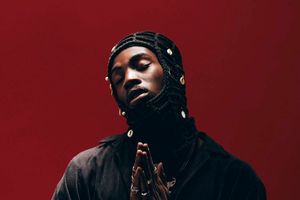
Joy Njoki,whose stage name is Joy Njokey, is a singer, songwriter, vocalist, and a film scorer based in Nairobi.

Who is Joy Njokey?
I would describe myself as a singer, songwriter and a vocalist. I started my career back in 2023. I’m also a film scorer based in Nairobi. I have worked on two film scores. One is called Terrorists. It is about a cartel leader in Nairobi and the challenges they face, including someone trying to con them. The other one is called Family Portrait. It is about family drama and the things that happen in families that outsiders don’t really see. Both were done by Dan Cuff Brown.
You studied radiography and sonography. Can you take us back to that journey and how music fit into your life at the time?
Music has been part of my life since primary school. I joined JKUAT in 2019 to study Radiography, but COVID disrupted everything. In 2021, I deferred to try a different course, but I later realised I still wanted something that would allow me to pursue music as well. So, I returned to Radiography in 2022 and graduated last year.
I started music even before campus, but I only began taking it seriously in 2023. I felt more ready as an adult because I had better training, my skills had improved, and I had more freedom to explore, especially being away from home. My first official track then came out in 2024, while I was still on campus.
Do you remember the moment you realised music could be more than just passion?
Well, in 2023, I had no music out. I was mostly singing at open mics. Then in February 2024, I released my first single without really telling people. It felt like sending a risky text and disappearing. When I came back online, I saw my friends had reposted it and people liked it. That boosted my confidence and pushed me to release my first project.

Joy Njoki,whose stage name is Joy Njokey, is a singer, songwriter, vocalist, and a film scorer based in Nairobi.
Every artiste has a first step into the industry. What did your debut feel like emotionally and creatively?
Honestly, I was scared. I had seen how people try and it does not work out, so I felt like maybe I was being overconfident about what I could offer. It was a lot of fear. But I had good friends in the industry who held my hand through it, so that helped me move forward.
Looking back at your early days in the industry, what were some of the realities that surprised you the most about being a musician?
Music is very expensive. There are many costs like studio time and production. If you want live instruments, you have to pay musicians. There is also transport and food, and all these things add up. I did not fully think about this at the start.
It is also not easy to find places to work or perform. There are not many studios, so people compete for time. Venues are also limited, and you often have to pay to use them. If there were more studios, producers, and performance spaces, it would make things much easier for artistes.
A lot of your music feels deeply personal. When did you start turning your real-life emotions into music?
I have always had a habit of journaling, just writing about how I feel. At some point, I started noticing that what I was writing felt like poetry. When you feel blank, it becomes easier to channel your emotions into your writing. I did not want to do that at first, but I learnt slowly. Then I realised that the songs where I was honest and emotional were the ones people connected with. People would tell me that the music helped them express how they felt. And that is when it really made sense to me.
When you started writing about that pain, was it therapeutic or did it sometimes feel like reopening wounds?
It was kind of both. It was therapeutic because I was able to go deeper into feelings I had not fully faced or accepted, but it also opened some wounds. Still, I would say it was mostly therapeutic.
Putting such vulnerable emotions out to the public can be scary. Were you ever afraid of how people might interpret your story?
Oh yes, I definitely was! Especially because some people might think the songs are about them. Also, no one really wants to admit they were hurt, so putting that out there felt very scary. But I also realised that the music that helped me when I was going through things came from artistes who were very vulnerable, and I wanted to be that for someone else.
Your sophomore EP ‘Grey’ feels incredibly reflective. What inspired that project?
The project came from my experience with heartbreak and healing. I went through different stages and could not fully explain how I felt to the people around me. When I finally sat down to write, everything just flowed. I realised I needed to go through that to be able to tell this story in a way that people would understand.
Across the project, there is a sense of restraint and vulnerability rather than spectacle. Was that intentional?
It was not something I forced, it just came from being honest. The songs reflect different stages of heartbreak, from denial to acceptance, so the tone naturally stayed vulnerable and real.
The music industry can be tough. What business realities have you had to learn along the way?
I have learnt that business is business, even when you are working with friends. I have been in situations where I was not paid properly because I treated it as friendship instead of business. I realised that if I want to keep making music, I need to take that side seriously. Also, the industry depends a lot on networking and the work you put in, and while it does pay, it is not always consistent.
Have you started earning from your music, and how much or is it more than what you earn from being a radiographer in the healthcare?
Yes, mostly from gigs. Musicians earn more from gigs than streaming right now. When I perform, like an acoustic set for about an hour and a half, that is a gig and I get paid.
I wouldn’t say it is more because gigs are not regular. You can make in one night what you earn in a month, but the next gig might be two or three months away.
Music can be expensive to sustain. How have you been funding your journey?
I fund my music career through my job as a healthcare worker. That is what supports my projects for now, until it gets to a place where I do not need to rely on work as much.
For example, mixing and mastering alone can cost around Sh10,000. Then, there is recording, beat production, and vocals, all charged separately. You can end up spending close to or more than Sh40,000 for just a few songs.
Aside from music, what are some of the other passions or work people might not know about you?
So, I studied radiography and sonography, and I work with X rays, CT scans, MRI, and ultrasound. Outside that, I volunteer with St John Ambulance. I have been part of it since high school, from 2015 up to now, and I have trained high school students. I also grew up in a Christian family. I learnt piano with a tutor and was trained to sight read.
Do you still use your piano skills in your music today?
Yes, I do. I own a piano, so when I’m writing, I put down my melodies on it, then I send them to a producer. For example, my song “Nuru”, I played it on my piano and sent a sample to the producer, and then he built on it.
Is there part of being a radiographer related to making music?
Not really. Maybe the only connection is that in both cases I’m trying to touch people’s lives. In radiography, I deal with human lives. In music, I deal with people’s souls.
Joy Njoki,whose stage name is Joy Njokey, is a singer, songwriter, vocalist, and a film scorer based in Nairobi.
Do you keep your music life separate from your professional life?
I would not say I hide it, I just don’t really talk about it. But people still find out. Some of my colleagues have come across my music online, and they support me.
Fans often notice your fashion as much as your music. How would you describe your personal style?
When I look good, I feel good. On a normal day, I am in scrubs because of work. But for photo shoots and performances, I pay a lot of attention to my hair. I have had my dreadlocks for about five years now, and they are a big part of my looks. I like wearing black and white for my wardrobe.
What is something you tend to spend a lot of money on?
I bank a lot on sunglasses and jewellery. I have about ten pairs of sunglasses, and I almost never leave the house without them. Even at night, I still carry them because I like how they complete my look. For jewellery, I love necklaces. Most of mine are custom made, and each piece can cost between sh1,500 and sh2,000. I also spend a lot on my hair, because it is an important part of my style.
Looking ahead, do you see yourself leaving healthcare to focus fully on music?
If I fully focus on music, I do not think I will stay active in healthcare. I might move into the corporate side or step back from it. I do not think I can balance both at the same time.
Follow our WhatsApp channel for breaking news updates and more stories like this.