Too much political chatter… Can we get a revolutionary song?
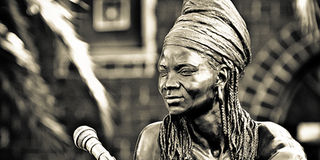
The Brenda Fassie sculpture, created by artist Angus Taylor, is a 1570-metre life-size bronze that stands outside the Bassline music venue. Songs have been the common language that defines unity for a course or a common purpose.
Music has always played a superior role in the communication of human emotions and rallying of solidarity.
What could not be spoken loudly in baraza meetups was exclaimed and sang away.
Of the musicians who braved the times and sang out the challenges that held Kenya breathless by the neck was Eric Wainaina.
In the history of mankind, music has always played a superior role in the communication of emotions and rallying of solidarity. As an art form, songs have been composed to entertain, warn of impending danger and even to educate the masses. Every human occasion has, quite naturally, had a song composed to emphasise its significance, and or disruption of the norm. Birth, planting and harvesting seasons, marriage, war, and circumcision, among other occasions where human beings are the subject, have had people sing to acknowledge them.
Songs have been the common language that defines unity for a course or a common purpose. While some songs get more popular than others, based on the number of people chanting and dancing frantically to the beats, it is not lost on us that political and revolutionary songs are among the most popular and convincing. Why? Because they are an overt expression of inherent people power and help draw clear cut lines between the contestants and their acolytes.