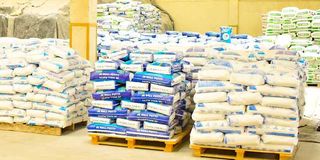
For years, grey cement has been the preferred building material for developers and contractors looking to maximise profits, due to its cost-effectiveness and attainability, compared to alternatives such as white cement.
In addition, the high content of iron oxide in grey cement has made it a preferred choice for large-scale construction projects where versatility and structural strength of foundations and walls are primary concerns. However, grey cement by itself does not offer very good aesthetic outcomes and has to be accompanied by other decorative products; therefore, while cost-effective in the initial project stages, in the long-run, it can be costly.
According to market estimates, while a 50kg bag of ordinary cement could cost anything between Sh700 to Sh1200, a 50kg bag of white cement could cost between Sh1900 to Sh2700 for a 40kg bag. However, to use grey cement effectively, one has to apply a primer, then wall putty and finally paint to prepare the walls for a finished look.
Wall putty prices in Kenya for a 25kg bag typically range from Sh1,200 to Sh1,500, while wall primer can range from approximately Sh320 for a litre to Sh6,800 for 20 litres. After the wall primer, you have to apply an undercoat of paint. When you add the cost of paint, which has increased significantly over the last two years due to taxes and high cost of raw materials, the cost of using ordinary cement becomes much higher than white cement, which can be converted into a textured paint by adding colour pigments and other additives.
In addition, the production and application of grey cement has continually posed great risks to the environment, making it less appealing to the contemporary consumer, who is more eco-conscious.
White cement products, such as white cement-based paint, for instance, have properties which reflect sunlight, thus reducing the temperature of buildings and, by extension, the usage of air conditioning, which is not only a big emitter of carbon dioxide, but also a big consumer of electricity.
As a result, white cement products, once used only in high-end real estate projects, have become more popular across the board, with users being drawn to the long-term benefits that the product offers.
“Within the last decade, we have seen a tremendous increase in the usage of white powder products in Kenya,” said Amit Kothari, CEO of JK Cement, a producer of white cement products headquartered in Dubai.
JK Cement CEO Amit Kothari.
Photo credit: Pool
“This increase in usage has been driven by the fact that the fundis find it easier to apply, whereas customers find that it is more competitive from a pricing and sustainability perspective in the long run,” he added.
Mr Kothari spoke during a recent visit to the company’s Nairobi manufacturing facility, opened about six years ago, to cut on importation costs.
DN2 Property
While ordinary cement is manufactured using raw materials such iron ore and manganese that give it the characteristic grey colour, white cement is made using raw materials that are low in iron and manganese. These raw materials, which may include white clay and limestone, give the cement its characteristic bright white colour that makes it suitable for aesthetic applications such as in building facades, sculptures and decorative elements in specialised construction projects.
When mixed with different pigments, white cement produces coloured concrete finishes that allow architects and designers to create visually appealing walls, floors and facades, making it ideal for modern architectural designs.
Manufacturers of precast concrete items such as tiles, panels and ornamental elements also prefer to use white cement as it can deliver a consistent colour and smooth surface while maintaining strength and durability. It also has high bonding properties, which make it ideal for the production of tile adhesives and grout, used to secure tile installation, especially in decorative areas like bathrooms, kitchens and outdoor spaces.
Terrazzo manufacturers use white cement to bind marble, glass, or granite chips in terrazzo floors. Its brightness enhances the appearance of the embedded aggregates, creating visually appealing and durable floors for homes, offices and public spaces.
White cement is also becoming a popular product amongst artists and sculptors, who are using it to craft statues, decorative mouldings, and artistic installations. Its smooth texture and aesthetic versatility allow intricate detailing and creative expression. Unlike the grey cement, white cement can be easily coloured with pigments to create other construction materials, such as textured paints. In addition, it can be used in the construction of swimming pools as well as roads, where its bright appearance can help to improve visibility, especially at night. The product is also commonly used to restore and protect old or historic buildings because of its toughness and ability to handle the effects of time and weather.
From a sustainability perspective, how does white cement compare with ordinary cement?
The cement industry is considered to be a big emitter of carbon dioxide, contributing approximately eight percent of global greenhouse gas emissions.
The chemical engineering of limestone to produce clinker, as well as the use of fuels like coal, gas and electricity to generate the very high temperatures required for clinker production, pose serious threats to the environment.
However, without cement, the world would not have modern infrastructure. Since we cannot do away with this product entirely, it is important we use technology effectively to reduce carbon emissions in the actual production process.
From a carbon emissions perspective, the technology that is used to produce white cement is already very low in terms of chemical and thermal emissions.
While ordinary cement absorbs sunlight, white cement reflects sunlight due to its bright colour. This helps to reduce the urban heat island effect and, by extension, the amount of energy used to cool buildings, particularly in areas that experience high amounts of sunlight.
White cement is also less prone to UltraViolet light degradation, making it a good choice for exterior applications. Its strong adhesive properties, thanks to its high silica content, makes it resistant to cracking and peeling due to weather elements.
White cement can be used to manufacture a variety of products including wall putty, tile adhesives and paints.
The challenge with white cement, however, is that it is more prone to staining and discolouration compared to grey cement. This is because it can be easily affected by environmental factors, such as dirt, pollutants, and chemical exposure, which can diminish its appearance. It can also be very sensitive to certain harsh chemicals and environmental conditions, such as acidic rainwater, and in areas with dirty air.
White cement is also susceptible to efflorescence, a process where soluble salts migrate to the surface, leaving a white, powdery deposit that can affect the appearance of the concrete. That is why specialised handling of this cement and its by-products is crucial during the production process. It is also important to choose a quality white cement supplier to achieve optimal results.
Is white cement really competitive from a cost perspective, for a developer or contractor looking to lower their cost of construction, with market data showing it is more expensive than ordinary cement?
Kenya is more of a project-based market, as opposed to an individual home builder market. There are more sophisticated consultants and contractors, which is a big benefit for someone selling the white cement. It is easier to talk to a more sophisticated customer who is willing to understand the benefits of the product, as opposed to focusing on price. True, white cement is usually more expensive than grey cement because of the specialised raw materials and manufacturing processes involved; however, the higher cost can sometimes be offset by its durability and the potential for reducing energy consumption in buildings. White cement generally offers excellent durability and strength, similar to, or sometimes even better than, grey cement, ensuring the longevity of structures.
What can be done to boost the uptake of white cement products, which is still relatively lower compared to ordinary cement?
In this dynamic and highly competitive market, you cannot remain relevant if you sell only one product. If you want to become relevant, you must offer more products. You may have the best product, but it is not enough. Manufacturers must constantly work on formulations that are more sustainable, adhesive and easy to apply, in order to attract the market. While there is a huge market for the product, particularly in the counties where we can see a lot of real estate developments coming up, white cement may not be as readily available in these areas.
Deepening consumer engagement beyond markets such as Nairobi is key to enhancing uptake. Manufacturers can leverage digital tools to streamline distribution and enhance dealer engagement through real-time inventory and order tracking. The other gap that needs to be filled to enhance the uptake of white cement products is in consumer education. If two generations of fundis or contractors are used to doing things in a certain way, it becomes difficult to change that.
In the early days when we introduced our product to the market, it would often be misapplied or damaged due to unfamiliarity. We resolved this by conducting training and working closely with the fundis. Continuous consumer education, particularly for the fundis, is very crucial because they are the ones who recommend products to project owners, and they will only make that recommendation if they like the product and understand how it is applied.
Before using the product, one must first ensure that the surface is clean, dry and free from dust, oil or loose particles. For walls, lightly dampen the surface before applying to prevent premature drying and cracking.
Normally, instructions about the ideal mixing ratios are included on the packaging of the product. For better adhesion, a thicker paste with less water is normally recommended.
Note that white cement, just like ordinary cement, has chemicals which could react if not handled well. That is why it is important to always mix it with clean water, in a clean bucket, using a mechanical mixer for consistency in larger quantities. Proper application of white cement products also involves the use of the correct tools. Depending on the finish required, one can use products such as a steel trowel, putty knife, or sponge float for application.
Keep the applied area moist for two to three days to ensure proper setting and drying. Exposing it to too much direct sunlight for rapid drying will not do. White cement takes longer to dry and harden completely; therefore, you need to be patient during this process to avoid cracks or weaknesses in the wall due to inadequate drying. Also, ensure you protect the applied surface from external weather elements such as rain for at least 24 to 48 hours after application, to prevent cracks and enhance the whiteness and lifespan of the finish.