Premium
First aid: Know-how is more important than the bandage kit
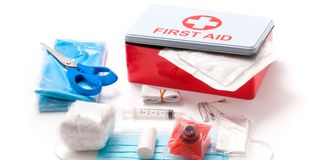
First Aid kit.

As far as I know, the law insists all cars carry a first aid kit but does not stipulate what should be in it. Aside from the law, what would you advise? Aretha M
To be as useful as possible in the event of a serious on-road injury, you should really carry two first aid kits. One in your glove box (not crucial) and the other in your head (extremely important).
First aid materials can be useful, but they can also be found or fudged on-the-spot to do what needs to be done to cope with the basics and possibly save a life. If you know what you are doing.

Even before the kit, there are non-medical priorities. At a road accident scene, collisions and fire are the main dangers, so approach with care, switch off engines, and warn other traffic.
Enlist the help of any bystanders for those tasks, and ensure emergency help is called for. Whatever medical assistance you give should be limited to what you are certain is correct and looked on as temporary until emergency services arrive.
When it then comes to first aid, by far the more important “equipment” is knowledge – of what needs to be done and how to do it. First, how to check and if necessary restore and secure the patient’s breathing. Second, how to staunch copious bleeding. Third, what NOT to do if the patient might have a spinal injury, smashed bones or the like. Hey, don’t wince. We’re talking about car accidents which are often not pretty.

First aid kit.
How you do the right things, not what materials you use, is what will save a life. Strict hygiene for the victim is good but secondary; while makeshift materials might not be sterile, hopefully – because you have called emergency services - the patient will soon be in an ambulance (second aid) or hospital (third aid) where germs can be dealt with before they become a problem.
The wider world has increasingly recognised this, to the extent that carrying a first aid kit is not compulsory but in many places passing a first aid exam is part of the driving test! Without that, no license, however well you drive.
Even if you have a first-aid certificate, remember you are not a doctor and make that clear to yourself and others. If you are the only source of help at a crash scene or other emergency, do what you can.
If there are others, who might include a fully qualified para-medic, that’s where your first aid kit might be especially useful. St John Ambulance - who have probably run more first aid training courses and for longer and in more places than any other – recognise the limitations of conventional first aid kits, and recommend the following:
* Triangular bandages (which are the most multi-purpose shape for at least 12 purposes from tourniqets to bandages to slings)
* A roll of medical tape (to secure packing in a deep wound)
* A safety pin (for whatever a sharp point or clasp might help)
* A pair of scissors (which help make dressings swifter and can be used for adapting makeshift aids such as cutting a seatbelt to use as strong strapping)
*Perhaps an eye patch because the material used in that area is especially important.
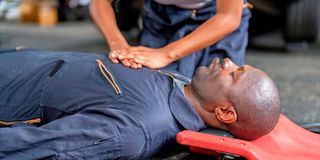
First aid.
More recently they have almost certainly added rubber gloves and made this newcomer the “most” important item for the person giving assistance. For the same reason, there are now simple gadgets to barrier infection during mouth-to-mouth resuscitation.
So, deal with ongoing danger. Get help. Do what you can for the injured (within your known competence).
Bear in mind that accidents are not the only cause of roadside medial emergencies.
For example, travellers have heart-attacks and strokes, others have violent allergic reactions to bee stings. In those instances items as small, cheap and mundane as aspirin (which thins blood) and piriton (an antihistamine) or better-still a (much more expensive) adrenaline “epipen” can be life-saving.
For remote safaris and expeditions, a much more comprehensive “medicine bag” or “doctor box” is recommended, including emergency items and also for simple comfort: pain-killers, cough sweets, indigestion tablets, rehydration salts, sundry lotions, creams and balms, antiseptics, insect repellents, gauze, padded plasters, eyedrops and decongestants.
The pros and cons of covering up when dust is a devil
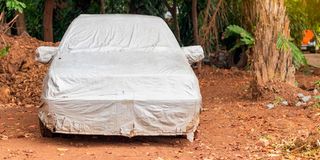
Would you recommend fabric covers for cars parked in dusty conditions? CM
“Dust Covers” do help protect paintwork from direct sun damage if a car cannot be parked in the shade, and from dust, leaf-fall, dripping sap, bird droppings and, at the coast, salt spray. But they can do more harm than good if they are pulled on and off too frequently (or carelessly) in a chronically dusty place. Covers of any kind, especially those that envelop a car completely, can also promote corrosion in rust-prone regions by limiting circulation of air.
So their primary benefit is for long-term parking or storage, especially if not under a roof. At the coast, where the air can be salty even several kilometres from the beach when there is a breeze, there’s a conflict between preventing sunshine and/or promoting rust damage. The remedy might be to rig up a sun “shelter” roof of some sort that blocks out direct UV rays from above, but allows air to circulate underneath, and to build a screen on one windward/seaward side to reduce low level salt spray.
Dust certainly settles quite quickly on paintwork and can build into a deep layer that could harbour moisture. But unless you live next to a limestone mine it is probably not caustic and, being still, it does not abrade. Just be careful when you wash off dust or any other kind of dirt to use copious quantities of water before and during cloth washing. Polished paintwork is resilient to things in the air, except the UV rays of direct equatorial sunshine. It does not like being scrubbed with dry grit.
Other storage protection measures specific to abbrasion and corrosion, either in addition to or instead of screens and covers, include waxing the paintwork with polish before you put the car into hibernation, squirting prone bare metal parts with WD 40 (aerosol lubricant), checking for and promptly removing caustic stains from birds or trees, and periodic rinses of all the paintwork with fresh water if practicable.
This column has previously dealt with preparing the mechanical and electrical innerds of a car, and the tyres, to minimise ageing in long-term (a month or more) storage.
Driving on three wheels
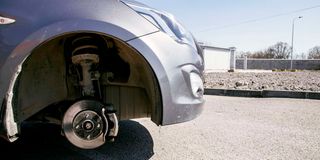
In your recent article on “bush fixes” you suggested that it was possible to drive a car, somehow, even with a wheel missing, but noted that was “another story”. Please tell us the other story, and whether many such tales from old-days rallying and wild safaris are true.
There’s a big difference between what might be “possible” and what might be “recommended”; and the difference between what might be tried as a last-resort in the wilderness, but never on a public road.
Yes, there are many instances of cars being driven – sometimes at quite high speed - with a wheel missing; usually where the people inside are wearing full-harness seatbelts and crash helmets, in cars with roll cages and a number on the door, piloted by a driver with very special skills. Aka rallysport. This is most readily achievable if the car is four-wheel or front-wheel drive and the missing wheel is from a rear hub.
I have personally experienced this three times – twice as a driver in dry daylight, in an old Land-Rover (whose 40-year-old wheel rim simply disintegrated) and then an even older Land-Cruiser (all the wheel studs sheared and the back wheel overtook us) on remote safari tracks; and once as a passenger in a night-time rally in the rainy season. I only drove the old 4X4s long enough to bring the vehicle to a halt, the right way up, without hitting any nearby trees, and on flat , clear ground. It took a while to restore one wheel in each corner and the journeys continued.
In the rally, there wasn’t time to stop and fix, and the driver simply kept driving, relatively normally on left-hand bends and somewhat more sideways on right hand corners. The only problem was at the next control point where it took some time to persuade the horrified control officer that we were aware (surprise, surprise) that one back wheel was missing, and needed him to stamp our card so we could proceed without delay towards our nearby service crew.
In events like the Rhino Charge, where one or more wheels is quite often off the ground anyway, one entrant drove on three wheels without even noticing. He did hear a noise and asked a crew member in the back to check the left-hand rear wheel. “Can’t see anything wrong with it,” the scout said. “In fact, it is not even there.”
In earlier days, rallyists had often kept a bare hub off the ground by placing a crew member on the diagonally opposite corner of the bodywork, and driving gently towards repair. Where a front wheel goes missing on a rear-wheel drive car, best progress is made by driving in reverse. Bare hubs are more easily dragged than pushed.
In a remote expedition context, it is possible to make a “ski-leg” to substitute the missing wheel, using a stout tree branch strapped to the chassis at an angle (like the arm of a “stretcher, litter” as once towed by horses; two poles are strapped to the saddle with the other ends dragging along the ground behind.) Applied to the back of a car, the pole(s) need to be strong and very firmly strapped in two places, at an angle that puts the rear tip on the ground at a ski-leg angle that lifts that rear corner and supports the car’s weight.
Alternatively, a stout enough log – with a slight upward bend or panga’d chamfer at the front end – can be strapped flat under the axle. That can work, albeit much more heavily and slowly.
When I spray some WD40 on my rusty grey cells, I think I recall the ski-leg solution made it into the Guinness Book of World Records (or similar). The distance achieved was several hundred kilometers across a desert.
If wipers fail, the best speed is zero
Is it true that if your windscreen wipers fail when it is raining, you will be able to see more clearly if your drive faster? Shiraz.
Technically, yes. Practically, not a good idea. Simply, don’t.
At normal motoring speeds raindrops collect on the windscreen in fat globules that seriously distort vision. That effect is more pronounced at lower speeds and less pronounced at higher speeds, but the levels of danger work the other way around. Only at very exceptional speeds does the wind flatten and sweep the water away so rapidly and completely that relatively clear vision is enabled.
Exceptional speeds? Well, 200 kph would be a good start. That’s why Formula One drivers have no wipers at all. Some of the spray behind them in wet conditions is coming off their helmet visors.
On any busy highway, if your wipers stop working then stop driving! If essential for any reason, drive slowly (headlights should already be on) and carefully if you can reach shelter or a garage by driving a short distance.