Ms Adeeva Shajarian is busy preparing an array of delicacies in her kitchen. She has guests coming over for Sunday lunch and it just occurred to her that she is yet to clean the house.
But Ms Shajarian is a clever woman, and so she does not need to worry. She pops some pastries into the oven and dashes into the sitting room, where she sets up her vacuum cleaner and in a second dashes back into the kitchen to continue with her lunch preparations.
Ms Shajarian’s LG Smart Hom-Bot Robot vacuum cleaner continues to clean away as she goes about her other business.
The tiny, disc-like device is so intelligent, it just simply zips around the room on its own; dodging the cat that lies lazily on its way and other barriers, disappearing under the seat and then re-emerging to take the corner at the wall and finally stopping after it is satisfied it has covered the entire room.
“All I had to do is give the vacuum cleaner an inductee’s ‘tour of the rooms’. After noting the routes and doing some programming, now it knows the layout of the floors and how to manoeuvre around the house on its own,” she says.
The cordless device is equipped with a learning function and a visionary mapping system that detects areas that are already cleaned, explains LG’s marketing and corporate communications manager for East and Central Africa, Daisy Mugo.
DETECTION MECHANISM
It is equipped with a home guard feature that enables it to detect intruders and will automatically capture images of its immediate surroundings and send them directly to her smartphone once it senses any movement.
“All I need to do is type ‘leaving home’ to activate the home guard mode,” she says. If she wants, she can use her phone to command the vacuum cleaner to do the cleaning while she is away at the office.
The communication between her vacuum cleaner and phone is made possible by a Wi-Fi Internet connection at home. Otherwise the vacuum could also be operated on location with a remote control.
Well, the prophecy is upon us. Whoever said the computer and the Internet would one day take over our lives was not kidding.
Now, from Ms Shajarian’s vacuum cleaner, to fridges that can give you a peek into their shelves on your smartphone, to washing machines that you can order to act from miles away, the futuristic vision of wireless domestic bliss that integrates your house with the Internet is here with us, baptised “The Internet of Things” by the techie world.
The appliances run on powerful computer chips that can link to the Internet to communicate with your computer ware, in most cases your smartphone, making homes smarter and more efficient.
Most are being designed to work with Wi-Fi connectivity. Apparently, the idea is to have the appliances not only communicating with their owners, but also with each other too.
The LG Smart Hom-Bot Robot vacuum cleaner keeps information in an internal memory so that the next time it is prompted, it already knows the places to clean. It also has a detection mechanism that allows it to avoid obstacles on its path. FILE PHOTO | COURTESY
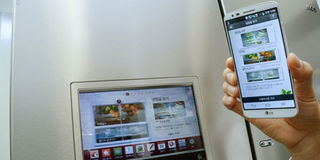
You should no longer stand stranded in your local supermarket trying to remember whether you ran out of milk back at home or not, for the modern refrigerator comes fitted with a smart feature through which you can monitor, in real time, what is on all its shelves via your smartphone or tablet through a wide-angle internal camera.
All you need is Internet connection on both devices. The built-in camera detects the opening and closing of the refrigerator, capturing images of the food items stored inside when last opened.
The fridge also has a freshness tracker to keep track of expiry dates, and can even recommend meal options based on the ingredients in it.
It will also make recipe recommendations as well as daily and weekly personalised meal plans based on the user’s body mass index (BMI), age, gender, weight and height.
It also has a smart power saving system which enhances its capacity to reduce energy consumption when the unit is not being accessed, like when everybody is asleep or on vacation.
While the command “leaving home” automatically turns on a smart power saving mode, an energy monitoring component helps users keep track of how much energy the refrigerator is using and how many times its doors have been opened.
LG’s offer has a lesser crucial feature called Photo Album that allows users to send pictures to the fridge’s tablet-sized screen.
Thus, via a Wi-Fi connection, you can keep an eye on your old mother by logging onto her fridge to keep tabs on her eating routine and what to take when you check on her later in the week. It retails for about Sh300,000 in the US.
Imagine a washing machine that you can remotely command and control while miles away from home by merely texting “start washing cycle” on your phone.
Well, imagine no more, for these Wi-Fi connected machines are now available locally under the LG, Samsung and Haier franchises.
Using an app on your smart phone, you can start your washing and ensure that your laundry is finished by the time you get home.
By sending the text “What are you doing?” to the LG machine, for instance, you will receive real-time updates on the washer’s progress, which is also equipped with a mechanism that makes it easy to select or download appropriate wash cycles.
The machines come with energy monitoring features and displays that allow consumption comparisons on levels of energy used per individual washing course.
The Samsung unit has an Auto Optimal Wash option that uses four sensing technologies to determine the right wash cycle, looking at temperature, washing time, rinse cycle and spin speed, based on the size of the laundry load and how dirty the clothes are. All this information is relayed to your phone or tablet from the machine.
The Guided Laundry function can recommend and automatically apply the optimal settings for any type of laundering scenario since the machines are installed with intelligent settings, for instance, for specific kinds of stains like gardening and cooking, as well as sports or even hygiene care functions.
For example, for orange juice spills, simply texting “remove juice stains” on your phone app to the machine will initiate one-touch washing to prescribe the appropriate course of action.
Using Wi-Fi, Near Field Communication (the ability for two devices to send data to each other simply by touching), and audible diagnosis, the machines and virtually all other appliances in this range can use smart diagnosis to alert the user of technical issues.
These smart washing machines also notify the user when the drum needs cleaning. Prices average Sh140,000.
Bored with the regular bulb? Well, Phillips has introduced smart bulbs with hue lighting systems that you control with an app available for iOS and Android phones.
Following in Phillips’ footsteps, LG and Samsung have also launched smart light bulbs, heating up the battle to illuminate your home. Others in the fray are Lumen, LIFX and Belkin.
Using an exciting range of state-of-the-art LED Wi-Fi light systems, one can change the hues of their bulbs to up to 50 variations.
The bulbs have been fitted with chips which allow control from an application on your phone. You can turn them on or off, dim them, or change the colours as you wish.
What is even niftier is the fact that the system has geo-fencing capabilities that tell the system when there is nobody at home so it can automatically turn off the lights, and turn them on when it senses your return.
The timer setting also lets you program the lights to follow your daily schedule, or turn on and off randomly while you are on vacation to deter burglars.
Because trends seem to indicate the number one deterrent to residential crime is lighting, the Plum app allows you to program and activate an “away mode” that turns on and off specific lights in your home on the schedule you program to set lighting schedules that mimic the appearance of someone being at home.
The age of flipping through tonnes of pages of cookery books to get a recipe may soon be slipping out the kitchen window with this new oven that will actually talk to you about recipes.
LG’s HomeChat oven has been fitted with a recipe search app with which homeowners can converse with their oven to recommend recipes for specific dishes.
All you need to do is select “return-home” using HomeChat and the smart oven will ask “What dish would you like to make today?” and open the recipe search window.
When ready to cook, the oven will automatically set the appropriate temperature and cooking time for the particular dish. The user can receive alerts on their smartphones when new recipes are available, encouraging owners to try new dishes.
Ovens have been programmed to make the users work easier. For example, LG’s HomeChat oven has been fitted with a recipe search app with which homeowners can converse with their oven to recommend recipes for specific dishes. FILE PHOTO | COURTESY
The Italian manufacturer of espresso machines, Saeco, is making sure you can have your latte macchiato, cappuccino, café latte, café crème, ristretto, and espresso any time you want to, so long as you have their machine and your mobile phone.
From a tablet or a smartphone, users of the machine can choose the type of coffee they want and control the water and milk density by moving bars on the tablet with a picture alongside the screen showing the expected product at the end of the digital manipulation.
From the communication device, users can also control the temperature of the drink. The Italian company partnered with Dutch technology company Philips to automate the coffee maker.
To work, the machine is connected to the phone through Wi-Fi or Internet. The phone should have the application installed in it before connecting to the machine.
New in the market and sold in limited-edition versions awaiting official release later this month, the coffee-makers are already a favourite for homeowners and small canteen business owners.
The device costs approximately Sh193,000.
These a just a few of the appliances in the home automation frontier, which has become the new battlefront not only for home appliance manufacturers like LG and Samsung, but also for the creators of apps that enable these interfaces of standard household tasks and appliances to occur.
Other appliances in this range include heating and thermostat systems, coffee makers, kettles and pet feeders. Philips even has a revolutionary air-frier that makes your french fries without the grease!
It does not have Wi-Fi connectivity, though, and that is such a killjoy because the ultimate dream, it seems, is to have interconnectedness between our smartphones, TVs and home appliances through a single integrated platform, all in the name of minimising household effort.
All users need to do in order to get recommendations or change the status of their smart home devices is to send simple texts in casual language through a mobile messenger, such as LINE.
This high degree of usability means that the full range of smart home functions are available through human language commands for the first time ever.
While Samsung Electronics has called the interconnected home the Samsung Smart Home and has even developed a dedicated Smart Home software protocol (SHP) to enable connectivity between all these emerging smarts, LG is calling it HomeChat.
The two Korean home appliance manufacturers are currently the leading athletes in the race to create an Internet-connected household, a market expected to grow into the next multi-billion-dollar tech revolution, with inputs from technological titans such as Google, Intel, Microsoft, Apple and Cisco, among others.
Presenting his 2020 vision of the “house of the future” in Berlin earlier this year, Samsung Electronics’ co-CEO, Boo-Keun Yoon, said: “For many it’s still just a vision, but change is coming and it’s coming fast. Just remember how quickly, in just a few years, smartphones and tablets have changed our lives.”
But Ms Mugo of LG East and Central Africa says the smart applications are still new in the market and will take a while to be adapted into the African market, even though her team is “constantly working on ways to enhance smart usability”.
“The task at hand now is to make it available, and make it affordable,” she says.
The new driving force for this wave, says Field Application Engineer for Intel East Africa, Chris Mwangi, is the growth of the smartphone and its role as a common user interface to allow remote and in-home control of devices.
“By providing the intelligence and connectivity that drive these devices, we are enabling improved efficiency, greater savings and even helping to save lives,” he points out.
He explains that the new generation of appliances are not only able to receive updates on software as does the smartphone, but also allow one to keep tabs on precisely how much energy each appliance is using and have them send relays to the manufacturer when they have defects.