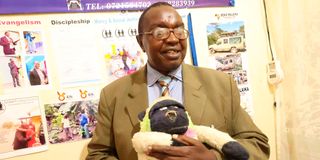
Rev Isaac Gitata Maina of Benie Malaika Global carrying a doll nicknamed Susan in his office in Maai Mahiu in Nakuru County on June 14,2025.

After being married for 12 years with no child, Isaac Maina and his Madagascar-born wife Benie Ange began considering adoption. As they were in the process of getting a boy to be put legally in their custody, fate brought them a girl who had been given up for adoption by her mother.
Eventually, the couple made history by getting a court’s blessing to adopt two children who are not relatives at the same time. That was 18 years ago, and the family of four is thriving today in Syokimau, Machakos County.
Rev Maina, who has been an ordained pastor since 2008, talks about the adoption and the miracles that came along the way. Below are excerpts from his story.
“The journey started after 12 years of marriage without a child. We felt an urge for a baby of our own so much that we decided to offer our services to our children’s home to take care of babies once a week: help clean them, help feed them. That was in 2006.
We felt that we needed to have a baby, but we didn’t know where to start with the adoption.
One day, I was reading an old Parents magazine, where I saw an adoption story. And so we started asking, ‘Where do we start?’
We went to a children’s home and asked them where we could start. By then, adoption was a dark area. People would talk of adoption as buying babies.
One of the requirements for adoption was an eligibility assessment. There were things they had to find out about us. By then, we were students in a Bible school. So, you can imagine we were not even qualified as such. None of us had a job. I was an assistant pastor, earning just about Sh2,000 a month.
The journey started with applying. A social worker helped us fill out forms at an abandoned baby centre, and then there was an issue of them visiting where we lived.

Rev Isaac Maina.
My wife is not Kenyan. She’s from Madagascar. We had served in Madagascar for many years as missionaries. When we came back in 2004 and started Bible school, we were accommodated in the school premises. Even when other students went home, we stayed. That was our accommodation. It was this student accommodation that the social worker came to.
But something amazing happened on the day she was supposed to visit us and assess our eligibility. Of course, we would not have been eligible because we were living in this one room and at that time, there were a lot of requirements for adoption.
On that very day, the social worker was called to the Pumwani Maternity Hospital about a baby girl who had been born a week before. That baby girl needed to be placed in a baby centre with facilities that would take care of her health because she was born premature. She was placed at the same facility we had gone to start the adoption process for a baby boy.
I kept calling the social worker. We were there, anxious, very nervous. At 5 pm, she came and told us, ‘I have just found your daughter.’
So, the story changed. It was not about whether our small room could fit a child, but she came with the news that there was a girl who looked so much like my wife: brown, very tiny, but you know, her eyes, big eyes. She just looked like my wife.
The social worker was so excited. And she was not even looking at our small space. She told us, ‘Come tomorrow to the abandoned baby centre.’
So, we went. And so, instead of one child, we applied for two at the same time. The social worker encouraged us.
To us, we didn’t qualify, not even for one. But for two, what I heard later was that we were the first couple to ever have two babies at once who are not related.
As we did the application, there was the issue of getting a lawyer who would help us. It was quite a lot of money to do that. We got a very wonderful Christian lawyer. She put the files of the two kids together and she told us, ‘I’ll do this for you as a service to God and humanity. I’ll not charge you.’ What she charged was the registration for the office, which was not much. It was, I think, about Sh2,500.
And so, the journey started. We got a placement for the boy, who was aged one year and three months. The placement was for three months, which is known as a bonding period, to see whether the child will bond with you. In that period, a [prospective] parent is allowed to give the child back to the children’s institution.
As for the girl, there was another hurdle. There was a need for parental consent because she was not abandoned. Rather, she had been given up for adoption by her mother. Her mother had felt that she would not be able to take care of this baby. So, she started the process when she was pregnant, and that process was finished when she gave birth. But it was not yet finished because the law allows for six weeks for the mother to think it through.
We always say we were pregnant with the girl for six weeks, because we didn’t know what the outcome would be. The mother could have said, ‘No, I want to keep this baby.’ And the mother had the right over that child. And so, six weeks went by, our hearts beating very hard, praying so hard.
We thank God because after six weeks, when she was asked, she gave consent. She signed the consent form.
We got our baby girl home after seven weeks.
We always see them as twins because here is our boy and here is our girl, they are home with us, we are students in the Bible school. It’s crazy. We were in the exam period. We slept in shifts. I learnt to fix bottles and change diapers for both.
We had quite an experience. I, being in a church that believes so much in faith, that you have to pray and ask God to give you a baby biologically. Everybody kept off. They were saying, ‘You didn’t have enough faith, Pastor. You should have waited on God more. Why did you have to go and buy children?’
But ultimately, they started to see these kids turning out to look like us. Our son is exactly my copy. My personality is his. He’s a people person. And physically, we look alike. I don’t always tell this [adoption] story. It’s not something we hide, but when we tell somebody, they get shocked. They say, ‘No, you are lying. There’s no way.’ It is because even my character is his.
Our daughter, on the other hand, is a copy of her mum. And my wife is an artist. She draws, she paints. And that’s what my daughter has picked up.
Everyone was now confused: ‘How come they look alike and we are saying this is not from God?’
I remember when we went through the final court process after one year and eight months. We had to go through court because you need an order granting the children as your own children. And it’s non-reversible.
The judge started playing with my son, giving him a pen. And then she asked the lawyer, ‘What are you doing in my court?’
The lawyer said, ‘We have come for consent.’
Then she looked at us and then the kids. Then she just said, ‘Go home and take care of these angels.’
And that was it. In under five minutes, we got the orders.
We didn’t believe we had our kids. We went out to a café somewhere and celebrated, and that was the beginning of having our children home.
Today, Christine is 18, and Samuel is 20. Upon adopting them, we gave them their current names, which we felt were fitting for them. You see, they normally have a name when they’re in a children’s home, for identity. You can either keep that name or you can give another.
As a father, I intentionally have to make time every day to spend time with my kids, even at their current age. Just a few days ago, my daughter sent me a Father’s Day greeting, and to me it was so touching that I shed tears.
My son called me and, to me, those small moments mean a lot because it means that to my son and my daughter, I’m first a father to them and then a provider.
Also, we nurtured our two kids exclusively, together with my wife. We’ve never employed a nanny. We did everything for our kids. I know everything about raising a baby, like taking them to the clinic.
They came to know they were adopted right from when they were small. We disclosed it to them; we didn’t hide that from them. And we didn’t hide that from their teachers because we felt that they needed to understand that being adopted is a plus. For a biological child, a parent has no choice. But adoption is a choice that a parent makes, to give birth to that child from their heart.
To fathers, I would say this: a father is a person. It’s you. It’s not what you have. And what a child needs is you, your presence. A child needs to hear you tell them you love them. So, they need the emotional part of you. They need that embrace. I embrace my kids a lot. I cheer for them.
My son is a soccer player, and I love to attend his matches. We attend his matches, and we cheer him up. Our daughter is good at cooking. We cheer her up. She is also into art.
So, the presence of a father is very important for a child. Affirmation is very important. It is more important than the money you give or the gadgets you give to that child. The memories a child keeps are those moments they spend with you and the words you speak to them.
I would like to say that adoption has become much, much easier because there are people who have actively done activism for that. One of them is an organisation that I’m part of, which is a community-based organisation called Adoption is Beautiful. In Adoption is Beautiful, we work with parents who want to adopt and help them know the process.
In the beginning, there was nothing I could refer to. But in Adoption is Beautiful, we help. There are lawyers who are out there, there are legal practitioners, there are different helpers who can come in and help the parents, existing parents, and even those who want to adopt, have a better process.
However, there are some challenges. Like when it came to obtaining a national identity card for the boy, I had to get a letter from his school so that the process would go forward. They had to prove that this child is my child, yet I have all these other documents. So, the school is the one that issues a letter to say, ‘This child attended school here and this is the parent.’
I would say even the local administration, when they meet with a parent who has an adopted child, should be kind. The chief in Mlolongo who took up my request for my son’s ID was extremely kind.
Also, what’s given when one adopts is a certificate that identifies a child and you, but it's not a birth certificate as we know it. So, you have to apply for the birth certificate, and that birth certificate, unfortunately, doesn't look the same as the normal one. So, there is some form of stigmatisation or differentiation. So, I would pray that it be made the same? Because a child is a child.”