The calendar was a plateful in 1963: American President John F Kennedy was assassinated. The Catholic Church accepted cremation as a funeral practice. The Beatles recorded their debut album.
Betty Freidan’s The Feminine Mystique was published, spurring the feminism movement. The Alcatraz jail in the US was closed after a prison break. Lawrence of Arabia won Best Picture at the 35th Academy Awards.
Dr No, the first James Bond film, was released. Real Madrid coach Jose Mourinho and basketball great Michael Jordan were born...
The Organisation of Africa Unity was formed. Nigeria and Zanzibar gained their freedom. Kanu won in the general elections — with Edward Hawkins, the only white candidate, losing (“Thousands of Kenyans ran through the rain-drenched streets of Nairobi... cheering at news of the results,” reported the BBC).
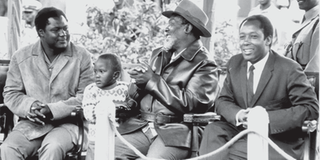
Then, that December 12, 1963, Kenya attained independence — 49 years today —with Jomo Kenyatta as Prime Minister.
“Burning Spear”, as good ol’ Jomo was called, was magnanimous in victory, rallying the country “not to look to the past racial bitterness, the denial or fundamental rights, and the suppression of our culture”. “Let there be forgiveness,” he thundered.
Politically, the Prime Minister had to ethnically balance his Cabinet, comprising assorted characters, some of whom were only content to have a flag on their limos. Besides Kenyatta’s delicately novice political assembly, Kenya as a country was climbing an arduous socio-economic promontory, with ignorance, poverty and disease as key priority areas.
Other statistics were grim: Three out of four Kenyans lived in mud huts. Only seven per cent of the population had salaried jobs and only three African learned friends practised law, the New York Times noted at the time.
In between steering the country, Kenyatta had to deal with minor encumbrances that were at variance with the enormity of state duty. Some included debt reminders, piling mail from colleagues requesting favours and headteachers reminding him — as a parent — of “extended Easter holidays that have delayed the opening of school”.
Others were letters from his children, like Jane at Kenya High School requesting to become a Catholic and: “Daddy, could I bring a cat home as a pet?... It is a nice cat and grey in colour,” she pleaded.
There is even a bill sent to him for settlement of Sh1.65 for “one small Pilsner” as Bar Charges from the Kenya National Assembly.
Indeed, House Speaker Humphrey Slade sent him a reminder on February 19th, 1964:
“You may not be aware that your Catering Account here now stands at Sh1,597.30, no payment having been made for some months past…. I should be very grateful if you could make a payment on account, as our reserves are not sufficient to carry large accounts outstanding for long.”
Then there was JM Ole Tameno, a veterinary surgeon who often treated Mzee’s cattle at his Gatundu home. In January 27, ’64, Tameno sent a ‘professional fee’ after treating Kenyatta’s Friesian and Heifer (30cts), drugs (28cts) and 62cts for “mileage Kentmere Gatundu and back.”
The heifer, Ole Tameno noted, was “suffering from a tick-borne disease — Anaplasmosis.”
You can picture Kenyatta, at 73, dealing with “Anaplasmosis” and pending arrears for “one small Pilsner” while weighing the more ponderous matters of Africanising Kenyan businesses, decolonising the civil service, pacifying communities, settling the landless, presiding over harambees, hosting dignitaries and sorting out leftist renegades in his government.
Kenya’s Independence Day Celebrations were organised by the Independence Day Celebrations Directorate, headed by A W Horner. It featured a State Ball at City Hall, a Garden Party at Government House (now State House), religious services, Parliamentary ceremonies, cultural events, bands, youth rallies, films, Tattoo and Forces Arena shows and dancers providing a “bewildering variety of colour and movement”.
This is how foreign guests were drawn: “Each Cabinet minister,” wrote Horner, “would be asked to submit… a list of not more than 10 names of individuals considered worthy of invitation as Honoured Guests of Kenya, giving reasons for each nomination…. Also, indicate whether any of the persons should be accompanied by (their) wives.”
For local guests, Horner asked the Permanent Secretaries to “submit 50 names to include wives and dependants where appropriate,” and all senior staff “will be required at the airport to meet guests of the government coming from abroad on a 24-hour basis.”
The Independence Day Celebrations Directorate depended on ministries for manpower and the Director of Personnel, T Neill, felt seconding staffers to Kenya House where the Directorate was situated was interrupting work.
In a circular, Neill wrote, “it may be prudent to recruit suitable men and women on temporary month-to month basis”, singling out “recruiting officers who are retiring in the near future or who may have recently retired and would be available for temporary employment.”
H L Bennet, Chief Supplies Officer, Ministry of Works, asked all ministers to “mark their chairs with an identification mark so as to ensure that chairs were correctly returned to ministries concerned after the celebrations.
Mr & Mrs JM Waiyaki and Mr Mrs SM Otieno were some of the eight Kenyan couples invited in their ‘private capacities.’
Freedom and after, in figures and letters
Rough estimate of Kenya’s population at independence, 55,759 of them Whites, according to colonial records.
Amount Kenya spent organising the Independence Day Celebrations, according to records from Independence Day Celebrations Directorate.
Number of seats reserved on the Royal Box where Prince Philip, the Duke of Edinburgh, represented the Queen.
Cost — less Sh12,216 as duty waiver — of Kenyatta’s Mercedes Benz 300SE Saloon, registration number KHN 545, as the Prime Minister’s official limousine, according to a 28th February 1964 letter from RB Moreto, the General Sales Manager at DT Dobie, requesting Kenyatta’s personal secretary Ruth Njiiri to “advise us on whom we should contact in connection with the refund of duty on the 300SE in order that a Credit Note may be passed to the Prime Minister’s account for this duty”.
Moreto also requested that “should the Prime Minister want to hand in his present Mercedes 220SE in part-exchange for the new 300SE, we will be only too pleased to arrange for this.”
The horsepower of Kenyatta’s Mercedes Benz 300SE, manufactured in 1963.
Cost of radio, “complete with aerial and one loudspeaker”, on the Mercedes Benz 300SE as a gift from Max Egon Becker of Germany.
Kenyatta, as the Prime Minister, received an endless stream of letters. And for all manner of reasons: greetings from old friends, requests for land allocation, soft loans to battle a court case, warring politicians explaining their positions, and prisoners requesting amnesty. Sample some, including this handwritten one from Kimani Wa Nyoike, later Nyandarua South MP:
Muthee (sic) Jomo Kenyatta,
“…I have had the luck to work with American government — quite high places — and I have slowly but consistently asked them to re-think their policy on Kenya. I have been quite successful, remembering I have no official credentials….
As a young man, all I can plead with you is that you obey your doctor’s orders — sleep well… Israel is one dangerous country! We must use it but it is watching our country with a hungry man’s eye! Britain, we need to work hard at as the hostility to you as a person is still deep… America is confused now. They are waiting to see what this Jomo Kenyatta can do.”
The letter ended: “Ndakena muno ungi nyandikira ka-note gaa kuga niwanyita marua maya na ati uri u mwega.” (I am would be glad if you wrote me a note saying you received my letter, and that you’re fine).
I am your younger servant,
Conscious that the letter might not be replied to, he wrote:
“I am reminded to say one thing — there is a good deal of criticism that your letters are not answered.”
That February 1963, Kenyatta requested Golda Meir, the Israeli Foreign Affairs Minister who later became her country’s fourth Premier, to visit his Gatundu home after her trip to the newly independent Uganda:
“I am sure when independence comes to Kenya,” he wrote, “we will be able to draw heavily on your experience in meeting the tasks which confront us…. Sorry your illness prevented you from coming to visit my home.... Pauline tells me that Margaret (Kenyatta) has gone off to Ghana for some conference. I hope Nyokabi is all right; I was very sorry to hear her husband’s misfortunes. Best wishes to the estate and the house, as well as to the family and old friends. After coming back here in the summer, we discovered, to our delight, that sweet potatoes could be got in the Jaipur Market, so, I think of you when we eat them. Cheerio!”
January 14, 1963: Letter from Dinah Stock, then a teacher in India. (Dinah stayed with the future President during his England Years in the ‘30s when she helped in editing Kenyatta’s book, Facing Mount Kenya. Dinah would later sent Kenyatta books when he was serving seven-years’ hard labour in Lokitaung from 1952.
She graced Kenya’s Independence Day Celebrations in 1963). Northern Kenya was under military occupation as there had been 17 bandit attacks, grenade attacks, kidnappings and murder by shiftas in June 1963. A citizen wrote the president:
“…Back in July this year all the firearms I had were collected by the police. Due to the recent unrest and disturbances in NFD (Northern Frontier District), as a stock trader, the worries I have whenever I move a herd of steers from one destination to another and without firearm to protect the steers is …well... I am about to be looted hopeless.”