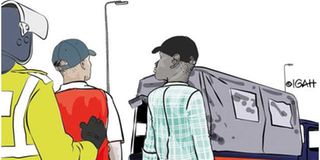
In the last three weeks, marauding teenage gangs in Nairobi's Umoja estate have made the news. Members of these gangs range from about 13 to 16 years. Last week, 14 members of this gang were arraigned in court to stand trial for the murder of a teen.
I was born and brought up in the much loved and dreaded Eastlands. Many people are of the opinion that Eastlands is the bedrock of crime and other social vices. Sure, our hoods have their share of bad rep. But it's not all doom and gloom.
Changing Course: Preventing Gang Membership was written by America's top criminal justice and public health researchers, under the auspices of the Centers for Disease Control and Prevention (CDC).
“A 13-year-old does not wake up one day and decide out of the blue to join a gang,” says Nancy G. Guerra, Carly B. Dierkhising and Pedro R. Payne in Changing Course.
“The decision is a consequence of a particular life environment, behaviour and way of thinking that leads a child to adopt the gang lifestyle later on.”
Which means what? This. That though at the moment our emotions are running high - and we have every right to feel aggrieved - we cannot just cast blanket judgements. We cannot just say these boys should be shot on sight, without doing a deep dive diagnosis to find out what has made them join gangs.
In describing individual and family factors in early childhood (ages 0-5) and during the elementary school years (ages 6-12), the authors note that joining a gang should be understood as part of a life course.
Yes, a life course. And this course begins when a child is born. Here's the surprising thing. Sometimes this course begins even before a child is born.
“For children between the ages of 0-5 years,” the authors note, “important risk factors include hyper-vigilance to threat, cognitive impairments, insecure attachment to a caregiver, and early aggressive behaviour.”
“For 6- to 12-year-olds, important risk factors include poor school performance and parental monitoring, deficits in social information-processing skills, antisocial beliefs, and negative relationships with peers, including being rejected and victimised by peers.”
In the late 80s to early 90s, my ‘hood, Jericho Estate was host to young men from better backgrounds than ours, who, it seems, just wanted a taste of the project's life. The one lad who stood out was nicknamed Johnny-Be-Good.
Cats in my ‘hood gave him this nickname, which was from a song by Peter Tosh. Johnny-Be-Good - (a pointy) - came from a solid middle class background. They were moneyed and he often came to our ‘hood rocking new Sahara boots, which were the status symbol back then. (Back then, we referred to a mixed race person as a pointy).
“What does Johnny-Be-Good see in this place?” I often wondered. “I wish I could trade places with him.”
The authors of Changing Course have the answers. Teens are attracted to gangs for the purposes of status, outlaw culture, relationships, protection and economics.
Gangs can be seen as a way to increase status and respect among peers. On the other hand, the authors point out that during the cognitive-development adolescence stage, being part of an outlaw culture - such as those popularised by musical influences - can be compelling for some teens.
Youth who feel marginalised, rejected or ignored — in the family, school or church — may join a gang to fill a need for relational support. The issue of protection is self-explanatory; being in a gang is a shield of sorts.
Economics is an issue we need to address as soon as yesterday. Or else? Like the Mungiki, these teen gangs will morph into uncontrollable monsters. Which, by omission or commission, are our own creation.