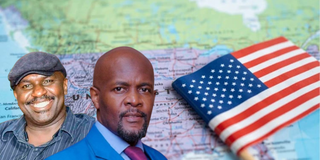
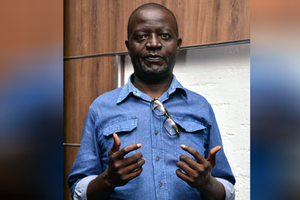
With the Donald Trump administration ramping up its deportation efforts targeting foreigners, two Kenyans who were previously kicked out of the United States and started afresh have one message for those who might face a similar fate: there is life after forced relocation.
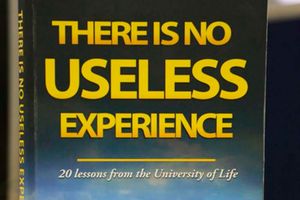
Fired by the need to document their journey and possibly to inspire those who might be affected by the same rules that saw them cut short their chase for the ‘American Dream’, Mwali Muyumbu and Levis Kones have both written books to tell their stories: Deported to Destiny (launching on August 1, 2025) and There is no Useless Experience (2022) respectively.
Kenyan-born Conflict Specialist Mukurima Muriuki, who is based in America, warns that things are not looking too rosy for immigrants going forward.
“We are seeing a clear ramp-up in deportation operations, detention facility expansion and executive orders aimed at fast-tracking removals. The administration has made it clear: deportations are a central priority. Immigration and Customs Enforcement (ICE) has received significant funding in the ‘Big Beautiful Bill’ meaning they can only go big on this,” he says.
“Kenyans, like many immigrants from Africa and other parts of the world, are increasingly being affected. Some have been detained for overstaying visas, while others are caught in broader ICE sweeps," he added.
In his upcoming book, Deported to Destiny , Mr Muyumbu details his journey from the excitement he felt when he held his passport and visa in hand.
Mwali Muyumbu is the author of an upcoming book titled, Deported to Destiny.
Photo credit: Pool
It is worth noting that unlike nowadays when going to the United States is relatively easy as long as one meets the visa requirements, back in the day going to the land of the Star-Spangled Banner was probably the next best destination after heaven. But then nobody ever prepared him for the shock of deportation.
For Mr Muyumbu, it was even more painful because he had travelled from the US to Kenya to attend the burial of his mother, who had died in a car accident.
“I had temporarily left the USA and travelled back to Kenya a month before deportation because of the tragic passing of my mother in a road accident. No sooner had I got over that than the deportation came. Immediately after, the 911 (September 2001) tragedy happened while I was in the process of appealing to the US embassy to reverse my visa cancellation so I could go back and finish my college studies," Mr Muyumbu recounted.
Diagnosed with colon cancer
"The outcome of the writing is not only to share my story but also to help anyone who has written off their life, their dreams, written off hope. Even more specific is anyone who may face deportation or related experiences and needs hope and encouragement, especially from the USA. All this to the end that we can help create an environment in Africa than does not necessitate our people to leave their homeland to become slaves elsewhere,” he says.
On his part, Mr Kones says that he started writing his book to document his journey of fighting the killer disease cancer.
“In 2018, I was diagnosed with colon cancer and soon after my diagnosis and seeing the doctor and getting to know the way forward in terms of surgery and chemo, I began writing on Facebook about my experiences. I would write about chemo number one, what's happening and so on and so forth, including the surgeries.”
The cover page of the book ‘’There is no useless experience ‘’ by Levi Kones.
Photo credit: Lucy Wanjiru | Nation Media Group
Mr Kones says he would go ahead to have a big following and that all of the readers started demanding that he pens a book. It was then that he realised that cancer was just a chapter in the story of his life. He expanded the book to accommodate experiences from what he calls ‘The University of Life.’
Just like Mr Muyumbu, Mr Kones says he got deported for violating the F1 (student) visa. He reveals what faced him when he came back home a reject.
“That was depressing. That was a low, low, low moment in my life because by the time I landed, everybody knew I'd been deported. The neighbourhood was talking about me. I tried to get into church. The church people were talking about me. I tried to, you know, get into places where I could mingle with people. It was like I was a leper and I was carrying this terrible disease of failure of going abroad,” he said.
He added: “And I think we are so harsh on people when they go abroad, and they don't make it as if Kenya is not home. And we should really wake up to the fact that it doesn't matter. You could go out there and you don't make it and Kenya is still your home and it should be okay. My own feelings were feelings of disappointment. I walked around. I had to go back to living with my parents and every time they looked at me and every time we looked at each other there was that, you know, feeling of failure in the room. It was, it was difficult.”
Mr Muyumbu says the period after deportation was quite difficult: It was a cocktail of different things that happened too fast and at the same time.
“I was just 24 years old full of hopes and dreams, I was barely getting started and mum and I had so many plans, so many plans. My father and family were equally just processing the loss of our mother but (soon after), my two other siblings lost their prestigious jobs, (and were) unceremoniously removed from their employment,” he says.
Redemption for Mr Muyumbu came in the form of taking up deejaying work with a friend who had moved back to Kenya from the United States. The job came with a lot of partying and drinking alcohol. All this changed when he became a born again Christian and quit the clubbing scene.
He later got a job with Samsung, a position he solely credits God for. The competition was of more polished candidates but finally he got chosen.
“During my four years working at Samsung Electronics overseeing 28 countries for their Consumer Electronics business, I was reminded by the director at the time that I was picked from over 300 masters students. The door God opened for me at Samsung gave me such a global exposure of business, life and my desire to understand Africa,” he says.
Mr Kones’s journey took a long winding path that saw him spend time in a rehabilitation centre over alcoholism followed by a stint at the then popular ‘Slimpossible’ TV show where contestants tried cutting down weight on national television.
While at the show he met the love of his life on the set (she was a technical staff with the crew shooting the show) but this was quickly followed by a court battle after the woman’s former lover brought up false allegations on social media using a notorious blogger.
Mr Kones finally moved to Australia where he is a volunteer counsellor working with the New South Wales Police Department to offer help to Kenyan and African students, who have found themselves on the wrong side of the law.
Levis Kones currently lives in Australia where he is a volunteer counsellor with the New South Wales Police Department.
Photo credit: Pool
“If I didn't get deported, I'd not be having a story that someone else could read. Stories of failure are what people read more than stories of success. People want to know, if you failed, how did you get back? If you did this, how did it work out for you?” he says.
Mr Kones adds: “We learn a lot from failure. We do learn from success, yes, but failure teaches us a lot more because all of us have failed at one thing or another. None of us is infallible in terms of the things that we do or the things that we aspire to do, whether here (in Kenya) or in other countries.”
Mr Muyumbu agrees, advising those deported not to stay too long in the “mourning” season.
“Mourn but do not over stay. Life, time and biology are so savage, they will not pause and wait for you to get your act together; they will keep ticking away. If you enter a state of either depression or trauma, seek help. Do not isolate yourself to your own detriment. Many churches have at least a first responder counselling service at no fee,” he says.
He explains that even though America has a great economy and opportunities, it is not worth wasting years in frustration after deportation.