Like many others her age, she had already faced about 20 job interviews and many rejections when she chose a path she once said she would never take. “I told myself cruise ships were not my thing,” says 24-year-old Eve Gacheru. “I never wanted to do that job. But when I got tired of the endless job applications, I had to try it out.”
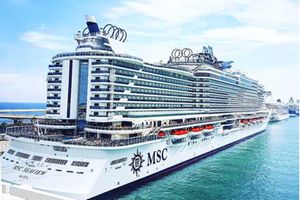
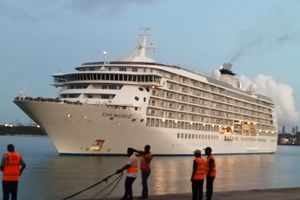
Today, she is far from home, working in Miami in the US, as a cook on Oceania Cruises, a 67,000-tonne mid-sized vessel with 15 decks. “It has a capacity to hold approximately 1,200 guests and 800 crew members,” she says. “When I reached there, at first I was scared. It was my first time leaving home and trying something totally new. On sea, inside a cruise ship, it feels normal. You cannot even tell you are at sea unless there is a storm or bad weather.”
In Kenya, Eve, who studied Culinary Arts at Boma International Hospitality College and graduated in 2023, had worked in many kitchens. “I actually got a job before I finished school,” she says. “I worked as a young chef at Hemingway Nairobi for three years. But I felt I would not grow; I wanted more.”
For one year and six months, she had no job, depending on her parents all over again.
“I felt like a burden. I kept trying to apply for jobs. I went for almost 20 interviews. Different hotels, different restaurants, but I never got a call back. No reply, no notification, just rejections.”
In August last year, she applied through a Kenyan agency called Genesis Cruise Services. A week later, she got a notification. “Honestly, I was overwhelmed. I was not expecting anything other than a rejection. I have received so many rejections that I expected another one. When I got the offer, I was so happy.”
The journey to the ship was not simple, though. Eve had to train for safety certificates, STCW (Standards of Training, Certification, and Watch keeping). “I went to an institute in Meru,” she says, referring to Primary Time Technical Institute. “I studied for one week and got the certificates approved by the Kenya Maritime Authority.”
Eve Wambui Gacheru, 24, works as a cook on a cruise ship in Miami, after spending about Sh150,000 to begin her journey overseas. Previously she worked at Hemingways Hotel in Nairobi as a chef.
Photo credit: Pool
She also needed a seaman’s book, which she describes as “a passport for the sea,” a valid passport, a CV, and a C-1D visa to enter the US.
Before boarding, she had to pass a full medical exam that included a comprehensive full-body scan done by a verified physician who works directly with the company. All of this came at a cost. “I spent almost Sh150,000 for the whole process,” she says. “That included approximately Sh65,000 for STCW certificates, Sh24,000 for C1/D visa fees, and Sh41,000 for the medical exam.
Additionally, the required vaccines, including Yellow Fever, Measles, and Varicella, cost about Sh24,000.” Even though she spent all this, the company refunded the visa and medical fees later when she settled.
On January 27, this year, she landed in Miami for the first time. “It felt unreal, I had chills, goosebumps all over,” she expressed her excitement. “I never thought my year would start like this.” The company placed her in a hotel for the night. The next day, she boarded the ship that would become her home.
“The sea has been rough a few times,” she says. “But I have never felt seasick. We are updated about weather changes early so we can prepare, and there is medication at the medical centre for those who get sick. We also have medical staff on board who treat both crew and guests for free.”
Life on the ship moves with a strict order. Eve works every day. “There is no off day,” she says. “You only get hours to rest.” Her schedule begins at 11am. She takes a short break at 12.30pm to 1pm. She works again until 4.30pm, rests for one hour and 30 minutes, then returns at 6pm and finishes at 10pm. “In total, I work up to 10 hours,” she says. “But we have breaks.” She still finds time to sleep. “I get enough rest,” she says. “I can sleep up to 10 hours.” Her contract lasts eight months and can be renewed.
Her work area, she describes, is quite different from her previous setup in terms of the workflow. “Currently, I’m assigned to the cold pantry, where I prepare dishes such as salads, fruits, and vegetables. Unlike my previous roles, where you remain at one station, the duties here are more dynamic, and I often prepare different menus for various restaurants throughout the ship.”
She shares a cabin with another Kenyan. “I thank God for that,” she says. “The room is small but complete. We have a bathroom, a toilet, a closet, a desk, a chair, and a television.”
Food is provided, but it is not what she grew up eating. “There is no Kenyan food,” she says. “So you have to adjust.” Most days, she eats rice and chicken. “Rice is the main food because many crew members are from the Philippines and Indonesia,” she explains.
The change was not easy. “At home, I worked from 7am to 3pm,” she says. “Here you work until 10pm. It took time to adjust.” She also feels the distance from home. “Sometimes you feel homesick,” she says. “And because of the time difference, you cannot always call your family.”
Still, the experience has opened her world. “I am a very positive person,” she says. “Meeting people from different countries has changed my life.” She has learned to use simple English to communicate. “We use basic English,” she says. “We call it ship language so everyone can understand.”
She has also travelled to new places. “So far I have been to six countries,” she says.
Her favourite place was Curaçao. “It is a beautiful, vibrant Dutch Caribbean island known for its stunning turquoise beaches like Kenepa Grandi, colourful Dutch colonial architecture in the capital city of Willemstad, and a rich, diverse culture. I loved the place,” she says.
When the ship stops at ports, she steps out for a few hours, sometimes until late at night. “Seeing different countries is the best part,” she says. “Just seeing what the world has.”
Eve Wambui Gacheru, 24, works as a cook on a cruise ship in Miami, after spending about Sh150,000 to begin her journey overseas. Previously she worked at Hemingways Hotel in Nairobi as a chef.
Photo credit: Pool
Back on board, life continues with small moments of joy. There is a crew bar, games, music, and events. “We even have cultural and traditional days where we dress in our cultural attire. As Kenyans, we did our usual Maasai attire, vitenge and beads,” she says. There are ten Kenyans on her ship, all working as cooks.
In the kitchen, she continues to grow her craft. “I enjoy making Italian food, especially risotto,” she says, describing it as a rice dish made slowly like pasta, with ingredients like mushrooms, pesto, or seafood. “We are going to Italy soon,” she adds. “I will get to taste real risotto in Naples.”
The financial change has been rewarding. When asked to compare her earnings to her job in Kenya, she answers simply, “Four times better.”
When she is not working, she rests, spends time with friends, does her laundry or shares her life online through her content. “I love being online and talking,” she says. “Posting my journey shows me that I was meant to do this. I also like helping people.” Still, she knows this is not her final stop. “I will get bored if I do this for a long time. This is a good opportunity, but I dream bigger. I believe content creation can also change my life.”
Her advice to young Kenyans looking to work on cruise ships? “Be patient. Sometimes the offer will not come quickly. You may have to apply again and again, even after getting rejections. But if you believe things will work out, they will work out. Just never give up.”