For more than three decades, Dr David Gikungu walked the corridors of the Kenya Meteorological Department, rising to director before retiring last month. His career spans two distinct eras: when weather forecasting relied on rudimentary tools and drew little public interest, and today's age of artificial intelligence, where climate dominates public discourse and drives national decision-making.
Our reporter interviewed him on the sidelines of the second Africa Climate Summit in Addis Ababa, Ethiopia.
Pretty well. You know, I saw it coming. It was not sudden. I say this because I worked in administration for many years. Even before I reached the top, I had chances to act in that same capacity. I could see some people not prepared for retirement. They got that letter, and it gave them a shock. I am still in the process of informing quite a good number of people that I have associated with.
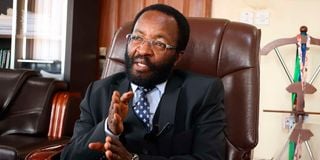
Kenya Meteorological Department Director Dr David Gikungu during an interview at the Kenya Meteorological Department in Nairobi on March 10, 2025.
Photo credit: Evans Habil | Nation
If I could put it very simply, acceptance of the service. That was like a 180-degree turn. Because I have worked in a system where you are received negatively. Whatever you say is received negatively. Even in meetings people say, these ones, whatever they say, take the opposite. But during the time I have served, I experienced something totally different.
And at one point, somebody attempted to treat me like that, saying that openly. And I said, "Please tell me what percentage of the reports that we give out are negative and which ones are positive." And with time, they realised that things had changed. So I thank God for technology.
Because it is not that I started doing things differently from my predecessors. No. It's technology that found me in the office at the right time.
Kenya Meteorological Department Director Dr David Gikungu explains weather patterns in the country during an interview at the Kenya Meteorological Department in Nairobi on March 10, 2025.
Photo credit: Evans Habil | Nation
There is also the question: who are you serving? Who receives what you produce? Users started appreciating that this information is useful. The lower you get [in scale], the more accurate it is. We've been inviting users from various disciplines to sit in our meetings when issuing seasonal forecasts. That builds toward the acceptance we're talking about.
You led Kenya Met during what we could call "two seasons"—one when people didn't know much about climate change and weather, and another when people were more aware. Talk to us about that transition.
It's the same thing I'm saying, because the benefit I have is that I grew up with the system. I was part of it when we struggled to get people to understand what we were talking about. We discussed the terminologies we use—do people understand?
We developed with the help from others who participated in systems in other countries where it worked. I saw it all. This change has been gradual and includes training. Now there's general appreciation of our services.
I don't know whether there is anything I can point out, because the work of an administrator at that level covers quite a lot. You work with people running shifts and others carrying out field observations. You are the boss of all of them. They need promotion and recognition. We're talking about leading people who are well-educated and knowledgeable.
Kenya Meteorological Department Director Dr David Gikungu speaks on August 30, 2023 in Nairobi during the release of the October, November and December 2023 short rain season forecast.
Photo credit: File | Nation
Keeping that system together and running throughout is not something I would call a small matter. In fact, I wouldn't call it a challenge, but a milestone in my life.
What happens at headquarters is a presentation of what happens everywhere. We observe weather elements. With time, we've been automating. With automation, we reduce the need for physical observation so you can work with fewer observers and get the same results. We've seen accuracy levels changing.
There were rough patches that Kenyans witnessed—times when you'd say one thing and politicians would say otherwise. Could you speak about that?
You state the facts as you see them. I remember a time we had a long drought period, and I found myself sitting with the same group of people. The leader confronted me about the rains that were pounding heavily. I said what we said was the truth because that is what we were observing. You may think they were hard times, but they were joyful moments. When you see things happening in your profession—whatever you said—it is joyful.
You are not out to settle scores. If they insist otherwise, it is for nature to prove them wrong. What we discuss is sensitive, and there are categories of people you cannot force to apologise. You don't insist on anything. You could even say, "Thank you for allowing me this opportunity to explain these things."
Kenya Meteorological Department Director Dr David Gikungu explains weather patterns in the country during an interview at the Kenya Meteorological Department in Nairobi on March 10, 2025.
Photo credit: Evans Habil | Nation
One thing I am happy about is that we managed to change the forecasting office in a week. We were using small screens, just bigger than a laptop. We got wall-to-wall screens, and even the office arrangement changed.
There has been progress, but we can improve coverage—the observation system. There are still many places without observation stations. The wider the network, the more accurate the reports. Then there's staffing. You might not go far when numbers are low.
As an administrator, I found God on my side all the time. There were sensitive matters. For instance, an organisation wanted to do business with the department. The names they were dropping, their approach—it was terrifying. There were all manner of ways to get me to agree, including sealed envelopes. Even with the backing they had, I didn't agree to it.
A service that is not leaning on the government for everything. There is independence you should have that can help you develop so you can be at par with those who have made it.