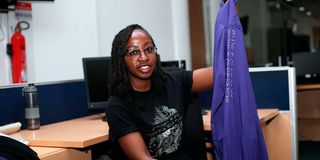
From the moment she graduated as a designer from the University of Nairobi in 2018, Angela Wanjiku knew she didn’t want to create clothes just to be worn. She envisioned outfits that spoke to identity and, most importantly, brought fashion to society’s marginalised.
As a creative brimming with ideas, Wanjiku explored many possibilities before one interaction at home in Thika set her path. While working with a school for the blind, she began pondering how visually impaired individuals experienced fashion. Were they given the same opportunities to enjoy it? Could they shop independently, and what help did they need?
These questions sparked her journey. “After graduating, I wondered what to do next. I decided to return home to Thika and share my skills with the community through fashion. That’s when I started working with visually impaired people, and my journey began,” says Wanjiku.
Her collaboration with the teachers at the school for the blind shaped her research project, which eventually became a brand advocating for inclusive fashion. By 2019, Hisi Studios was born, carrying a bold message to the fashion world about universal fashion—clothing designed for everyone, regardless of their ability to see.
Wanjiku’s first collection incorporated Braille lettering, offering visually impaired individuals an intimate and independent shopping experience. At Hisi Studios, style is meant to be felt rather than merely worn.
“The students at the school were the first to interact with the outfits. The excitement on their faces was priceless. Many were thrilled to connect with the clothes in such a meaningful way,” she recalls.
Some of the messages written in Braille include: “The less we see with our eyes, the more we see with our hearts.” According to Wanjiku, this reflects a call for kindness toward humanity and the planet.
Describing herself as an advocate for disability and inclusion, Wanjiku says her brand aims to start conversations. “We had our debut exhibition at the International Trade Centre in Addis Ababa, which was a great success. However, after the launch, Covid-19 struck, and we had to slow down. But by 2022, we resumed production,” she says.
The appeal of Hisi Studios extends beyond the visually impaired; sighted individuals are also intrigued by the designs. To enhance functionality, Wanjiku ensures some Braille elements are raised, improving the texture for touch. Each garment also includes a QR code tag. When scanned, the tag provides audio descriptions of the garment, including size, washing, and care instructions.
“This enables visually impaired customers to shop independently with minimal assistance, creating a more personal shopping experience,” she explains.
Her efforts have sparked curiosity among fashion enthusiasts, particularly the sighted, who are eager to learn more about inclusive fashion. “People often ask what the dots mean. These questions lead to discussions about inclusivity in fashion. For me, that’s a significant achievement. It’s not just about designing clothes for the blind but also about educating the privileged on the importance of inclusion,” she says.
The journey hasn’t been without its hurdles. Wanjiku highlights the challenge of sourcing affordable, high-quality fabric.
“The outfits aren’t cheap to produce. Our T-shirts retail at Sh2,800, a price I hope we can lower to reach more visually impaired individuals and persons with disabilities, many of whom face financial constraints,” she notes.
Despite the cost, demand continues to grow. Wanjiku aspires to involve more people with disabilities in production and expand her brand’s reach.
“Economic empowerment for people with disabilities is often limited. Lowering prices and creating more opportunities within production would be a step toward inclusivity not just in fashion but in the workplace too,” she says.
Through her work, Wanjiku is redefining how fashion is perceived and experienced, ensuring it’s accessible to everyone. Hisi Studios doesn’t just make clothes—it makes a statement.