Now Maskwembe claims he paid bride price, and that he owes us nothing!
In the conversation that followed, Maskwembe’s dad insisted that dowry had been paid.

When Caro’s big day of bride price payment turned chaotic, ending in her useless husband Maskwembe’s arrest, we were certain this would silence both him and his wife — my sister Caro, who happens to be Mwisho wa Lami’s CS for Misinformation, Miscommunication, and Broadcasting of Lies.
After Maskwembe’s arrest and Caro’s failed attempts to get him out, we saw a new version of Caro: quiet, humble, subdued. A version of her we didn’t know existed. Honestly, it was a good spectacle. We were not used to a calm Caro.
But it didn’t last. Caro somehow managed to get her husband out of the police cells, and soon after, she left all family WhatsApp groups, complaining she had received no support from anyone. Later, she confided in a friend that all she wanted was to be heard, not even believed. “No one in the family listens to me,” she told the friend.


Then, a few days after Maskwembe’s release, a boda boda rider arrived at our home carrying a letter addressed to my father. When we opened it together, we saw it was from Mzee Tobias — Maskwembe’s father.
Excerpts: “In light of my son's successful delivery of customary dowry payment, and the unfortunate events succeeding this auspicious occasion, which led to the unfair, and irregular incarceration of my beloved son Maskwembe in police dungeons, I hereby write to you seeking an audience where we can debate and deliberate the matter at hand with intention to mutually resolve it amicably. Eagerly looking forward to your acceptance of this request for a conclave between me and you. We owe it to our children.”
Clearly, this wasn’t Mzee’s English. Nor was it Caro’s. And definitely not Maskwembe’s. They had hired someone to write the letter.
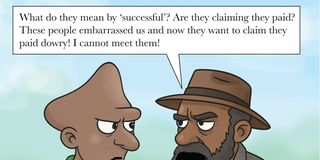
“What do they mean by ‘successful’? Are they claiming they paid?” my father asked, visibly irritated. “These people embarrassed us, and now they want to claim they paid dowry! I cannot meet them.”
I supported him. It was wrong for Maskwembe’s family to request a meeting without even acknowledging the shame and chaos they caused us. At the very least, they should have admitted their sins in the letter. But no — they were chest-thumping instead.
Different opinion
My brother Ford, however — who is still around, because fare to Kitui hasn’t reduced — had a different opinion.
“They’ve just asked to meet us. They haven’t claimed anything beyond that. It won’t hurt to hear them out,” he said. Then added, “You know, how we treat in-laws is how we’ll be treated when it’s our turn.”
He continued: “Pius and Dre only paid for one cow. Me? I’ve never even done a formal introduction at Rumona’s place.”
That hit home. Even Mzee softened. We finally agreed to reply to the letter and invite Maskwembe’s father for a meeting.
Our reply acknowledged receipt of the letter, and clearly stated that — according to Mzee, after extensive consulting of clan records — no dowry had been paid. We also specified that Mzee would only meet with Maskwembe’s father alone, not the entire clan.
We invited him to come last Wednesday. We intentionally picked a weekday to avoid fanfare. No one was willing to spend lavishly on food again, especially after the last ceremony that ended in chaos.
Last Wednesday, at exactly 10 am, a boda boda arrived, carrying Maskwembe’s father. He and my dad didn’t know each other well — they’d only ever met once, at a funeral.
We welcomed him into the house, where we served him breakfast. Interestingly, the breakfast had been prepared by Caro, who had travelled the day before. She insisted on cooking it herself, claiming she trusted no one — and only she knew what her new father-in-law liked.
After food, we expected to move to the agenda, but Maskwembe’s father had other ideas. Before my father could speak, he raised a concern.
“I don’t understand. In the letter, you asked me to come alone — yet here you are with your sons.”
Things became tense
Mzee shrugged. “These are just children. What do they know?”
But Maskwembe’s father was not convinced. He insisted Mzee wasn’t being genuine.
Things became tense.
After some back-and-forth, Mzee asked Ford to leave and instructed me to stay. But even then, Maskwembe’s father insisted that I should not say a word.
In the conversation that followed, Maskwembe’s dad insisted that dowry had been paid. He claimed that by the time police arrived, the cows had already been accepted by our family – we had even exchanged ropes as per tradition. Therefore, as far as he was concerned, his son owed us nothing.
Twice I tried to speak — but the old man wouldn’t let me.
As this was going on, a young man suddenly arrived with a cow.
“That’s the cow that was no one claimed was stolen,” said Maskwembe’s father. “I don’t know why we went back with it. I’ve asked that it be brought back. It belongs here.”
The young man who had brought the cow left after having some tea.
“This is not a matter I can decide alone,” Mzee said. “In fact, no man participates in his children’s dowry negotiations alone. Let us discuss this another day when we have our elders present.”
“We are not negotiating dowry!” Maskwembe’s father barked. “That was done already. I’m just here to return the cow you rejected and inform you that we owe you nothing.”
Then, with one final jab, he added, “And if you knew our customs, you’d have allowed me to bring my elders too.”
Seeing that they were not making progress, Maskwembe’s dad took out his phone and called someone. Shortly after, a boda boda rider arrived and took the old man back.
“I’ve done my duty,” he said before leaving.
Later, Mzee called Ford and explained how the discussion went. He asked us what we thought.
I said that we should return the cow that had been brought and stand firm that no dowry had been paid, especially since the other three cows had been taken by the police.
But Ford had other ideas. “Let’s keep this one. It looks like a good cow — I just hope it’s not stolen.”
Even before anyone said anything, Ford added: “I know what to do,” Ford said. “I’ve asked a trader to come and inspect it. If the price is good, we sell.”
“What?! Why?” Mzee exclaimed.
“Do you know why I’m still here?” Ford asked. “Because I don’t even have fare to go back to Kitui. Plus, I spent a lot of money during the last chaos.”
Just then, the trader arrived. Ford didn’t want us to participate in the conversation, despite us being the only ones who knew the actual price of cows in this area. Anyway, the deal was closed, and the trader left with the cow.
Ford later said, “I’ve closed the deal.”
Then he immediately called a boda boda rider and left for Kitui. That evening, he sent me Sh500.
And just like that, Maskwembe’s family had won. We had accepted one cow, and the one with the police had been taken from us, not them. But I believe Ford was behind all this, so as to get fare to Kitui.