What was formerly whispered inside closed doors is now being boldly shared on Instagram Stories. Once thought to be a luxury only available to the elite or influential individuals, waxing has now become commonplace among many Kenyans. A new generation of smart entrepreneurs, primarily women, are driving this rapidly expanding trend.
Waxing is a semi-permanent method of hair removal that involves applying a sticky substance (usually wax) to the skin and then quickly removing it, thereby pulling the hair out from the root. It is popular because it provides smoother skin for a longer period compared to shaving.
The growing desire for a completely smooth body has also led to an increase in the number of standalone waxing studios, compared to older times when beauty salons included waxing treatments in their full-service spa offers.
Hard wax at the Ryncy beauty parlour in Nairobi on June 16, 2025.
Photo credit: Lucy Wanjiru | Nation Media Group
A spot check in various waxing studios revealed the rising number of individuals prioritising waxing.
“I was inspired by the growing number of people who wanted another option other than shaving every day,” says Naomi Macharia, the owner of Pamper and Glow Waxing Lounge in Ruaka, Kiambu County.
Having worked in the hospitality sector for 10 years, Naomi says that using shavers or applying hair removal creams are risky options compared to waxing.
“The good thing about waxing is that you are removing the hair from the root. There is a lot of information about waxing as an option for hair removal, but waxing has become quite popular,” Naomi said.
When Naomi opened the waxing parlour in 2023, she says only a few men came asking for waxing services, but today she has so many male clients.
With charges from as low as Sh400 for underarm waxing and Sh1,500 for Brazilian waxing, her business has been on an upward trajectory. Brazilian wax is a hair removal method that removes pubic hair from the bikini area, including the front, sides, back, and sometimes the area around the anus.
The price is determined by the products used and the time spent on a client. Naomi only uses organic products, which she prepares herself using lemon water infused with honey or sugar.
Most of her clients are women, and most of them are repeat clients. She advises that for consistent results, one should not combine waxing with other hair removal methods.
“The products are becoming quite expensive because of high demand. Sugar being the key ingredient that I use is currently retaining at Sh150-Sh200 per kilogramme.”
She maintains her spa hygiene by cleaning up after every session with the clients. The bedding covers are changed after every session and the beds are disinfected for proper hygiene.
Naomi started promoting her business through Instagram, something she didn’t think would help her get more customers. However, she currently attends to almost 15 clients a day.
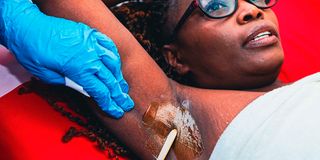
Naomi Wachira undergoing an underarm waxing procedure at Pamper and Glow Spa in Ruaka on June 16, 2025.
Photo credit: Lucy Wanjiru | Nation Media Group
Although the number of waxing parlours has significantly risen, Naomi says she is not afraid of competition. “Competition is good. When you have competitors, that is when you know you are in business,” she says.
With a profit margin of 25-30 per cent, she admits that waxing is a profitable business. For such a business to thrive, one should look out for locations with good customer flow.
“Accessibility of the spa is also key. Avoid very crowded places for the clients’ privacy,” she adds.
With evolving techniques of hair removal like laser treatment, Naomi maintains that it is better to do thorough research before venturing into the business.
Men too are getting attracted to waxing, unlike previous years. According to Naomi, 10 per cent of her clients are men, and the numbers are ever rising.
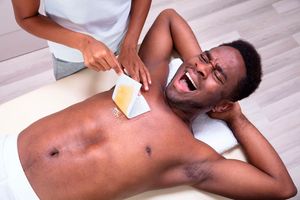
Requests for intimate waxing services for men, known as Manzilian, are surpassing the once common back or chest wax bookings. These are charged at a higher rate.
Regardless of the current trends, Naomi says that clients will keep coming back if they are made to feel good about their bodies during the procedure. Managing clients’ demands requires smart marketing.
“I started with a salon and saw the waxing parlour as an additional feature to the business,” says Prudence Amimo, the manager of Rynchy Beauty Parlour, a waxing studio in Kahawa Sukari.
“We were only doing hair and beauty services, but clients kept asking for waxing services, and not many places offered them then. We saw a gap and it’s been picking well since.”
Hard wax at the Ryncy Beauty Parlour in Nairobi on June 16, 2025.
Photo credit: Lucy Wanjiru | Nation Media Group
Waxing is not exactly new. But the way it’s being done and the people doing it have drastically changed in the past five years. Salons are no longer the only players. Standalone waxing studios and mobile beauticians are on the rise, and so is creativity.
Like Prudence, many waxing business owners got their start from either spa training or short beauty courses. As Kenyans became more comfortable talking about personal grooming, word spread quickly.
University and college students also form a growing base, thanks to affordable mini-wax packages for eyebrows or underarms, and the influence of beauty trends shared across social media. “I get students from nearby hostels who come in groups,” she says, adding that they usually want to look neat.
“Always use gloves, sanitised tools, disposable applicators, and clean towels,” Prudence emphasises. “Clients notice. If they see anything suspicious, they won’t come back and they might post about it on social media, which may damage the reputation of the business.
“In fact, online reviews are becoming a key marketing tool. Happy clients often refer others or leave glowing reviews. A bad experience, on the other hand, can spread like wildfire.”
Purity Wangeci runs Waxluxe beauty parlour in Roysambu. She says, “There’s sugar waxing, hard wax and even honey wax. People are now very interested in knowing the ingredients. They want vegan, cruelty-free, or sugar-based wax that’s kinder to the skin.”
On TikTok and Instagram, beautypreneurs show off their skills, explain the benefits of waxing and demystify procedures like bikini waxing or full-body waxing. Their content is slowly changing people’s perceptions.
Purity, who started by doing house calls in 2023, says the demand for waxing is rising. Her youngest client so far has been a 14-year-old. “Parents are also embracing the trend. Years ago, no one would openly say they got Brazilian wax. Now clients post it with captions like, ‘Self-care day!’ Purity adds with a smile.
So, why is waxing suddenly so popular? The answer lies in a mix of changing attitudes, social media, and lifestyle shifts.
“People are more aware of grooming now,” says Purity. “Even men are seeking cleaner looks, especially for their chest, back or beards.”
Beyond vanity, there’s also the convenience factor. Waxing lasts longer than shaving, and many people are tired of dealing with daily razor bumps. For many, waxing has become part of their wellness routine.
“It’s not just about hair removal,” says Purity. “It is a form of self-care. There is always a good feeling after waxing.”
Who’s booking? While the majority of clients are still women aged 20 to 40, more men are walking into waxing studios, some discreetly, others boldly.
Purity adds that male clients often have different needs since some have coarser hair or more sensitive skin.
In a business that involves intimate body parts, hygiene can make or break your brand.
“You have to be clean, gentle, and respectful,” Purity says. “You’re dealing with peoples’ bodies. Trust is everything.”
“Depending on location and setup, you can start small with as low as Sh50,000 for equipment and wax. The equipment includes a bed and towels. But you must learn the technique. Bad waxing session can scare a client away.”
Once set up, many waxpreneurs charge between Sh300 to Sh2,500 per session, depending on the body part. A full-body wax can go for Sh6,000 in mid-range studios.
“Rent and product costs are the biggest challenges,” Naomi says. “With the fluctuating prices of sugar, sometimes we have to pass that cost to clients.”
To survive, some offer combo deals, loyalty cards, or mobile waxing services—especially to clients who prefer privacy. Others stock and sell their own wax lines or expand into skincare products.
“The future is bright,” Purity says. “People want smooth skin and are willing to pay for it. As long as we stay professional, this business will grow.”
“With Kenya’s youth increasingly embracing grooming, wellness and entrepreneurship, waxing is no longer just a trend. It is a good business opportunity if done correctly,” she adds.