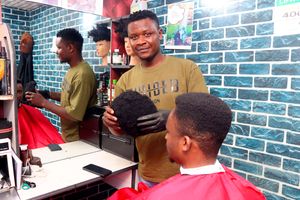
The barbershop is a sanctuary where men sit in rows, waiting their turn, flipping through their phones or trading banter about football and politics. But if you watch closely, the haircut is just half the story.
There is a ritual that begins when the barber dusts off the cape and hands the client over to a lady, the “shampoo girl” or the aftercare specialist.
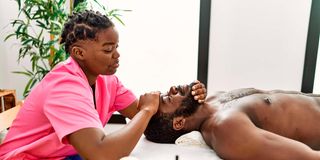
Her role? A one-hour after-care service involving massaging the scalp, neck and shoulders. For some men, it is not just a quick rub-down, they trust a specific pair of hands. And if she is not around, the haircut can wait.
Preston Martin* is a 38-year-old banker who has been bald for over a decade and wears his beard like a crown. For years, he despised the aftershave massage ritual that most men seem to enjoy.
“I never believed in it, honestly. Being bald, I’m very particular about my barber because if you get someone who doesn’t know what they’re doing, you end up with bumps on your scalp, and once that happens, you’re in trouble for weeks. So I was already very strict about who touched my head. To imagine finishing the shave and letting someone else rub my scalp and shoulders just felt off. I thought it was unnecessary, maybe even a little gross,” he says.
From the corner of the barbershop, Preston would watch other men lean back in their seats, loosen their collars and let the aftershave ladies work.
“You would see them close their eyes, some even remove their shirts and stay in their vests, and they seemed relaxed. I used to think, these guys really have the courage, but I wasn’t going to try it.”
But one Saturday afternoon, curiosity got the better of him.
“My barber had been telling me for years to give it a chance. That day he told me, ‘Preston, stop being stubborn. You never know, you might enjoy it.’ And I don’t know why, maybe I was just in a good mood, but I agreed. And to my surprise, it wasn’t bad at all. In fact, it was really good,” he laughs.
Preston explains how the lady who massaged him that day changed his mind. “What struck me was how professional she was. She didn’t just start working on me. She kept asking, ‘Are you okay? Is the pressure fine? Do you want me to stop?’ She was very careful, very respectful, and that made me relax,” he says.
In the barbershop, a haircut is just half the story.
Photo credit: Shutterstock
Since then, Preston has only allowed one person to do his aftershave massage and if she isn’t around, he skips it. “I wouldn’t postpone my shave because she is absent, but I definitely won’t let anyone else touch me. I’ve stuck with her for the last five years. The trust is not something you just hand over to another person.”
“It is not just rubbing someone’s scalp. When the barber is done, the client comes to me. I’ll wash his head, condition it, and treat it if necessary. Then I apply spirit or aftershave to cool the skin, moisturise his face, and finally do a face massage before working on the head, neck, and shoulders. If I do it right, he feels relaxed,” says Fridah Njoki, an aftercare lady at the Glits & Glam barbershop in Nairobi.
“Men are like children,” she laughs. “They just want to be pampered, to feel like they are being taken care of. If you do it well, they will always come back. But it is not just about the massage, it is how you carry yourself. If you’re clean, respectful and professional, they’ll never want anyone else. If you act the wrong way even once, you can lose their trust forever.”
She insists that professionalism is everything in her line of work. Ms Njoki knows some people view aftershave girls with suspicion, but there are boundaries in what they do.
“Your service and your character speak louder than anything. The clients watch how you behave, how you talk, how you carry yourself. If you are respectful, they respect you back. If you start being playful or crossing boundaries, things can go wrong. But I’ve learned that most men are not there to misbehave. They just want comfort, to relax, and to be treated well,” she says.
Some clients even open up during the massage. “Sometimes they talk a lot about their work, their stress, even personal things. Yours is to listen. You are not supposed to talk about it afterwards.
“There is one man who has never gone to another barbershop since 2019. If he comes and I’m not there, he will not let anyone else touch him. He will either wait for me or come another day. That kind of loyalty, you don’t take it for granted.”
Some clients, Ms Njoki says, even request house call services. Does age make a difference in loyalty?
“I can’t say older men are more respectful than younger ones. I’ve met young clients who are very disciplined and loyal, and I’ve met older ones who are the same. Then there are those, either young or old, who are disrespectful. It depends on the person, not the age,” she says.
Building trust and loyalty
This loyalty is not a surprise to the barbers. Gerry Tamaro, who works at a popular grooming shop in Nairobi’s Kilimani, says the aftershave experience is a big attraction for many clients.
“Some clients walk into a barbershop not just because of the haircut but because of the ladies who do the aftercare. It adds something extra, something personal that complements the haircut,” he adds.
He is quick to say that as much as it is a marketing strategy, they have made it a professional service.
“Our aftershave ladies are well-trained, they’re dressed appropriately, and they do the job in a way that makes the client feel comfortable. I know there are other places where the image of the ‘aftershave girls’ is different, but here it’s about grooming and relaxation. It’s part of the culture we are building,” Gerry says.
The barber adds that the bond between client and aftershave lady often runs deeper than the haircut itself.
“I have had clients for years, and when I introduce them to an aftercare person they like, that relationship sticks. Sometimes it’s even stronger than the bond with the barber. I’ve seen men walk in, find their aftershave lady is not around, and either wait or come back another day.”
But how does this compare to the wellness industry, where massages are marketed as therapy and self-care?
“At the spa, our focus is the entire body. We look at massage as a form of therapy, so it’s not just about rubbing shoulders after a shave. We use oils, we work with pressure points, and we create an environment where the client disconnects completely. A session takes at least an hour. It is designed to relax you, to release deep muscle tension, to improve your circulation,” says Grace Nduta, a massage therapist at Azure Spa & Wellness in Nairobi.
Ms Nduta acknowledges that the barber shop ritual fills a different gap. “When men go for that aftershave massage, it’s not about clinical healing. It’s on the trust, routine, and that feeling of being taken care of in a space they are already comfortable with. A spa might feel intimidating, but the barbershop feels like home. The environment is cheery with familiar people,” she says.
The wellness therapist adds that she finds the loyalty fascinating. “Some men will refuse a massage altogether if their trusted lady isn’t there. In spas, the bond is with the environment and in barbershops, the bond is with the person,” she laughs.
The aftershave massage may last only a few minutes, but it has become part of Kenya’s evolving grooming culture. What began as an extra service is now, for many men, a non-negotiable part of the barbershop visit.
According to counselling psychologist Cleopa Njiru, there is far more going on than meets the eye. He explains that what looks like a simple head-and-shoulder massage is tied deeply to psychology, loyalty and the need for safe human connection.
“When a man insists on being served by a particular lady in a barbershop, we are not just talking about shaving or massage. We are talking about rapport, about a relationship that has been established over time. In psychology, we know that once a man feels respected, understood, and safe in a particular space, he will keep going back, not because he cannot find another barber, but because he has found a relationship that makes him feel comfortable,” he says.
This attachment, the psychologist says, is similar to what businesses are trained to create through customer relations, except in this case, it is more personal.
“In business psychology, we say, if you want repeat clients, you create respect, empathy and warmth,” he explains. “That is exactly what happens in these barbershops. When a man sits down, removes his shirt, and allows someone to massage his head and neck, it is not about the oil or the towel, it is about trust. And when that trust is there, the man feels safe. He knows if he opens up, his secrets will remain protected.’ That is why you find some men staying with the same lady for five…even 10 years. It becomes a ritual of loyalty.”
Still, he cautions that this bond can sometimes be misunderstood. While outsiders may assume that a man’s loyalty to a female masseuse must have sexual undertones, he says it is often the opposite.
“There is a misconception that when a man prefers a lady to do the aftershave massage, it must be sexual attraction, but what I have seen in my practice is that, in most cases, this loyalty has nothing to do with sex, it is about professionalism. In fact, men respect those boundaries very much. They know that if they cross the line, they would lose the very safety that keeps them coming back,” Mr Njiru adds.
This sense of safety, Mr Njiru explains, is important especially in a society where men struggle to open up emotionally.
“In many marriages and relationships today, men are going through challenges, but they don’t talk about them openly. When they go into a barbershop, for that one hour, as someone washes their head and massages their shoulders, they find a space where they feel accepted. Sometimes it even feels therapeutic. They open up not because it is another man, not because it is a counsellor, but because this is a safe environment where they are not judged. That is why, for some men, it is more than grooming, it is therapy disguised as a haircut.”
The psychologist adds that attraction does play a role, but not always in the way people think.
“We cannot deny that human beings are attracted to certain things. A man may feel drawn to a particular lady because of how she carries herself, how she treats him, and how she maintains professionalism. But that attraction is not always about sex, sometimes it is an innocent attraction, the kind that creates long-lasting relationships built on trust. It is a connection, but not an intimate connection,” he says
Yet, he warns, there are cases where boundaries blur.
“We see situations where the relationship shifts, where invitations happen beyond the barbershop, and that can complicate things. This is why caution is needed because touch is powerful, and depending on what a man is going through, either grief, trauma or loneliness, the massage can open doors to confusing emotions. Both the client and the service provider must understand that professionalism is what keeps this relationship safe,” Mr Njiru says.