My beloved and revered teacher, Prof Mohamed Abdulaziz, guided me, in one of our conversations, to reflect on a famous mshororo (line of verse) from the work of Muyaka bin Hajji. “Kuvua numbi si kazi (making a big catch is no great deal)” runs the line, “kazi ni ugawaji (the deal is sharing it out).” For us littoral communities, whether by the sea or by the lakes, the significance of the observation is obvious.
We depend on the water bodies and their teeming fauna for our primary occupation, which is fishing, our nutrition and our economic transactions. It is, therefore, crucial that we approach our water harvesting activities with manifest prudence and fairness. Hence the nationwide outrage and uproar at the proposal, by an eminent foreign investor in the fish industry, that the Uganda Parliament should enact a law banning local consumption of nile perch (mbuta), in order to boost foreign export volumes of the prized commodity.
In effect, the investor’s proposal means that Ugandan natives should keep their hands, and mandibles, off the delicious nile perch and content themselves with ngege (tilapia) or omena, which are not in particularly high demand on the export market.
Indeed, the reality is that most Ugandans looking for a taste of nile perch resort to what they call “fillet”, skeletons of perch from which the meat has been sliced off and packed for export. Is there a need to legislate about this?
I used the term “native” advisedly above, because that was the label the colonists stuck on us when they were stripping us of our liberties and rights, telling us what we could and could not do in our own countries.
Foreign investors’ attempts to influence legislation on what we can and cannot eat, from our own lakes and rivers, smack rather loudly of economic neo-colonialism.
Do you remember the story of the hospitable desert man thrown out by a camel he had allowed to shelter his snout in his tent? Or is this investor Nyamgondho wuod Ombare, turning on us lake foundlings who have enriched him beyond his wildest dreams?
To be fair to the investor gentleman, he has since apologised for his unfortunate “slip of the tongue” and the furore it kindled.
Still, a number of thoughts and questions arise in the mind in the face of such developments. Given, for example, that we need investors for our economic development, how far backwards should we bend over without mortgaging our entire heritage and rights to them?
Secondly, what are the factors that lead to such severe depletion of resources that some key players are tempted to resort to measures patently alien to the fair sharing of the “catch”?
To the first question, I do not have any answer. To the second, however, as a typical Jonam (lake man) and fanatical lover of fish, I can attempt a few suggestions.
The first is that the fish in the lakes, and the seas, are a limited and exhaustible resource and sustainability must be the key factor in their management and exploitation. Unleashing all sorts of marauding trawlers, with their all-sweeping nets, into our water bodies is a disastrous act of irresponsibility and delinquency and a sure road to the death of our fishing industry. The diminishing returns from our lakes is a clear pointer to this grim reality.
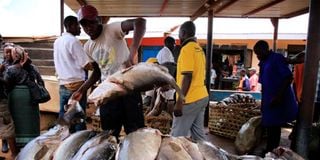
Dwindling quantities of mbuta
Secondly, even with the best management practices, our rivers and lakes cannot meet the growing demand for what we have been traditionally harvesting from them.
There is a definite need to develop and expand aquaculture, the systematic farming of fish and other marine life that we used to assume was endlessly available from the existing water bodies.
The problem here is that we have degraded our wetlands to such an extent that they can hardly support any kind of life.
Indeed, what we are saying about fish and aquaculture is true of ordinary agriculture and other aspects of our lives. The more advanced, developed and modern we become, it appears, the more we pollute and degrade our environment.
Today we may be quibbling about the dwindling quantities of mbuta and ngege, tomorrow it may be water, and the day after, the air we breathe. Why can’t human beings learn and determine to handle their environment and use their resources rationally and sustainably?
This brings me to Glasgow, the great Scottish city where a make-or-break international conference is due to open tomorrow.
The Cop26 indaba is expected to bring together some 25,000 delegates from 200 countries to discuss global climate change and the best course of action to take against it.
Basically, all of humanity is now convinced that the endless emission of various gases into the atmosphere and beyond leads to a disastrous impact on our climate. It causes drastic weather extremes and their consequences, like prolonged droughts, torrential rains and floods, unquenchable forest fires, the melting of polar icecaps, the rise of sea waters and the submerging of islands and low-lying coastlands. The list is endless and horrendous.
If we add to that the damages and degradations that we directly inflict on our planet through daily misdoings, like deforestation, gashing the earth for mines and brick and block-making, spraying with herbicides and other poisonous chemicals, littering with plastics, most of which end up in our water systems, our poison cup is much more than overflowing.
Few of us, however, want to look at or even hear about this “inconvenient truth”, as Al Gore, the former US Vice-President, called it in his documentary film on the environmental crisis. I have a feeling that the extreme noise with which we pollute our surroundings is also an attempt to drown out the painful groaning of our dying planet.
Will the Glasgow Cop26 come up with some concrete and implementable strategies to deal with some of these threats? We will be waiting with bated breath. After all, the deliciousness of the mbuta is in the eating.