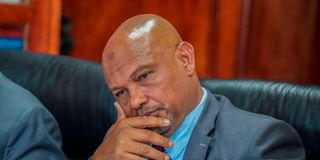
President William Ruto’s nominee for the chairperson position at the National Land Commission (NLC), Abdillahi Alawy on Monday struggled to respond to questions during his parliamentary vetting on Tuesday, even admitting that he was “shaky”.
The tense session prompted MPs to give him a short break to compose himself.
Dr Alawy’s difficulties before the committee revived memories of 2014 when he was rejected by the House Labour Committee after being vetted for appointment as a member of the National Gender and Equality Commission.
However, that committee’s decision was later overturned by the full House.
His current nomination has also faced opposition through memoranda submitted to the committee by the Institute of Surveyors of Kenya, the Architectural Association of Kenya and Kituo Cha Sheria.
The committee chaired by North Mugirango MP Joash Nyamoko was urged to examine the nominee’s potential conflict of interest in a long-running Sh3.9 billion historical land dispute in Wasini Island, Kwale County.
The dispute, which has been in court for 46 years, recently ended with a ruling granting ownership of the land to the Alawy family.
The 309-hectare (about 610-acre) island had been claimed by local residents. During the vetting, Dr Alawy admitted that his family had sponsored the legal case that resulted in eviction orders against the occupants.
Dr Alawy, who declared a net worth of Sh62 million, currently serves as chairperson of the Agricultural Development Corporation (ADC), a State agency mandated to support food security and agricultural commercialisation.
However, MPs noted that he appeared ill-prepared for the vetting session. At several points, he referred to notes and documents prompting suspicion among committee members.
“I understand you prepared notes and that is what you are reading. Now don’t read that material. Put it aside,” Mr Nyamoko said after suspecting that some of the questions may have been leaked beforehand.
After setting aside the documents, Dr Alawy struggled even more with the questioning often responding to issues that had not been asked.
“I am a bit shaky,” he admitted at one point.
Mr Nyamoko, however, remained firm.
“Don’t be shaky. Just pay attention to the questions asked by members. At the end of the day, we will indicate in the report that you were shaky in responding,” he said.
Despite the warning, Dr Alawy continued struggling with the questions.
At one point, he sought permission to answer questions one by one, saying he found it difficult to recall them.
“We cannot bend the rules for this nominee,” Mr Nyamoko ruled, adding that a nominee for the chairpersonship of a constitutional commission should be able to answer questions promptly.
“You were here in 2014 and you were rejected by a parliamentary committee,” he reminded him.
Eventually, the committee granted Dr Alawy a five-minute break after Bahati MP Irene Njoki suggested giving him time to compose himself.
“He says he is tense. Let’s give him a breather,” she proposed.
Although he initially resisted the break, Dr Alawy later admitted that the vetting environment was challenging.
“This is a new environment for me. I am already feeling the weight of NLC on my back. Usually, I am a very composed and listening person,” he said.
However, the questioning intensified around the Wasini Island land dispute, which has sparked protests among residents.
The Alawy family claims ownership of nearly half the island based on a title deed dating back to 1908. In September 2025, the government issued the family with a freehold title deed after the NLC and the courts recognised them as victims of historical land injustice.
The ruling triggered eviction notices affecting about 12,000 residents, many of whom have lived on the land for decades.
Local leaders argue the land is ancestral and accuse authorities of ignoring the rights of residents.
MPs pressed Dr Alawy on whether he would face a conflict of interest if the matter came before the commission.
“Your family is involved in a land dispute in Wasini Island against the locals. Will you be fair to the residents if you are appointed?” Mr Katana asked.
The committee also questioned his conduct during a parliamentary fact-finding visit to ADC offices in Tana River County regarding the 1.6-million-acre Galana Kulalu Irrigation Scheme.
“You can imagine MPs travelling all the way there on a trip funded by taxpayers only to return with nothing,” Dr Nyamai said.
He was also criticised for failing to implement a parliamentary resolution directing that 250,000 acres of ADC land be allocated to landless residents in Tana River, a proposal originally initiated during the presidency of Mwai Kibaki.
The committee further raised concerns after Dr Alawy disclosed that 52,000 acres of ADC land had been allocated to a cement factory in Mombasa, even as local communities remained landless.
A report by the National Assembly Labour Committee in 2014 indicated that he had lost Kenyan citizenship in 2005 after acquiring American citizenship under the old constitution, which did not allow dual citizenship.
Although he later presented documents indicating declaration of dual citizenship under the Kenya Citizenship and Immigration Act 2011, the committee concluded that he had failed to demonstrate that due process had been followed in regaining Kenyan citizenship.
Under Article 14(5) of the Constitution of Kenya 2010, a person who lost Kenyan citizenship after acquiring another nationality is entitled to regain it upon application.