Ruto's bags of goodies for minority groups at State House event

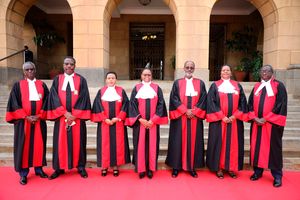
President William Ruto during the World Minority Rights Day celebrations at State House, Nairobi, on December 18, 2025, where he reaffirmed the government’s commitment to safeguarding the rights of minority and marginalised groups through inclusive policies, social protection programmes and equitable development.

President William Ruto on Thursday unveiled a sweeping package of affirmative action measures for ethnic minorities and marginalised communities, including a Sh500 million national scholarship programme.
Dr Ruto also unveiled a State-funded health insurance for 200,000 vulnerable people and a Sh200 million annual allocation to improve schools and mid-level colleges in underserved regions.
The announcements were made at State House during celebrations to mark the International Day for Minority Rights and the launch of the National Policy on Ethnic Minorities, Indigenous and Marginalised Communities (2025–2035), following its approval by Cabinet.


“At long last, we are moving from recognition to action, and from promise to delivery,” President Ruto said, describing the policy as a “transformative blueprint” to give effect to Article 56 of the Constitution, which obliges the State to protect and advance the rights of minorities and marginalised groups.
Under the new measures, the government will immediately roll out a Sh500 million National Minority Scholarship Programme to support children from “indigent minority and marginalised communities” to access secondary and tertiary education.
“This programme will ensure that poverty is no longer a barrier to talent,” President Ruto said.
In healthcare, the State will pay Social Health Authority (SHA) contributions for 200,000 vulnerable individuals drawn from minority and marginalised communities, a move Dr Ruto said would “guarantee access to quality and affordable healthcare” for populations that have historically been left out of the system.
The Ministry of Education has also been directed to set aside Sh200 million annually as an Education Infrastructure Fund to construct, upgrade and equip schools and middle-level colleges in marginalised areas.
“These interventions are not symbolic. They are practical, funded and targeted actions to dismantle the barriers that have locked entire communities out of opportunity for decades," President Ruto said.
The newly launched policy establishes a comprehensive framework for minority inclusion, including the creation of a Minorities and Marginalised Communities Directorate within the Executive Office of the President and plans for a National Council for Ethnic Minorities and Marginalised Communities through legislation.
The Head of State said the policy was developed through extensive nationwide consultations and would compel all ministries and counties to integrate minority inclusion into planning and budgeting. “Representation and equity will no longer depend on goodwill, but on constitutional obligation,” he said.
“Never again will minority and marginalised communities be an afterthought. You are central to our national identity, essential to our resilience, and indispensable to our peace and prosperity,” he said.
The policy also addresses long-standing grievances over land and political exclusion, committing the State to accelerate the issuance of community land titles, protect ancestral territories and implement court rulings on historical injustices affecting communities such as the Ogiek.
On political representation, President Ruto said new legislation would be pursued to ensure minority inclusion in Parliament and county assemblies is guaranteed by law, not left to discretion.
Kenya is home to dozens of minority and indigenous communities, many of them living in arid and semi-arid lands, forested regions or historically neglected border areas.
They include hunter-gatherer and forest-dwelling groups such as the Ogiek, Sengwer, Boni (Aweer), Yaaku and Watta; pastoralist and largely Cushitic-speaking communities like the Somali, Rendille, El Molo, Gabbra, Dasenach, Burji and Orma; as well as coastal and other smaller groups including Nubians, Makonde, Shona, Abasuba and Ilchamus.
Other religious minorities, particularly Muslims, Hindus and adherents of traditional belief systems, have also long complained of exclusion from State services and national decision-making.
Follow our WhatsApp channel for breaking news updates and more stories like this.