The government has issued its strongest warning yet against the proliferation of political goons across the country, declaring that it will take firm action against leaders who mobilise young men to unleash violence, disrupt public gatherings and endanger the lives of Kenyans.
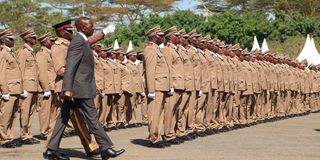
Speaking during the graduation of 5,892 chiefs and assistant chiefs at the National Police College Embakasi ‘A’ Campus, President William Ruto directed Inspector-General (IG) of Police Douglas Kanja to move decisively against individuals who hire youth for violent disruption, saying Kenya would not allow lawlessness to take root.
The officers underwent training on paramilitary skills, paralegal knowledge and security management competencies designed to enhance their operational readiness and strengthen Kenya’s national administration - a fact that President Ruto’s administration hopes will help in further securing the country and stamp out any forms of political violence and chaos.
“We cannot allow those using youth as goons to cause chaos and death to continue doing so. I have instructed the Inspector-General of Police that these individuals should face severe legal action to end hooliganism and stop activities that threaten the security of our country,” President Ruto said.
His warning came against the backdrop of a series of violent incidents that have unsettled communities and raised concerns about the growing sophistication of hired gangs acting at the behest of political and business interests.
The most recent of these incidents unfolded on Sunday in Kariobangi North, Nairobi, where a thanksgiving service for MCA-elect David Wanyoike descended into chaos. Worshippers had gathered peacefully at PCEA Berea Parish for an event attended by former Deputy President Rigathi Gachagua.
As congregants stepped outside after the service, waiting for Mr Gachagua to address them, a swarm of youths riding motorbikes stormed the compound. Armed with crude weapons, the attackers charged at the crowd, hurling bottles and swinging metal rods.
In the panic that followed, four people were injured as worshippers ran for safety while others struggled to fend off the intruders. The coordination, timing and mode of attack left little doubt that the disruption had been planned well in advance.
In a statement hours later, the National Police Service, through its Spokesperson, Muchiri Nyaga, condemned the chaos and explained that the “nature of the disturbance appeared both planned and premeditated”.
“Nairobi Regional Police Commander, alongside the Directorate of Criminal Investigations, have been ordered to use all available resources and to get to the bottom of this callous and regrettable incident,” part of the statement read.
In March, gangs of young men reportedly mobilised by politicians caused chaos during President Ruto’s development tour of Nairobi. In Westlands, pedestrians and motorists were attacked, and property vandalised, while in Mathare, a police officer was said to have lost his firearm in the disturbances that happened after the president had concluded his political rallies.
Along Jogoo Road, several citizens were robbed of their mobile phones and handbags by goons who mostly operated from speeding motorcycles shortly after President Ruto’s tour in Eastlands ended in mid-March.
Senior government officials said that rival factions were attempting to use violence to embarrass the President during official engagements.
Months later, in June, masked youths on motorbikes disrupted peaceful protests in Nairobi’s central business district. The demonstrators were calling for justice after the death of blogger-teacher Albert Ojwang in police custody. Before the main crowd could gather, the attackers swooped in, beating protesters, stealing from bystanders and disappearing into the confusion as police fired tear gas nearby.
A similar scene unfolded in Gilgil in early November, when an opposition rally attended by Mr Gachagua and other leaders was violently disrupted. As the event began, groups of youths stormed the venue, hurling stones and assaulting residents.
Fear swept through the gathering, forcing the leaders to cut short their speeches and flee. Opposition figures accused local allies of the government of sponsoring the attackers, reigniting concerns about the political use of violence.
Interior Cabinet Secretary Kipchumba Murkomen, speaking at the same Embakasi event as the President, echoed the alarm, describing the rise of goons as a disturbing phenomenon spreading across the country.
He warned leaders who parade or deploy youths armed with machetes and crude weapons that they would be held personally accountable.
The Interior Ministry boss said chiefs and assistant chiefs have increasingly found it difficult to perform routine duties—including attending community meetings and funerals—because of intimidation by armed groups mobilised by politicians.
“There is a phenomenon that has grown in the country, the issue of goons. They are perpetuated by leaders who mobilise youths to cheer them while carrying machetes and weapons. Chiefs are struggling to cover events including funerals,” he said.
He also described the Kariobangi attack as unacceptable and vowed that those responsible would face the full force of the law.
Behind these incidents lies a murky economy of paid violence in Kenya’s political culture. Hiring goons has become a transactional, structured, and dangerously affordable process.
A recent report published by Odipodev and Tribeless Youth revealed that young men, often from informal settlements and facing chronic unemployment, are paid a few hundred shillings to shout down opponents, throw stones or escort convoys.
More hazardous assignments involving land disputes or targeted attacks fetch a few thousand shillings. Payments are made in cash, exchanged quickly at petrol stations or behind pubs, leaving no trail.
Recruiters—known as bigfish—act as intermediaries, mobilising groups of youths while pocketing a portion of the funds. Meanwhile, the actual financiers - politicians, businessmen, land speculators and cartel figures- remain insulated by layers of handlers and operatives.
A separate report by the National Crime Research Centre also warned that political actors routinely turn to gangs during election cycles to intimidate opponents or enforce territorial control.
Although the reports vary in detail, they converge on one reality: violence is being outsourced, monetised and normalised, and it thrives on desperation, impunity and weak enforcement.
It is also fuelled by widespread drug abuse and alcoholism, which both the Head of State and the Interior CS described as devastating communities and leaving young men vulnerable to manipulation.
Dr Ruto warned that drug abuse is destroying the country’s youth, feeding into cycles of crime and exploitation. He called for a whole-of-government effort to shut down the supply of illicit brews and rehabilitate affected young people.
In his address, the Commander-in-Chief reminded the graduating chiefs and assistant chiefs that they are the country’s frontline defenders and must play a crucial role in dismantling the networks that allow criminal groups to flourish.
He urged them to expose bandits, cattle rustlers, drug traffickers and political thugs operating in their areas, insisting that criminals should not be allowed to operate freely when government officers are present. Security, he said, is the foundation upon which Kenya’s economic transformation rests.
The President referenced findings from the nationwide Jukwaa la Usalama public dialogues led by CS Murkomen, where Kenyans voiced frustration with crime, gang activity, youth unemployment and political interference in policing.
These recommendations, he said, must be acted upon urgently, even as he called on chiefs to lead efforts against gender-based violence, reminding them that strong communities protect their most vulnerable.
“On the issue of GBV, we must be a society that is sensitive to and protective of all of us. Women are our mothers, sisters, wives and daughters, and we must protect them,” he said.
From church attacks to violent disruptions at political rallies and protests, Kenya’s rising tide of organised goon violence has reached a point where even state officials acknowledge that the phenomenon has become a national threat.
In their remarks, which happen to be the strongest condemnation of the goon culture, President Ruto and Mr Murkomen signalled the State's readiness to confront not only the goon foot soldiers, but also the sponsors and architects behind them.
“The future of our nation rests heavily on your leadership at the grassroots. Let us, together, build a safer, stronger and more prosperous Kenya,” President Ruto said.
The chiefs’ and the assistant chiefs’ graduation ceremony itself marked the end of the largest training programme ever undertaken for National Government Administration Officers.
IG Kanja revealed that the close to 6,000 graduates had undergone rigorous preparation over three months and termed the exercise as important because “chiefs and their assistants are very crucial in managing the country from the grassroots”.
These officers, he noted, now form a revitalised frontline capable of responding to emerging threats, supporting community policing and reinforcing the government’s presence at the grassroots.
“Chiefs and assistant chiefs are the face of the government, and this training was a much-needed impetus in their service delivery. They have gone through community engagement and communication skills, understanding and mitigating threats at the community level and are leaving this institution much fitter and healthier,” IG Kanja said.
On his part, Deputy Inspector General, Administration Police Service, Gilbert Masengeli, explained that the training was conducted in three phases—August, September and October—with 997 participants in the first cohort, 3,058 in the second and 1,837 in the final phase. It included 4,451 male and 1,441 female officers.