France denies excluding South Africa from G7 summit under pressure from Washington
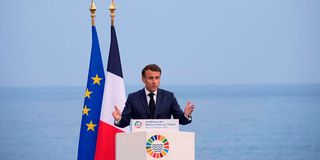
French President Emmanuel Macron speaks during the third United Nations Ocean Conference in Nice, France June 9, 2025.

French officials on Thursday denied excluding South Africa from the list of invitees to the G7 leaders' summit in June due to pressure from Washington, saying Kenya had been invited instead ahead of President Emmanuel Macron's visit there later this year.
France announced earlier that it will host the leaders of India, South Korea, Brazil and Kenya at the summit to be held in Evian-les-Bains.
South Africa, a regular guest at past G7 summits, said the French embassy in Pretoria had communicated the decision to the government about two weeks ago, saying the U.S. had threatened to boycott the summit if South Africa was invited.


"We've accepted the French decision and appreciate the pressure they've been subjected to," said Vincent Magwenya, a spokesperson for South African President Cyril Ramaphosa.
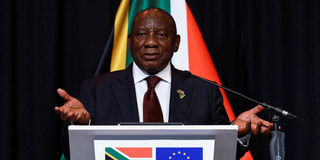
South African President Cyril Ramaphosa attends a press conference with European Commission President Ursula von der Leyen and European Council President Antonio Costa at the end of a South Africa–EU leaders meeting, ahead of the G20 Summit scheduled for November 22-23, in Johannesburg, South Africa.
Asked at a briefing whether South Africa had been excluded on the U.S.' request, a French official said this was not the case and that France had decided to invite Kenya this time. Macron is due to visit Kenya in May for a two-day Africa-France summit.
A White House official backed France's account, saying the decision to invite Kenya came after talks among G7 members, without commenting directly on the exclusion of South Africa. G7 leaders often invite multiple countries as guests.
“The French, in their capacity as 2026 G7 host, expressed a desire in January to invite an African nation to the June G7 leaders’ summit in Evian. After discussion among G7 members, it was collectively determined that Kenya should be invited to the summit. The United States welcomes Kenya’s participation," the White House official said.
U.S. President Donald Trump has criticized South Africa's foreign policy and domestic race laws during his second term, boycotted last year's G20 summit in Johannesburg and excluded South Africa from G20 meetings this year.
Iran crisis may overshadow long-term goals
France had been hoping to focus the G7 on preventing a "massive financial crisis" by urging China - which is not a member - to boost domestic demand and reduce its destabilizing exports, and by calling on the U.S. to curb its deficits and on Europe to produce more and save less.
Those long-term goals may be overshadowed, however, by more immediate pressures, with the summit unfolding against the backdrop of an energy shock caused by the U.S. and Israeli war on Iran, tensions in the transatlantic alliance, and questions about the relevance of the G7 itself.
"We don't know where the Iran crisis will be by June," an adviser to Macron said. "However it evolves, we will have to address its energy and economic consequences."
China will not attend the summit on June 15-17 and continues to question the legitimacy of the G7 as a "club of rich countries", French officials said.
France, which had tried to invite Beijing according to diplomatic sources, will "engage" China through separate channels, an official said, adding that it was also in China's interest to avoid a confrontation.
"The risk for China is to see global markets, and European markets, closing off to it," the official said.
The countries invited instead are all democracies and market economies that play by the rules of international cooperation, he added.
Adding to the uncertainty is whether Trump, whose use of tariff threats has rattled allies and rivals alike, not to mention the world's markets, will attend.
"I won't make any predictions, but if Trump doesn't come, it also makes sense - it's a new international reality and we need to organize ourselves accordingly," the official said.