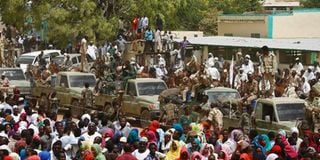
The long-running UN-African Union peacekeeping mission in Darfur came to an end on December 31, under a peace deal signed by Sudan's government and rebels.
On Sunday, a little over two weeks later, state media reported that two days of tribal clashes in the West Darfur capital El Geneina have killed at least 48 people.
Here is a recap of the situation in Darfur where the UN says the brutal civil war that erupted in 2003 killed at least 300,000 people, mostly during its initial years, and displaced 2.5 million.
Rebels of the Sudan Liberation Movement/Army (SLM/SLA) and the Justice and Equality Movement (JEM) take up arms, accusing the Khartoum government of marginalising the vast Darfur region of western Sudan.
In February, rebels seize Gulu, a key town in northern Darfur.
The state-backed Janjaweed militia -- a group of mostly Arab raiders travelling by horseback, camels and armoured pickups -- enter the fray.
A hybrid AU-UN force, called UNAMID, takes over from an African force that has been posted in the region since 2004.
In 2008, more than 220 people are killed when JEM rebels attack Khartoum's twin city of Omdurman, travelling hundreds of kilometres from Darfur to the edge of the capital.
The Hague-based International Criminal Court (ICC) issues an arrest warrant for Sudan's then-president Omar al-Bashir for war crimes and crimes against humanity in Darfur.
In 2010, heavy fighting resumes after an accord with one faction of the SLM breaks down.
More than 2,300 people were killed in 2010, the UN reports.
In November, Darfur's rebels form an alliance committed to regime change.
Sudan accuses newly-independent South Sudan of working with the JEM, and of backing rebels in its South Kordofan and Blue Nile regions. Juba denies the accusations.
In March, the UN criticises restrictions imposed on humanitarian workers in Darfur and an increase in the number of displaced people.
In November, Bashir calls for a planned withdrawal of the force, after peacekeepers probe accusations of gang rape by Sudanese soldiers.
In a controversial April referendum, the division of Darfur into five states is maintained.
In June, the government declares a unilateral ceasefire but two months later negotiations break down between Khartoum and rebels.
In September, Amnesty International accuses Khartoum of carrying out several chemical weapon attacks in Darfur -- charges denied by the government.
On April 11, Bashir is ousted by the military and detained, after four months of mass anti-regime protests.
In August, new authorities tasked with preparing the way for civilian rule vow to restore peace to conflict-ridden regions, including Darfur.
On January 24, 2020, a coalition of rebel groups signs a preliminary agreement with the government.
In June, the Janjaweed militia's Ali Kushayb, wanted since 2007, turns himself in to the ICC.
On August 31, government and most rebels groups meeting in Juba ink an accord aimed at ending 17 years of civil war.
On October 19 during a visit to Khartoum, ICC prosecutor Fatou Bensouda explores options for putting on trial those accused in the conflict.
On December 23, the UN Security Council agrees to end UNAMID's now 8,000-strong mission in Darfur when its mandate ceases on December 31.
A little over two weeks later, on January 17, state media reports that tribal clashes in the West Darfur capital El Geneina have killed at least 48 people.