At least 21 million Ugandans today have the chance to decide the future of the country by electing a president and Members of Parliament (MPs) to steer the country for the next five years.
Eight presidential candidates and more than 2,700 parliamentary candidates have been combing different districts, constituencies, and villages across the country for the last three months to canvas for votes, whose outcome will be decided today.
Mr Harold Achema, a veteran diplomat and political scientist, yesterday said there is no reason Ugandans of voting age should not go and vote. He said elections in Uganda happen once every five years, so no Ugandan who is above 18 years old should give an excuse for not showing up to cast their vote.
“Tomorrow [today] is a golden opportunity for all registered voters to go and exercise their constitutional duty. People have been preparing for this moment. I want to encourage all people, especially the young ones. It is everyone’s obligation to go and vote for a candidate of their choice,” Mr Achema said.
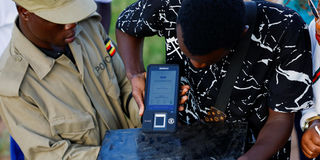
A worker arranges boxes containing electoral materials before their distribution from the Uganda Electoral Commission warehouse, ahead of the country's January 16 general election, in Ntinda suburb of Kampala, Uganda January 8, 2026. PHOTO/REUTERS
Data from the Electoral Commission (EC) indicates that the voter turnout has been declining across the election since 1996, with many saying voting cannot change anything. Voter turnout declined from 72.9 per cent in 1996 to 67.6 percent in 2016, with the northern and central regions having the highest number of people who did not turn up to vote. In the 2021 General Election, it came down further to 59.35 percent of registered voters.
But Mr Acema said the fact that voting is by a secret ballot and the voters are not under any obligation to reveal the people they have voted for, gives them the chance to decide who should lead them. He also warned that if the registered voters do not turn up to cast their vote today, they would not have any right to complain if the wrong leaders are elected into power.
Chapter One of the Constitution states: “The people shall express their will and consent on who shall govern them and how they should be governed, through regular, free, and fair elections of their representatives or through referenda.”
Mr Acema’s views were echoed by Ms Charity Kalebo Ahimbisibwe, the Executive Director for Electoral Laws Institute-Uganda. She urged Ugandans to turn up in big numbers to cast their votes.
Ms Ahimbisibwe said it is the citizens’ civic duty to go and vote, stressing that today will determine what the voters want from their incoming government and Parliament.
“The leaders we are electing today will determine the type of government we shall have for the next five years. If you do not exercise this duty, you will not have people who represent your views in Parliament, and you cannot ask for accountability,” Ms Ahimbisibwe said.
She added that it is not enough to only register, but that those who registered and updated their details have a duty to participate in the elections. Chapter Five of the Constitution spells out how Ugandans should be represented at all levels of leadership.
Clause 1 of the Constitution states that every citizen of Uganda of 18 years of age or above has the right to vote. It goes on to state that it is the duty of every citizen of Uganda of 18 years of age or above to register as a voter for public elections and referenda.
“The State shall take all necessary steps to ensure all citizens qualified to vote register and exercise their right to vote. Parliament shall make laws to provide for the facilitation of citizens with disabilities to register and vote,” it adds.
Mr Emmanuel Dombo, the communications director of the ruling National Resistance Movement (NRM) party, yesterday urged all Ugandans to embrace this constitutional provision and turn up in big numbers to exercise their constitutional rights.
He asked the people to make the right choices as they cast their vote today. Mr Dombo said whereas the citizens will be voting for their candidates, they will also be voting for the political party and the manifesto that will be implemented in the next five years. “The power was returned to the people to determine their leaders. They will also select the manifestos that will be followed in the next five years. The people will not be voting for individuals alone, but also for manifestos,” Mr Dombo said.
Mr Patrick Oboi Amuriat, the opposition Forum for Democratic Change (FDC) party president, said the party is set to do what it takes to protect its vote and asked Ugandans to turn up in big numbers to cast their vote.
Whether the voters will heed the calls by the different politicians and civic leaders across the country and reverse the voter apathy remains to be seen.
Nonetheless, there are also fears that the violence, particularly meted out to the Opposition supporters in the course of the campaigns, could keep some people away from the polling stations. But for all this time, different politicians and civic leaders have for months urged Ugandans to go and cast their votes to choose the leaders they want, although cases of irregularities have been cited in previous elections.