The high-stakes trial of suspended First Vice President Riek Machar and his co-accused was, again, adjourned—this time to Wednesday—as legal technicalities and procedural delays continued to dominate proceedings inside Juba’s Freedom Hall.
The Special Court, presided over by Justice James Alala, also includes two other judges. It paused the hearing on Monday after the prosecution team failed to fully submit key documents that were expected on the first day of proceedings.
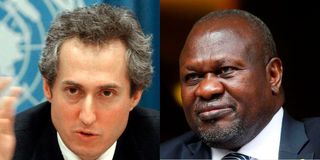
Outside the courtroom, the United Nations added its voice to growing scrutiny surrounding the case. Speaking from New York, UN spokesperson Stéphane Dujarric confirmed that the UN Mission in South Sudan (UNMISS) was closely monitoring the trial and emphasised the importance of upholding international legal standards.
“Our mission reminds all concerned that the judicial process must adhere to international standards of fairness and transparency, with full respect for the rule of law and human rights,” Dujarric told reporters in New York.
The judges also noted that the prosecution had yet to formally address the legal challenge raised by the defence regarding the inclusion of private advocates on the state’s prosecution panel, specifically referencing the role of prominent lawyer Ajo Noel Julius.
Back inside the courtroom, the defence team—led by former Court of Appeal Justice Dr Geri Raimondo and advocate Kur Lual—once again pressed their argument that the Special Court lacked jurisdiction to hear the case. They cited the 2018 peace agreement, which they say mandates that such serious charges must be tried in a Hybrid Court.
The judges responded by stating that a formal ruling on jurisdiction would be issued on Wednesday. Meanwhile, public interest in the trial continues to swell, following earlier controversy over access restrictions. Addressing that issue directly, Judge James Alala clarified that the court remains open to the public and all media outlets.
“We would like to inform the audience that the court is open to the public. I mentioned on Monday that a public hearing means citizens are allowed to access the court. Media—all media houses—are allowed to access the court and report.
“They know how to report and what they are reporting. There is no way to close or block any media house that is coming, or any other interested citizen. So, this must be clear,” said Alala.
The trial, which opened on Monday, includes Machar and seven top SPLM-IO officials. They are facing charges including murder, treason, conspiracy, financing terrorism, and crimes against humanity—allegedly linked to a militia attack on a military base in Nasir County earlier this year.
On Monday, the session was also adjourned after a lengthy debate over whether the court had the authority to prosecute under the terms of the 2018 peace accord signed by President Salva Kiir, Machar and several other armed groups. The peace deal names Kiir and Machar as parties to the peace agreement, rather than their respective political parties.
And there is also a chapter on hybrid courts, which is supposed to try suspects during the transition. The debate, which judges should solve, is whether the incident in March is part of the transitional crimes, and subject to issues of accountability and Justice as indicated in the agreement.
The first day of proceedings was marred by reports of restricted access to victims’ families, journalists, and civil society groups—sparking outrage and raising questions about the transparency of the process.
The issue was further inflamed by the recent death of Captain Luka Gathok Nyuon, a close bodyguard of Machar, who died while in military detention in Juba. His arrest in March occurred shortly after Machar was placed under house arrest.
As the trial resumes on Wednesday, the focus will be on how the court addresses the jurisdictional challenge—and whether the process can regain public trust as a true test of South Sudan’s commitment to justice and the rule of law.